

Search is no longer just about blue links.
According to Search Engine Journal, enterprise marketers are already seeing AI-powered search results reshape how visibility, authority, and traffic are distributed — with generative AI influencing discovery, decision-making, and conversions at scale.
Meanwhile, multiple industry analyses show that AI-generated answers now reduce traditional organic clicks by 18–25% for informational queries, especially at the top of the funnel
In simple terms:
Search Generative Experience (SGE) is about the experience of how users find brands, who gets cited, and why some websites win without ranking #1.
If you’re a business investing in SEO, this shift isn’t optional to understand. It’s foundational.
This guide breaks down AI search optimization in a simpler way. You’ll learn what SGE is, how it changes SEO, and how to prepare your business for 2026—without chasing hype or shortcuts.
AI Search (SGE) Optimization Explained
AI Search Optimization is the process of structuring content, authority signals, and technical foundations so your brand can appear inside AI-powered search results, including Google’s Search Generative Experience (SGE).
Instead of ranking pages alone, SGE evaluates:
- Content clarity and usefulness
- Topical authority and trust
- Real-world expertise
- Structured and machine-readable data
The goal isn’t just rankings anymore.
It’s being referenced, cited, and trusted by AI systems.
Key Takeaways
- AI-powered search results prioritize clarity, trust, and usefulness, not keyword stuffing
- Traditional SEO is still important, but it’s no longer enough on its own
- Businesses must optimize for answers, not just pages
- EEAT, structured data, and topical depth are critical for SGE optimization
- Brands that adapt early will own visibility while competitors fade
What Is AI Search (SGE)?
AI Search, often called Google’s Search Generative Experience (SGE), uses generative AI to answer queries directly inside search results. Instead of showing ten links, Google synthesizes information from multiple sources and presents a conversational response.
However, SGE doesn’t replace websites. It depends on them.
Behind every AI-generated answer are trusted pages, expert content, and authoritative brands. If your content helps Google understand a topic deeply, SGE may reference or summarize your insights.
More importantly, SGE focuses on user intent. It aims to solve problems faster, reduce friction, and guide decisions—especially for complex or research-heavy queries.
Explore more about how Google Experiments with AI Overviews
How AI Search Is Changing SEO
SEO is shifting from ranking mechanics to information credibility.
In traditional SEO, success depended on keywords, backlinks, and technical fixes. In AI search optimization, success depends on whether your content deserves to be trusted as a source.
AI systems evaluate:
- Depth of explanation
- Original insights
- Contextual relevance
- Real expertise and experience
As a result, thin content loses visibility—even if it once ranked well. Meanwhile, brands that explain concepts clearly, cite facts responsibly, and structure content logically gain exposure inside AI-powered search results.
This is where using AI for SEO strategically matters. AI helps research, outline, and optimize—but human judgment ensures accuracy, nuance, and trust.
Google is already experimenting with how AI summarizes web content, as seen in its tests around AI-generated descriptions, which signals exactly why businesses must adapt their AI search optimization strategies early.
Why Businesses Need AI Search Optimization
Let’s be direct.
If your business depends on organic discovery and you ignore SGE optimization, your visibility will shrink—even if your rankings look “fine.”
AI search pulls users earlier into decision journeys. It influences:
- Brand awareness
- Shortlists
- Buying confidence
When your brand is missing from AI-generated answers, competitors become the default authority.
For B2B, SaaS, eCommerce, and service-based businesses, this means lost trust before users even visit a website.
AI search optimization protects your future pipeline by ensuring:
- Your expertise shows up early
- Your brand is cited, not skipped
- Your content aligns with real buyer questions
Key Ranking Factors for SGE Visibility
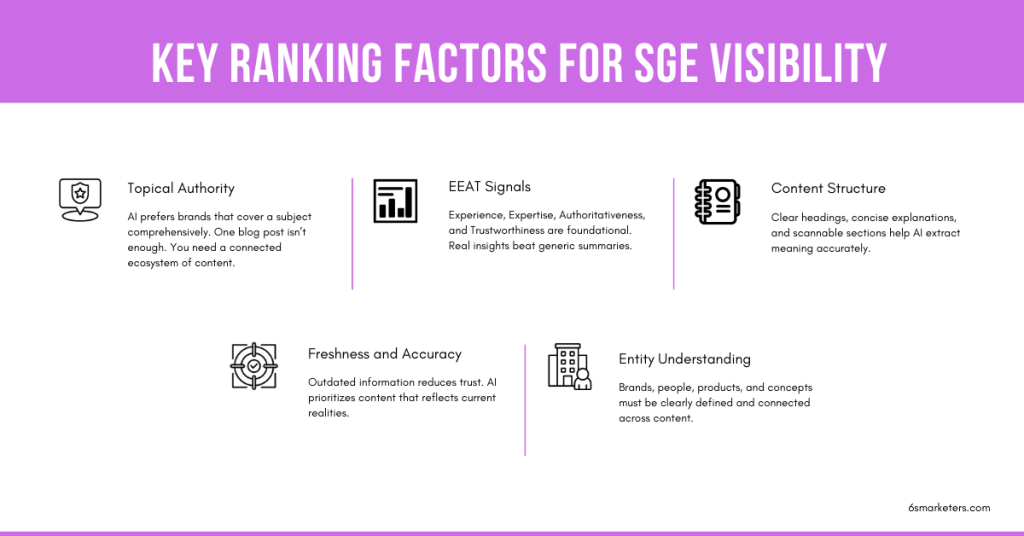
SGE doesn’t rank content the same way traditional SERPs do, but it still evaluates signals.
Here’s what consistently matters:
Topical Authority
AI prefers brands that cover a subject comprehensively. One blog post isn’t enough. You need a connected ecosystem of content.
EEAT Signals
Experience, Expertise, Authoritativeness, and Trustworthiness are foundational. Real insights beat generic summaries.
Content Structure
Clear headings, concise explanations, and scannable sections help AI extract meaning accurately.
Freshness and Accuracy
Outdated information reduces trust. AI prioritizes content that reflects current realities.
Entity Understanding
Brands, people, products, and concepts must be clearly defined and connected across content.
This is where how to rank in SGE becomes less about hacks—and more about strategy.
How to Optimise Content for AI-Generated Results
Optimizing for AI-powered search results starts with answer-first thinking.
Instead of asking, “What keyword should we target?” ask: “What problem is the user trying to solve?”
Then build content around that intent.
Effective SGE optimization includes:
- Clear definitions early in the content
- Contextual examples and real use cases
- Natural language phrasing
- Supporting subtopics that reinforce authority
Using AI for SEO can help identify patterns and gaps, but humans must validate accuracy and tone.
Also, avoid over-optimizing. AI penalizes manipulation faster than humans do.
If you’re unsure whether your current content is AI-search ready, this is the moment to act.
6S Marketers helps businesses align SEO strategies with AI-driven search realities—without risking brand credibility.
Connect with 6S Marketers to future-proof your organic growth.
Technical Requirements for AI Search
Strong content fails without strong foundations.
Technical SEO still matters, but now it supports machine understanding, not just crawling.
Key requirements include:
- Clean site architecture
- Schema markup for entities and FAQs
- Fast-loading, mobile-first pages
- Secure, accessible experiences
Structured data helps AI interpret context correctly. It clarifies relationships between topics, brands, and services.
Without technical readiness, even expert content struggles to surface in SGE results.
E-commerce, Local & B2B Impact
E-commerce
AI search influences product comparisons, buying guides, and recommendations. Brands that explain value—not just features—gain trust.
Local Businesses
SGE pulls data from reviews, profiles, and local content. Consistency and reputation matter more than keyword density.
B2B Companies
AI-powered search results reshape research behavior. Decision-makers rely on summarized insights before engaging vendors.
In all cases, visibility depends on clarity, credibility, and completeness.
Strategic Recommendations for 2026
To win with AI search optimization, businesses should:
- Build topic clusters, not isolated blogs
- Invest in expert-led content
- Combine human insight with AI efficiency
- Monitor AI SERP appearances, not just rankings
- Partner with SEO agencies that understand SGE evolution
This isn’t about chasing algorithms. It’s about becoming the most helpful voice in your niche.
SGE vs Traditional Search: What Businesses Must Understand in 2026
If you rely only on traditional SEO metrics, you may think nothing has changed.
But in reality, AI-powered search results influence decisions before users ever click.
This comparison helps decision-makers understand:
- Why traffic may decline while influence increases
- Why ranking #1 doesn’t guarantee visibility anymore
- Why SGE optimization complements—not replaces—traditional SEO
| Factor | SGE (AI Search) | Traditional Search |
| Primary Goal | Deliver a complete, AI-generated answer by synthesizing information from multiple trusted sources | List ranked web pages for users to explore individually |
| Visibility Model | Brands gain visibility by being referenced, summarized, or cited inside AI responses | Visibility depends on position in SERPs (Top 3 results win most clicks) |
| Content Evaluation | Prioritizes clarity, topical depth, EEAT signals, and usefulness | Prioritizes keywords, backlinks, and on-page optimization |
| User Journey | Users get answers without clicking, especially for research and comparison queries | Users must click through to find answers |
| Traffic Impact | Fewer clicks, but higher-intent exposure and authority building | Higher click volume, but lower intent consistency |
| Ranking Signals | Topical authority, structured data, freshness, factual accuracy, and entity understanding | Keywords, backlinks, page authority, technical SEO |
| Role of Domain Authority | Helpful but not mandatory if content demonstrates real expertise | Often critical for competing keywords |
| Content Format Preference | FAQs, explanations, comparisons, step-by-step guidance | Blog posts, landing pages, category pages |
| Update Sensitivity | Highly sensitive to outdated or vague content | Slower to penalize outdated pages |
| Optimization Focus | AI search optimization: answering intent, context, and trust | Traditional SEO: rankings, CTR, and link acquisition |
| Measurement of Success | Mentions, citations, visibility in AI answers, assisted conversions | Rankings, clicks, sessions, conversions |
| Best Use Cases | Complex queries, research, comparisons, “how-to” searches | Navigational, transactional, branded searches |
Conclusion: Why 6S Marketers Is Built for AI Search
AI search is not killing SEO. It’s raising the bar.
Businesses that adapt now will own visibility, authority, and trust in 2026 and beyond. Those who wait will compete for a shrinking share of attention.
At 6S Marketers, we specialize in:
- AI search optimization strategies
- EEAT-driven content frameworks
- Technical SEO for AI readiness
- Sustainable, human-first SEO growth
If you’re serious about staying visible in AI-powered search results, it’s time to evolve, not experiment blindly.
Talk to the experts at 6S Marketers and prepare your SEO for the AI-first future.