

You put all the effort into writing a blog post. You publish it, you have shared it once, and watched the traffic dripping. And, in a short span, the blog post gets buried. Meanwhile, a competitor with less expertise than yours keeps appearing everywhere, on YouTube, Instagram, and LinkedIn. The difference is rarely output. It is almost always a strategy.
A performing content repurposing strategy is how smart marketers get more visibility from every piece of content they build. According to Wyzowl, 91% of businesses now leverage video as a marketing tool. And, those who frequently repurpose written content into video posts bring better engagement and maximized ROI across every platform they publish on.
In this guide, we will walk you through the effective process. You will learn to recognise what you have to repurpose, how to script and distribute videos that actually get more views.
Key Takeaways
- What content repurposing is — and how it works in practice
- Why turning blogs into videos makes business sense
- A six-step content repurposing workflow to follow immediately
- The best content repurposing tools marketers use today
- Best practices to maintain quality as you scale
- Clear FAQ answers for the most common repurposing questions
What is Content Repurposing?
Content repurposing involves taking what you have already created and presenting it in a different format to attract a different audience or channel. A long blog becomes a short explainer video. A webinar recording becomes a written guide. A data report becomes an infographic series. The core ideas stay the same — only the packaging changes.
It is also a central pillar of any effective content distribution strategy. When one blog post can power five different formats across five platforms, your reach multiplies without your effort multiplying with it. If you want to get more out of existing content through SEO, 3 SEO Strategies to Securely Refresh Your Existing Content from 6S Marketers is worth reading alongside this guide.
Why Content Repurposing Strategy Matters for Your Brand
Most content gets one shot. Brands publish, promote briefly, and move on to the next piece. The problem is that most of your audience missed it the first time — buried by algorithms, flooded inboxes, and fast-moving feeds. Publishing only once is not enough.
Repurposing content gives each idea a bunch of chances to be seen in different places. There are many things you can do with a blog post like that, changed into a LinkedIn post, a cute little Instagram Reel or a quick excerpt in an email newsletter. Before you know it, the same nugget of insight is working hard across four channels at once. According to research from SEMrush, brands that post consistently across loads of different formats get up to three times the traffic that single-platformers get.
The Business Benefits of Repurposing Blog Content
Here is what a consistent repurposing habit actually delivers for your brand:
- Longer content lifespan: Older posts with proven value can generate leads for months or years after publication — when repurposed into fresh formats.
- Wider audience reach: Blog readers and video viewers are often entirely different people. Content repurposing will help you access both segments without developing a dual strategy
- Stronger SEO performance: Including a video in your blog post not only makes it more engaging but also helps boost its SEO effectiveness.
- Lower production costs: One well-researched blog feeds a video, a carousel, an email, and a short-form clip — rather than four separate briefs and budgets.
- Better brand recognition: Repeated exposure to the same ideas across platforms builds familiarity, and familiarity is what converts browsers into buyers.
Here is one more reason to act on this: video content generates 66% more qualified leads annually than other formats. For businesses that already invest in blogging, adding a video repurposing step is one of the highest-leverage moves available.
Want expert help building a content repurposing strategy that performs?
6s Marketers works with growing businesses to create content that ranks, converts, and scales. Connect with the team here →
Step-by-Step Content Repurposing Workflow: Blog to Video
A successful workflow for content repurposing allows you to transform a one-off job into a repeatable process. This is how you can build it:
Step 1: Identify Your Best-Performing Blog Posts
Find your analytics. Utilise a filter to identify posts that have higher pages viewed, time on the page, backlinks or shares. Content that has already attracted attention from your target audience is the best first step, but not that which didn’t do well.
Step 2: Pick One Focused Video Angle
Blogs can be used to cover a variety of concepts. Videos require a single idea. Concentrate your entire video on one thing you think is the most valuable thing in your video. Think about it this way: whether a person has 60 seconds to watch, what’s the most important thing to know?
Step 3: Script It Like You Are Talking to Someone
Don’t duplicate your blog’s content and paste it into scripts. It is the quickest method to make your video seem unnatural. Instead, write the main elements the same way as you would describe them in a conversation with short sentences, a natural rhythm, a hook within just five seconds, and an explicit call to action at the conclusion.
Step 4: Choose the Right Video Format
* Talking-head posts: opinions, personal insights, personal reflections, thought leadership
* Screen recording or tutorial guidebooks, tools, walkthroughs, process posts
* Animated explanation: abstract frameworks, concepts, or complicated concepts
* Slideshow with voiceover heavy on data, listicles, posts, statistics roundups
Step 5: Record, Edit, and Add Captions
A phone, adequate lighting, and a peaceful space are all you need to begin. Edit to suit the pace of your video. Eliminate every pause and words that are filler and slow the viewers down. Make sure to include captions. 85% of social platform videos are watched on mute or with no sound. Captions aren’t an accessibility feature anymore; they’re a standard procedure.
Step 6: Distribute Across Every Relevant Channel
Post the full version of the video on YouTube. Cut short clips to use on Instagram Reels, TikTok, and LinkedIn. Include the video directly in your blog’s content to boost your dwell time and search engine optimisation. Include it in your newsletter. Each new channel provides an independent way for your readers to discover you.
For ongoing content ideation, visit: Five Ways to Discover Innovative Concepts for Content Writing.
Best Content Repurposing Tools Worth Using
- Lumen5: Paste in your blog’s URL into the browser, and it automatically generates an incredibly short video. An excellent starting point for teams that are new to video production.
- Descript: Descript edits video as you edit the text in a Word document with the help of editing transcripts. Best for repurposing long videos into short-form clips.
- Canva: You can convert your blog’s comments, statistics, quotes, and other important details into infographics for social media Carousels, animated posts, and fast.
- Opus Clip AI: It analyses videos longer than 30 seconds and selects the most share-worthy 30-90-second videos automatically.
- Buffer: Schedules the repurposement of content across platforms, so that distribution can be completed without manual effort every time.
- ChatGPT: ChatGPT speeds up caption creation, script writing, and brainstorming content by using ideas that are repurposed from content.
Pick the tool that will solve the biggest bottleneck first. If scripting takes too long, begin using ChatGPT. If you feel that video creation is slow, consider Lumen5. The goal is to make repurposing the content to social media appear as a normal element of your routine and not a burden.
Best Practices For Content Repurposing
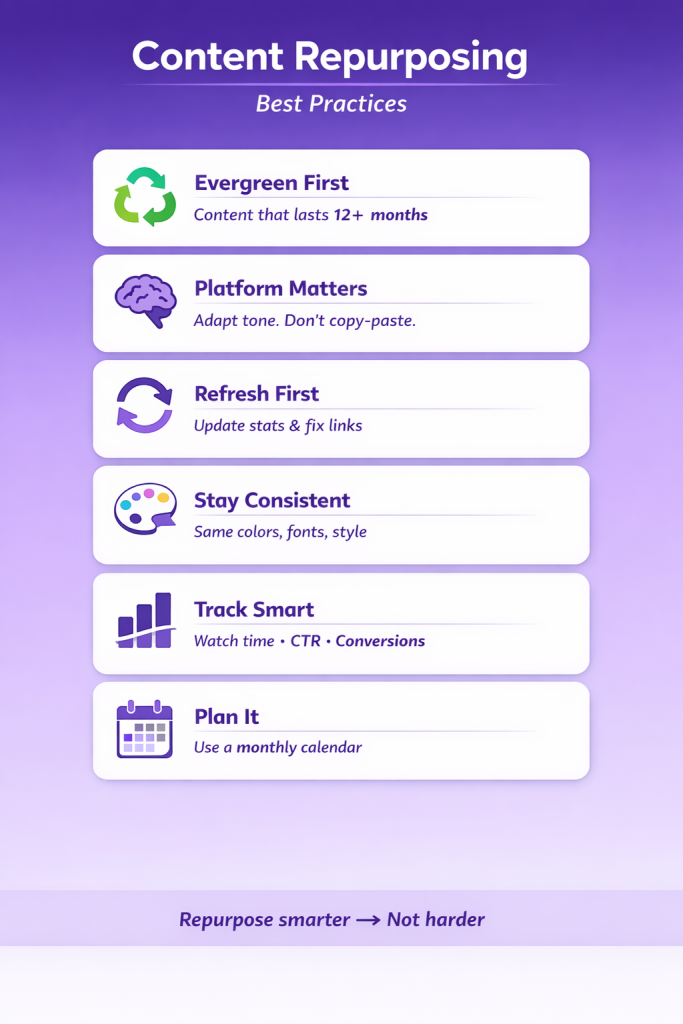
Lead with evergreen content: Repurpose posts whose advice holds up for 12 months or longer. News-based content dates quickly and reduces the return on your repurposing effort.
Rewrite for each platform: LinkedIn audiences want depth. TikTok rewards personality and pace. Adapt your tone and framing — do not republish the same caption everywhere.
Refresh before you repurpose: Update outdated stats and fix broken links before creating a video from an older post. Your video carries your brand — keep it accurate.
Stay visually consistent: Use the same colour palette, fonts, and graphic style across all formats. Recognition builds trust over time.
Track the right metrics: Watch time, click-through rate, and conversions matter more than raw views. These numbers tell you which content repurposing ideas actually drive business outcomes.
Build a repurposing calendar: Schedule which posts to repurpose each month. An irregular approach produces irregular results.
Conclusion
Every blog post you have already written holds more value than a single publish can deliver. Taking your best content and guessing where your audience is and getting it to them – that’s what a smart content repurposing strategy is all about.
The formula is simple: find your strongest content, sharpen the message for video, build a content repurposing workflow, and use the right tools. Just do it consistently, and your content will start to compound.
If you want a team that understands how to make content strategy actually perform, 6s Marketers offers SEO and content marketing services built specifically for businesses looking to grow. From full content audits to done-for-you repurposing strategies, they help brands turn content into results. Connect with us today and start making every piece of content count.