

Inside Google’s ad platform, advertisers can track how well their products are performing. The newest Google Ads tracking update reduces tracking issues. It has enhanced visibility at the product level and adjusted reporting to fit user cross-device shopping. Google Ads product campaign tracking update adds greater ease to campaign-level measurement and product insights in automated campaigns.
This update matters as retail advertisers are constantly boosting their spending on automation. According to Google, ecommerce conversions across Search, Shopping, and YouTube are now driven by automation such as Performance Max campaigns. As tracking gets better, businesses need to adapt faster to stay accurate on attribution and ROI.
In this guide, you will learn what changed, how it impacts ecommerce brands, and how to adjust your setup without losing data integrity. Google Ads product campaign tracking is directly affected by this update and will be reflected in your reports.
What Is the Google Ads Tracking Update?
Google simplified product campaign tracking by consolidating how product data is reported across campaign types, especially within automated formats like Performance Max. Advertisers now get clearer product-level reporting and improved visibility without complex tagging structures.
This update enhances:
- Product-level reporting of Google Ads insights
- Cross-channel attribution clarity
- Streamlined Google Ads conversion tracking
Key Takeaways
- Google reduced tracking complexity inside ecommerce campaign tracking.
- Product-level reporting of Google Ads insights is more accessible.
- Performance Max tracking changes align product reporting across channels.
- Conversion accuracy remains intact when set up correctly.
- Advertisers must validate their Google Ads conversion tracking configuration.
- Smarter tracking supports better SEO and paid media alignment.
What Changed in the Google Ads Tracking Update?
The Google Ads tracking update simplifies how product interactions are attributed and reported. Previously, advertisers relied on multiple tagging layers and campaign segmentation to isolate product performance. Now, Google centralizes reporting within the Google Ads interface, reducing dependency on complex manual configurations.
Performance Max tracking changes play a major role. Since Performance Max blends Shopping, Display, Search, Discover, and YouTube, advertisers struggled with fragmented product insights. Google now improves product-level reporting in Google Ads views inside these automated campaigns, giving brands clearer visibility into what products drive conversions.
This shift supports a broader trend toward automation. Google continues to push AI-driven optimization. When tracking becomes easier and more unified, advertisers spend less time troubleshooting data gaps and more time optimizing revenue-driving products.
How Google Ads Product Campaign Tracking Impacts Ecommerce Advertisers
Ecommerce brands depend on precise product reporting. When tracking lacks clarity, optimization suffers. The updated Google Ads product campaign tracking improves decision-making in three practical ways:
- Clearer product attribution
Advertisers can see which SKUs contribute to conversions without building complex segment layers. - Improved budget allocation
Strong product-level reporting of Google Ads data helps shift budget toward high-margin products. - Better automation control
Performance Max tracking changes reduce blind spots within AI campaigns.
Retail ad spend continues to grow globally. According to Statista, global digital advertising spending surpassed $600 billion in 2023 and continues to rise. Ecommerce brands cannot afford misattribution in such a competitive environment.
When tracking clarity improves, ROAS optimization becomes more predictable. That directly influences revenue growth.
How to Adapt Your Google Ads Conversion Tracking Setup
You do not need a complete rebuild. However, you must validate your configuration. Strong Google Ads campaign tracking depends on proper implementation.
Follow these steps:
1. Audit Existing Conversion Actions
Review your Google Ads conversion tracking inside the platform. Confirm that purchase events fire correctly and match backend sales.
2. Verify Product Feed Accuracy
Your Merchant Center feed drives product-level reporting and Google Ads insights. Ensure:
- Accurate product IDs
- Correct pricing
- Clean categorization
3. Align with Performance Max Tracking Changes
Since Performance Max consolidates placements, confirm:
- Enhanced conversions are enabled.
- First-party data signals are active.
- Attribution model matches business goals.
4. Cross-Check With Analytics
Compare conversion data between Google Ads and analytics platforms. Minor differences are normal. Large discrepancies require investigation.
If you need expert implementation, our team at 6s Marketers Paid Search Services supports ecommerce brands with advanced tracking configuration and performance optimization.
Before vs After Google Ads Update: What Improved?
| Aspect | Before Update | After Update |
| Product visibility | Limited segmentation | Unified product-level reporting for Google Ads |
| Automation clarity | Partial transparency | Improved Performance Max tracking changes |
| Setup complexity | Multi-layer tagging | Simplified configuration |
| Attribution insights | Fragmented | Centralized inside Google Ads |
| Optimization speed | Slower | Faster product-based decisions |
The difference lies in clarity. The new Google Ads product reporting experience reduces guesswork. Advertisers act on cleaner insights.
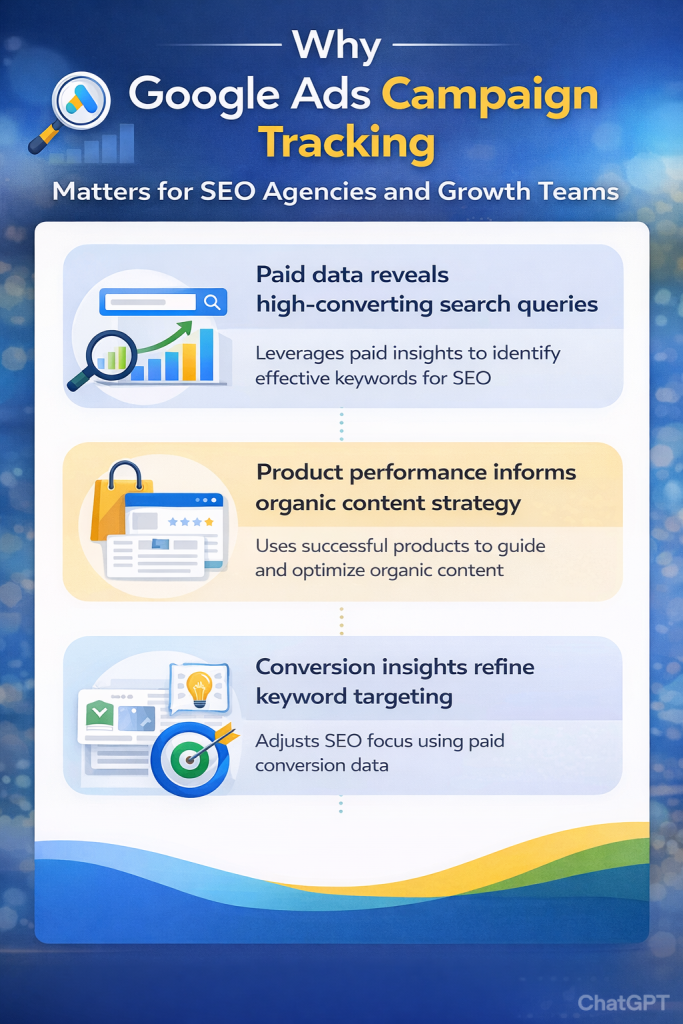
Why Google Ads Campaign Tracking Matters for SEO Agencies and Growth Teams
Businesses searching for SEO agencies often overlook paid media tracking quality. That creates growth gaps. Strong Google Ads campaign tracking supports SEO strategy alignment.
Here is how:
- Paid data reveals high-converting search queries.
- Product performance informs organic content strategy.
- Conversion insights refine keyword targeting.
If you want deeper insights into algorithm updates and tracking shifts, explore our ongoing coverage at Google Updates Hub.
Modern digital growth requires integration. Paid search, SEO, and analytics must work together. Fragmented tracking reduces growth momentum.
The Bigger Picture: Automation, Data, and Accountability
Google continues simplifying campaign management. Automation expands. Tracking becomes centralized. However, accountability still rests with advertisers.
Google Ads conversion tracking remains accurate when:
- Tags fire correctly
- Enhanced conversions are active
- Merchant feeds stay updated
If tracking breaks, automation amplifies the error. That reality makes proactive audits essential.
Conclusion
The latest Google Ads tracking update strengthens product-level reporting and simplifies ecommerce campaign tracking. Businesses gain clearer product attribution and faster optimization decisions. Performance Max tracking changes remove much of the previous reporting confusion.
However, simplified tools do not replace strategy.
If your tracking setup lacks precision, your budget efficiency drops. If your reporting remains fragmented, your growth stalls. High-performing brands invest in structured tracking, SEO alignment, and paid search optimization.
At 6S Marketers, we combine SEO expertise with an advanced Google Ads campaign tracking strategy. We help ecommerce brands unify organic and paid performance for measurable ROI. If you want a partner who understands both entity SEO and product-level reporting Google Ads strategy, connect with us today.