

Overview of Google Ads in 2026
Based on the internal Google data published in Jan 2025, we now know that Google officially confirmed it has processed more than 5 trillion searches annually. But what’s really changed, and how those searches are answered and monetized? Well, by 2026, that’s about to look very different indeed. Performance Max now controls budget allocation across six Google channels simultaneously. Smart Bidding is no longer a feature you toggle on; it is the default operating mode. And first-party data has quietly become the sharpest competitive edge in paid search — more impactful, in many cases, than budget size alone.
The gap between current Google Ad practice and peak performance is expanding every quarter. The Google Ads trends in 2026 are not theoretical. They are actively rewarding teams that have adapted and penalizing those that have not.
This post aims to give marketing leaders a clear heads up on what’s changed, what’s driving results now, and exactly how to recalibrate your Google Ads strategy to stay ahead without throwing away budget on trial and error.
Key Takeaways
- AI now drives most bidding and optimization decisions automatically.
- Performance Max campaigns are expanding across all Google inventory.
- First-party data is your most valuable paid search asset today.
- Conversational search is reshaping how ads match user intent.
- Privacy-compliant measurement is now a competitive advantage.
- Google Ads strategy must align creative, data, and automation together.
Google Ads Evolution
Google Ads has always been changing, but the 2026 version feels quite radical in both pace and depth. What used to be a platform all about keywords and manual bids has morphed into an intelligent layer that reads signals, predicts intent, and places ads all across Google’s sprawling ecosystem – that’s Search, YouTube, Discover, Gmail, and more.
Google’s VP of Ads has described this as an “expansionary moment” for the whole industry. And it makes sense – consumers are searching in completely new ways: they’re snapping photos, asking questions as they would a mate, and expecting answers that feel tailored to their personal needs.
For CMOs and demand gen leaders, this evolution means that old benchmarks may no longer be reliable guides. CTR models that worked in 2022, keyword strategies built for text-based queries, campaign architectures designed for one channel at a time — all of these deserve a critical review in light of where Google Ads is heading. Explore Our Paid Search Marketing Solutions.
Top Google Ads Trends in 2026
Here is a clear summary of the dominant forces reshaping paid search this year:
| Trend | Impact |
| AI-Powered Bidding | Higher ROAS, reduced manual effort, smarter spend allocation |
| Performance Max Expansion | Cross-channel reach with unified campaign management |
| Conversational Search Ads | Higher intent matching through natural language queries |
| First-Party Data Priority | Better targeting accuracy as third-party cookies phase out |
| YouTube Creator Partnerships | Stronger brand trust and faster consumer conversion |
| Privacy-First Measurement | Consent-mode adoption ensures compliant, reliable data |
Each of these trends is linked to a bigger shift: the increasing role of machine intelligence in how ads are built, served, and measured. So let’s break out the most significant ones.
Role of AI & Automation
AI in Google Ads is no longer a supporting feature. It has now become the operating system. Smart Bidding has moved a long way since its inception, and in 2026, Target ROAS and Target CPA strategies are producing some seriously strong results for brands that give them high-quality conversion data. But this isn’t a ‘set and forget’ situation.
But automation is not a hands-off solution. The marketers getting the best results from Google Ads automation are the ones who treat it as a collaboration – they decide on the right conversion goals, build their campaigns to give the algorithm clear signals, and are always testing new creative inputs that the machine just can’t generate.
Where teams stumble is when they conflate automation with abdication. Setting a Performance Max campaign live and walking away is not a strategy. Google’s systems need signal-rich environments — strong landing pages, accurate conversion tracking, and differentiated creative assets — to perform well.
The most effective Google Ads strategy in 2026 sees AI as a tool to amplify human strategic thinking, and not a replacement for it. Your job is to feed the algorithm the best possible info; its job is to then optimise the outputs at a scale no human team can match.
Performance Max Campaign Growth
Performance Max (PMax) has become the default campaign type for most growth-focused advertisers, and its influence is growing. PMax campaigns run across Search, Display, YouTube, Discover, Gmail, and Maps – all from a single campaign structure – using AI to chunk budget at the places with the strongest conversion signals.
The appeal is clear: unified management, broad reach, and machine-optimized delivery. The challenge is equally clear: visibility into what is actually working across channels remains limited, and brands without robust first-party data or strong creative assets often see diluted results.
Leading brands are countering this by investing upstream — building rich asset libraries (images, videos, headlines, descriptions), uploading customer lists as signals, and using audience insights to guide PMax rather than leaving signal collection entirely to Google. The teams treating PMax as a creative performance channel, not just a bidding tool, are consistently outperforming those who don’t.
The PPC trends narrative around PMax also intersects with brand safety. Monitoring placement reports and excluding irrelevant inventory categories remains a manual discipline that smart marketers are building into their weekly review cadence. Talk to a Paid Search Expert at 6s Marketers
Privacy & First-Party Data Trends
One of the most significant paid search trends in 2026 is the shift towards first-party data. As third-party cookies get phased out across browsers and regulatory scrutiny ramps up globally, the ability to fire off your own customer data through Google Ads has become a real competitive differentiator.
Google’s Enhanced Conversions and Customer Match features allow brands to pass hashed first-party signals into the platform — improving measurement accuracy and enabling more precise bidding without relying on third-party tracking. Brands that implemented these features early are now reporting materially better conversion modeling, particularly in the post-click attribution window.
Privacy-first measurement also means embracing Consent Mode v2, which adjusts conversion modeling based on user consent states. This is not just a compliance checkbox — it is a data quality decision. Campaigns using their own clean, consented signals are outperforming those that don’t, as Google’s algorithms are relying more and more on first-party behavioural data to drive optimisation.
And for marketing directors evaluating their data infrastructure, the message is clear: your CRM, CDP, and Google Ads account need to be connected and actively exchanging signals. This integration has just become a performance lever – not just a privacy requirement.
How Should You Adapt Your Google Ads Strategy
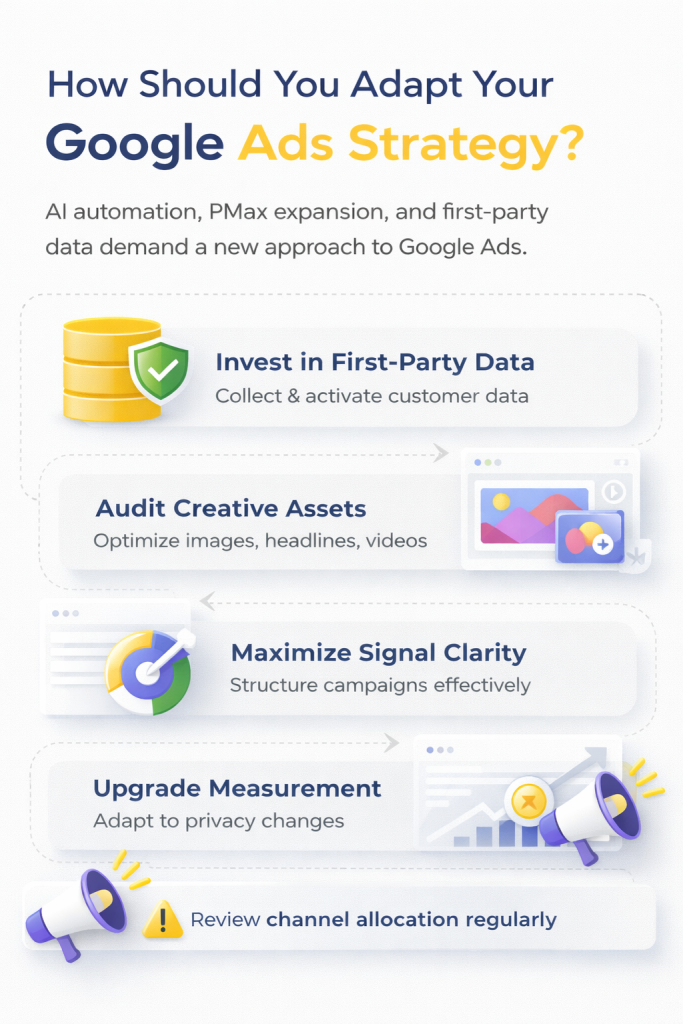
The combination of AI automation, PMax expansion, and the drive towards first-party data calls for a Google Ads strategy that’s built on four solid pillars:
- Invest in first-party data infrastructure – that means building systems to collect, clean, and activate customer data across all your Google Ads campaigns. Customer Match and Enhanced Conversions should be live in every account.
- Audit your creative assets with rigor. PMax and responsive search ads perform based on the quality of inputs. You need top-quality images, diverse headlines, and strong video assets. They’re no longer optional extras.
- Structure campaigns to maximize signal clarity. Group products or services with similar conversion values together. Feed the algorithm coherent goals rather than mixed signals across campaign types.
- Build a measurement framework that takes account of how privacy is changing – consent mode adoption, offline conversion imports, and server-side tagging should all be part of your 2026 measurement plan.
- Review channel allocation across paid search and Performance Max regularly. Automated budget decisions might not always reflect your brand priorities – so human oversight at the campaign level is still essential.
The brands seeing the strongest results from paid search marketing in 2026 are those who have that have aligned their internal data, creative, and analytics capabilities with the realities of an AI-driven Google Ads ecosystem.
Conclusion
Google Ads in 2026 rewards marketers who lead with intelligence – both machine intelligence and human strategic insight. The trends shaping this year are not just some abstract shifts on the horizon; they’re actually influencing your Quality Scores, conversion models, and return on ad spend right now.
AI and automation will keep evolving, first-party data will keep getting more valuable, and Performance Max will keep growing its footprint. The marketers who thrive will be the ones who engage with these trends deliberately – not just react to them.
The opportunity is real and substantial. There is a playbook. What it needs is the organisational will to invest in the right foundations – data, creative, measurement, and strategic oversight – and the agility to keep learning as the platform continues to evolve.
If you are ready to build a Google Ads strategy that is genuinely fit for 2026,6S Marketers can help you get there. Get in Touch with Our Team.