

Introduction
Imagine searching for something on Google today and seeing not the meta description you wrote, but an AI-generated summary powered by Google’s own model. That’s not science fiction: Google has begun experiments with AI Generated descriptions and AI snippet summaries in search results. These changes could reshape how users engage with search, how traffic flows, and how SEOs plan for the future.
In this post, you’ll learn:
- What Google is testing, and how it differs from the traditional snippet/meta description
- Potential impacts on click-through rate, SERP visibility, and traffic
- How to prepare your SEO strategy for generative AI in search
- Early observations, risks, and long-term direction
- Practical steps agencies (and in-house SEO teams) should take now
What Are AI-Generated Snippet Summaries?
What Google is Testing
Recently, SEO watchers have spotted Google experimenting with replacing or augmenting search result descriptions using its own AI models (notably Gemini) rather than simply pulling text from a page’s meta description or from page content.
There are two main variations observed:
- Full AI-generated description — the meta description is ignored, and Google shows its own AI-crafted summary.
- AI summary overlay/augmentation — Google may display your existing description, but also show (or replace with) a shorter AI-generated snippet.
Here is the screenshot. The changes were spotted by Paul Shaprio that who shared them on X.
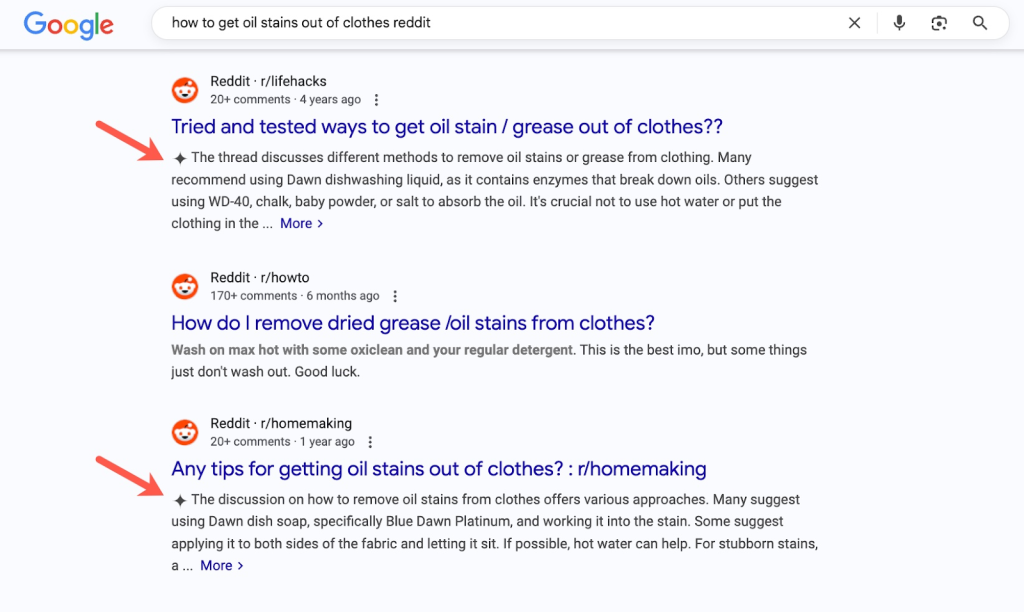
In many of the examples, a small Gemini (or similar) icon appears next to the AI description, indicating that the snippet was generated by Google.
These experiments suggest Google is testing how generative AI can alter the first impression a user sees on a SERP.
How This Differs from Traditional Meta Snippets & Featured Snippets
- Traditional meta description: You write a short description (often 150–160 characters) in the HTML <meta> tag; Google may or may not use it.
- Dynamic snippet extraction: If Google deems your meta description irrelevant, it often dynamically extracts a fragment of your content to serve as a snippet.
- Featured snippet: A specially selected block (list, paragraph, table) is pulled to appear above organic results when a query is very direct (e.g., “how to tie a tie”).
In contrast, the AI-generated snippet is abstractive: it synthesizes and rewrites information based on multiple parts of your page (and often from multiple pages), instead of just copying a fragment. (In research terms, this is closer to abstractive snippet generation rather than extractive.)
So while your meta description still matters, its role may become more indirect: serving as input data, but not necessarily the version that users see.
Why Google Is Testing This
Why invest in this shift? A few possible motives:
| Better relevance & context | Google’s AI may better understand context, nuance, and user intent, allowing it to tailor the snippet more precisely than static meta descriptions. |
| Consistency in user experience: | By generating its own summaries, Google can ensure a more uniform tone, style, or clarity across results. |
| Stronger control over SERP experience | As generative AI becomes more central, Google may want more control over how results are presented (while still linking to external sites). |
| Reducing dependency on metadata quality | Many sites neglect or misconfigure meta descriptions. Google may compensate by producing its own better versions. |
| Advancing Search Generative Experience (SGE) / AI Overviews: | This experiment aligns with Google’s broader push into generative engine optimization (GEO) and answer engine optimization (AEO), embedding AI more deeply into search. |
In short, Google is hedging on generative AI becoming a primary interface for search, not just a back-end assistant.
Possible Impacts on SEO & Traffic
Click-Through Rate (CTR) Shifts
If Google writes a snippet that’s more compelling than your meta description, it may boost CTR for some pages. But it could also:
- Emphasize parts of your content you didn’t want users to see
- Oversimplify or misinterpret your message, leading to misleading impressions
- Drain traffic if users feel they’ve “got the answer” without needing to click (i.e., increasing zero-click searches)
Loss of Message Control
Your carefully crafted brand voice or call to action in a meta description may get overridden. The AI might highlight features you didn’t prioritize, or omit important disclaimers.
Increased Competition & Volatility
With AI summarization, pages with clearer structure, semantic coherence, and topical depth may fare better. Pages that are disorganized or verbose may suffer.
Metrics & Analytics Challenges
Traditional metrics like “impressions → clicks → CTR” may become less meaningful. If more users rely on AI summaries, traffic attribution might shift, and “visibility” doesn’t always translate to clicks.
How to Optimize / Prepare for AI-Generated Snippets
You can’t fully control what Google’s AI will show—but you can prepare your content to be a stronger candidate.
1. Strengthen On-Page Clarity & Structure
Use a clear content structure: introduction + headings + concise paragraphs + summary bullets. AI models often rely on headings and short “topic sentences” as anchors for snippet generation.
2. Write Intent-Aligned Meta Descriptions (Still)
Continue writing crisp, relevant meta descriptions that reflect user intent. Even if AI may override them, your meta still provides a signal and fallback context. Many experiments seem to draw upon the page’s meta in generating their summaries.
3. Use Schema Markup & Structured Data
Structured data helps signal entities, definitions, FAQs, and other helpful modules. That could help AI better understand and prioritize your content blocks.
4. Emphasize Authority & Trust Signals
Since AI decisions will likely weigh quality, trust, E-E-A-T (Expertise, Experience, Authoritativeness, Trustworthiness) becomes more important than ever. Make author attribution, sourcing, and credentials clear.
5. Monitor Performance & CTR Changes Closely
Track CTR, ranking, traffic dips, and anomalies post-rollout. Use Search Console and analytics tools to detect when AI snippets change and how they affect engagement.
6. Test & Iterate Headlines, Snippet Hooks & Intro Paragraphs
Think of your first paragraph or H2 as “snippet bait”, include a concise, useful summary with the main keyword and benefit. AI summarization is more likely to pick up clean, well-phrased opening lines.
7. Diversify Traffic Sources
Don’t rely solely on organic search. Build traffic through email, social, direct, partnerships, and other channels to hedge against shifts in search behavior.
Early Observations
- Some tests show the AI snippet completely replacing meta snippets; others show a hybrid approach.
- The AI snippets often cite sources (links) to pages used to build the summary, which helps preserve click opportunities.
- In practice, AI summaries sometimes oversimplify, drop nuance, or misinterpret tone. Early audits warn about inaccuracies.
- Because Google has already experimented with AI Overviews / SGE / AI Mode, the snippet test is probably a further extension of that direction.
Risks, Challenges & Limitations
- Inaccuracies/hallucinations: AI might misstate facts, omit critical caveats, or generate misleading phrasing.
- Loss of nuance & depth: Complex or subtle ideas may be flattened.
- Brand misrepresentation: Tone, disclaimers, or value props might be changed or omitted.
- Unpredictable deployment & regional variation: Google may roll this out unevenly, test variants, or retract.
- User trust: If AI summaries are wrong or biased, user confidence (and your brand reputation) could suffer.
Future Outlook & Strategic Recommendations for Agencies
- View AI snippet summaries as another “touchpoint”: Just as we optimize for featured snippets or knowledge panels, optimize for AI snippet summaries as a new battleground.
- Experiment with content “snippet anchors”: Use opening summary paragraphs, bullet lists, or “takeaway boxes” that are easy for AI to lift.
- Align messaging and brand voice: Ensure key statements (value props, unique differentiators) appear early and clearly.
- Use data & AB testing: When possible, test variants of intros and measure impact on CTR and engagement.
- Stay current with Google’s labs/experiments: Monitor announcements around AI Overviews, SGE, Search Labs, and Search Central guidelines.
- Educate clients: Help clients understand that meta control is diminishing; success will depend on content quality, clarity, and trust alignment.
- Advocate for transparency/oversight: Engage in the SEO community and push Google to allow feedback or partial overrides if AI summaries misrepresent content.
Conclusion
Google’s experiments with AI-generated descriptions and AI snippet summaries signal a meaningful shift in how search results may present content. While you won’t (yet) have full control over what appears under your listing, you can influence it by strengthening your content structure, clarity, authority signals, and snippet hooks. Rather than fearing the change, smart agencies and SEO teams can treat this as a new optimization frontier in the era of generative AI in search.
As always, our guiding principle remains: write for your human audience first, and optimize thoughtfully for the machines second.