

Fintech startups work in one of the most credibility-sensitive digital markets. PwC states that over 60% of customers rank trust as the top factor when choosing a financial service provider. Parallely, McKinsey reports that digitally established fintech companies achieve 2–3x higher revenue growth than competitors with weak marketing foundations. Therefore, growth in fintech depends on credibility, visibility, and intent-driven acquisition.
A well-defined marketing strategy for fintech startups becomes very crucial. Founders require a system that attracts qualified users, aligns with regulations, and supports long-term scalability. This blog breaks down proven fintech marketing strategies, performance channels, compliance frameworks, and execution tactics that work in 2026—backed by verified data and industry best practices.
Fintech Marketing Strategy for Startups
A fintech marketing strategy for startups focuses on trust-led acquisition, regulatory-safe messaging, and full-funnel growth. It integrates SEO, fintech content marketing, performance channels, and a lifecycle that gives sustainable revenue.
What you will learn:
- How to structure a scalable marketing strategy for fintech startups
- The most common challenges fintech startups face while marketing
- Performance marketing channels delivering ROI in 2026
- A compliance-first fintech marketing framework
- A full-funnel model for fintech growth
- Execution tips for early-stage fintech teams
What is Fintech Marketing Strategy for Startups
Financial choices involve real risk, which is why buyers spend time validating credibility before choosing a provider. They assess credibility, content quality, compliance clarity, and brand authority.
Successful marketing strategies for fintech companies prioritize educational visibility. SEO-led blogs, product explainers, and case studies attract users early in the buying journey. These assets support AI search visibility while improving conversion quality.
As per HubSpot, SEO-driven content generates 3 times more leads per dollar than paid advertising over 12 months. For fintech startups, this impact grows further because content builds authority in regulated decision-making environments. This makes fintech content marketing a core pillar of sustainable growth.
Challenges for Fintech Startups
Regulatory and Compliance
Fintech marketing works with strict regulatory oversight. In money matters, every word matters. Claims about returns, security, or compliance can’t be overemphasized or loosely framed. They should be precise, verified, and legally correct.
Financial product marketing is closely monitored by regulators like the RBI, SEBI, FCA, and SEC. Even small wording choices can strongly impact whether a campaign gets approved or rejected.
This is the reason why fintech marketing can’t work in isolation. Marketing teams need to partner closely with legal and compliance from the start. Clear disclosures, honest risk explanations, and fact-based messaging don’t just keep regulators happy—they build credibility, protect the brand, and earn long-term trust from users.
Increasing Customer Acquisition Costs
Paid media costs continue to rise across financial services. Statista reports that CPCs in the finance category have increased by 18% year-on-year. This pressure limits the effectiveness of performance-heavy acquisition models.
As a result, fintech startups benefit from investing in organic channels like SEO and content that reduce dependency on paid traffic and improve lifetime value.
Performance Marketing Channels That Work in 2026
High-Intent Paid Search
Google Search remains effective for bottom-funnel fintech queries such as “best payment gateway for startups” or “B2B forex platform.” These searches indicate readiness to convert, which improves efficiency.
Smart fintech teams cap budgets, focus on conversion-led keywords, and use landing pages aligned with compliance standards.
LinkedIn for B2B Fintech Growth
For B2B fintech brands, LinkedIn delivers consistent performance. According to LinkedIn Marketing Solutions, B2B financial services campaigns achieve up to 2x higher engagement rates compared to platform averages.
Thought leadership ads, account-based marketing, and lead-gen forms perform well when paired with strong educational content.
Channel-Wise ROI Benchmarks (Verified Data)
| Channel | Average ROI / Efficiency | Source |
| SEO & Content Marketing | 3–5x ROI over 12 months | HubSpot |
| Google Search Ads (Fintech) | 1.5–2x ROI | WordStream |
| LinkedIn B2B Ads | 1.8–2.5x ROI | LinkedIn Marketing Solutions |
| Email Marketing | 36:1 ROI | Litmus |
| Retargeting Ads | 2–3x ROI | Google Ads Benchmarks |
Compliance-First Fintech Marketing Framework
Trust Signals and Transparency
A compliance-first fintech marketing strategy includes visible certifications, security assurances, regulatory disclosures, and transparent pricing. These elements reduce friction and improve conversion confidence.
Websites that clearly communicate compliance standards experience stronger engagement and lower bounce rates.
Content Aligned With Regulations
Fintech content marketing performs best when it educates users clearly and accurately. Product explainers, compliance guides, and use-case articles simplify complex topics without exaggeration.
A specialized fintech content marketing agency helps brands balance SEO performance with regulatory safety, ensuring consistency across channels.
Full-Funnel Strategy for Fintech Growth
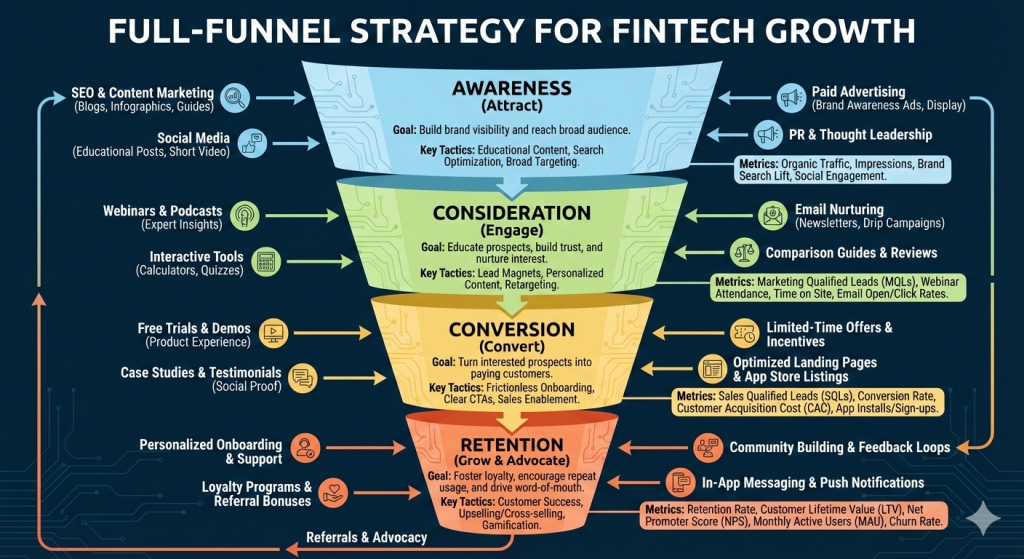
Top Funnel: Awareness Through Education
SEO blogs, AI-search-optimized content, and explainer pages attract early-stage users. These assets rank for informational queries and support long-term discoverability.
This layer builds authority while feeding qualified traffic into the funnel.
Mid and Bottom Funnel: Nurture and Conversion
Email workflows, case studies, demos, and webinars help users progress toward action. McKinsey reports that personalized financial journeys increase conversion rates by up to 40%.
A full-funnel fintech marketing strategy aligns content, paid media, and lifecycle engagement for predictable growth.
If your fintech startup needs scalable growth without compliance risk, 6S Marketers helps you implement SEO-led fintech marketing strategies built for trust and conversion. Connect with our fintech SEO experts today.
Execution Tips for Early-Stage Fintech Startups
Prioritize One Core Channel
Early-stage teams achieve stronger results by focusing on one channel first—typically SEO or LinkedIn. This creates traction without spreading resources thin.
Clear priorities accelerate learning and execution.
Track Revenue-Aligned Metrics
Measure CAC, LTV, organic conversions, and pipeline contribution. Strong B2B fintech marketing strategy frameworks connect marketing performance directly to revenue outcomes.
Conclusion: Scaling Fintech Growth With Confidence
A strong marketing strategy for fintech startups focuses on trust, compliance, and intent-driven growth. SEO, fintech content marketing, and full-funnel execution create visibility that compounds over time.
6S Marketers partners with fintech brands to build compliant, high-impact SEO strategies that drive qualified demand. Reach out to us to scale your fintech brand with confidence.