

Most SEO strategies rely on best-guess assumptions. You pick keywords based on search volume, build content around them, and wait months to see if they actually pay off. Sometimes they do. More often than not, they don’t. So, how to use PPC data to improve organic traffic? We will explore.
Meanwhile, your PPC campaigns are quietly generating real answers. They show exactly what people click on, what messaging actually grabs attention, and what actually converts. That’s a huge gap where most opportunities are being lost.
With Google Ads trends evolving, deeper Google Ads automation, and the growing role of AI in Google Ads, paid campaigns have become so much more than just acquisition channels. They’re now your fastest source of truth. Instead of making wild guesses about what might work in SEO, you can use PPC data to see what already works – and scale it up organically.
The shift is simple but powerful: stop treating PPC and SEO as separate efforts, and start using one to help the other out.
Key Takeaways
- PPC reveals exactly what people are searching for
- CTR data helps you craft more effective organic title strategies
- Conversion data tells you which keywords are actually worth prioritizing
- Using paid insights can cut down on SEO experimentation time
- Aligning PPC and SEO strategy drives stronger multi-channel returns
Why PPC Data is a Game-Changer for SEO
SEO takes an eternity to validate. PPC gives you immediate feedback.
That’s the core advantage.
With paid search trends shifting toward automation and AI-driven bidding, your PPC campaigns are now acting as supercharged testing environments. You can validate keyword intent, messaging, and landing page effectiveness in a matter of days – not months.
Here’s what makes PPC data so powerful for SEO:
- Real-time validation: You get to see what users are clicking on today
- Intent clarity: You understand exactly which queries are driving conversions
- Message testing: You get to test headlines before committing to any SEO content
- Market responsiveness: You can adapt super quickly to Google Ads trends
And a lot of teams still rely solely on keyword volume. That metric lacks context. PPC fills that gap by showing what’s actually driving action.
Want to connect both channels effectively? Get in touch with us.
Using PPC for SEO Insights
Not all PPC data is created equal when it comes to SEO. Focus on metrics that reveal user behavior, not just performance.
1. Click-Through Rate (CTR)
CTR highlights which headlines are actually resonating. If a paid ad consistently racks up high CTRs, its messaging can inform your:
- Meta titles
- Meta descriptions
- Blog headlines
2. Conversion Rate
This metric separates traffic from the actual value. High-converting keywords should be your top SEO priorities.
3. Search Query Reports
These reports reveal actual user queries – often way more detailed than what your keyword tools pick up.
You’ll uncover:
- Long-tail opportunities you never knew existed
- Emerging search patterns
- Hidden intent variations
4. Cost Per Click (CPC)
High CPC often signals strong commercial intent. These keywords deserve SEO investment even if they’re super competitive.
5. Impression Share
Low impression share with strong conversions indicates a huge opportunity being missed. SEO can help fill that gap.
How to Use PPC Data for Keyword Strategy
Keyword strategy becomes way stronger when it’s rooted in performance – not assumptions.
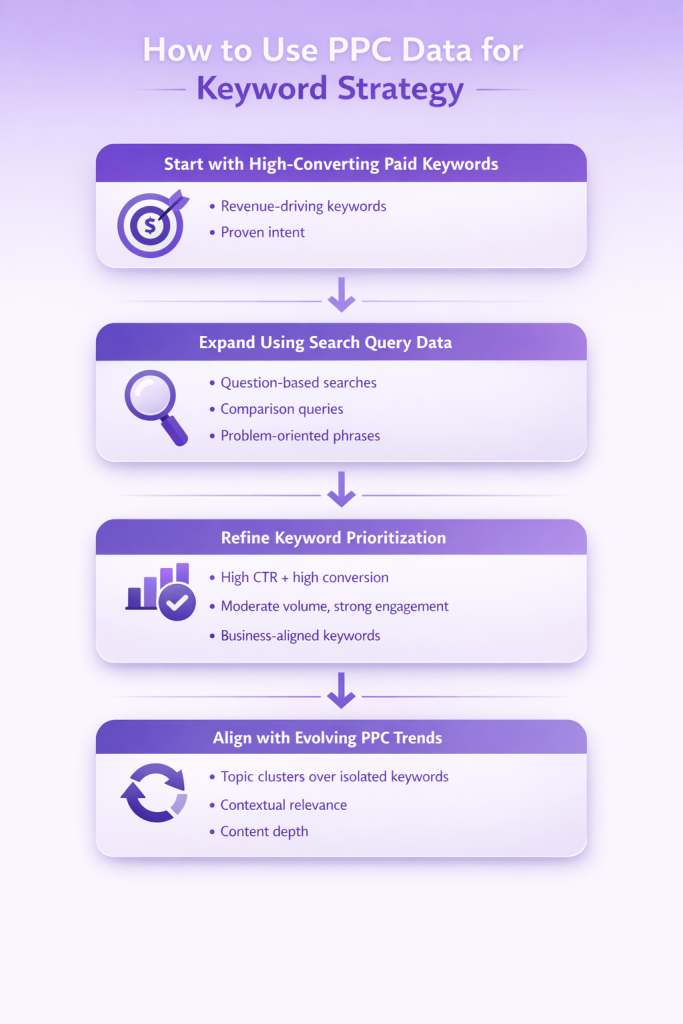
Start with High-Converting Paid Keywords
Don’t just look at traffic. Focus on keywords that drive revenue in PPC. If a keyword converts in paid campaigns, it’s proven intent. Build SEO content around it.
Expand Using Search Query Data
Search query reports often uncover:
- Question-based searches
- Comparison queries
- Problem-oriented phrases
These are perfect for blog content and long-form SEO pages.
You can dive deeper into intent using this guide: Search Intent in SEO.
Refine Keyword Prioritization
Instead of chasing volume, prioritize:
- High CTR + high conversion keywords
- Moderate volume but strong engagement
- Keywords aligned with business outcomes
Align with Evolving PPC Trends
Modern Google Ads Strategy is increasingly reliant on automation. That means keyword match types are more flexible, and intent signals matter even more.
SEO needs to adapt by focusing on:
- Topic clusters instead of isolated keywords
- Contextual relevance
- Content depth
Using Conversion Data to Boost SEO
Traffic without conversion is just noise. Conversion data helps you focus.
Identify High-Intent Pages
Analyze landing pages that convert well in PPC.
Ask yourself:
- What messaging drives action?
- What structure works best?
- What objections are being addressed?
Then, replicate those elements in your organic pages.
Improve Content Structure
Conversion-focused pages often include:
- Clear value propositions
- Strong CTAs
- Logical content flow
SEO content often lacks these elements. Bringing them in can improve performance.
Optimize for User Journey
PPC campaigns often target specific funnel stages. SEO should mirror that:
- Awareness: Informational blogs
- Consideration: Comparison pages
- Decision: Service or product pages
Reduce Content Waste
Many SEO teams produce content that ranks but doesn’t convert.
PPC data helps prevent this by showing what’s actually driving outcomes.
Need help aligning SEO with real conversion data? Get in touch with our SEO experts.
Getting the Most Out of Your Budget with PPC and SEO Strategy
Alignment is key to real growth, but it’s not just about sharing numbers; it’s about sharing the same vision.
Industry insiders are saying that teams need to break down those silos and start talking the same language.
Getting Keyword Strategy on the Same Page
Both teams should be working from:
- The same list of keywords
- A consistent way of mapping out intent
- A clear understanding of what good performance looks like
By doing this, you avoid getting bogged down in duplication and conflict.
Stealing Winning Ideas from PPC
PPC teams are constantly testing new messages, and SEO should be quick to adopt the winners.
Think about it, ad copy becomes meta descriptions, headlines get repurposed as blog titles, and landing page angles start to influence your content themes.
Using PPC to Reduce the Risk in SEO Investments
Before you go all out on a big SEO project, test:
- Whether the keyword is actually worth investing in
- Whether the message is really resonating with your audience
- Whether the conversion rate is what you’d hope for
By doing this upfront work, you avoid wasting a lot of time and money.
Creating Feedback Loops that Really Work
The best teams out there are the ones that have set up continuous loops of feedback:
- PPC tests out an idea and checks the results
- SEO scales up what works
- The performance from organic starts to influence what PPC is doing
And the cycle just keeps going, compounding growth and getting you further and further ahead.
To learn more about combining your strategies effectively, check out: SEO and PPC Marketing Combined Strategies.
Adapting to the Changing Landscape
With more AI in Google Ads and deeper Google Ads automation, you can’t rely on just doing things manually anymore.
That’s what makes cross-channel insights even more valuable now.
You can’t just stick with isolated strategies anymore – you need to be thinking on a whole different level.
PPC Data vs SEO Benefits – Where Do They Intersect?
| PPC Data Insight | SEO Benefit |
| High CTR keywords | Better meta titles and descriptions |
| High conversion queries | Stronger keyword prioritization |
| Search query variations | Expanded long-tail content strategy |
| Landing page performance | Improved content structure |
| CPC trends | Focus on high-value keywords |
Conclusion
PPC data isn’t just for paid campaigns anymore – it’s a top source of truth for SEO strategy. You can also improve SEO using Google Ads along with SEO and PPC marketing.
As Google Ads trends shift and paid search trends go more towards automation, the gap between paid and organic insights is just shrinking.
It’s not about who’s got the biggest budget that’s going to win. It’s the team that learns the fastest.
Using PPC for SEO insights, you can:
- Reduce the guesswork in SEO strategy
- Prioritise the keywords that will make the biggest impact
- Make your content conversion-focused and improve it
- Make sure your messaging is aligned across channels
The real benefit, though, is integration – when SEO and PPC work together, the results compound.
The question is, are you still running two separate strategies or building a single system that learns and grows together?
External Resource
Search Engine Land – SEO PPC Teams Shared Standards Mutual Gains