

Why SEO Pricing Varies
Ask five SEO vendors in India what a “standard package” costs and you’ll get five completely different answers. Not because anyone’s being dishonest — but because there’s genuinely no standard. None.
India’s search landscape is unlike most markets. 900 million internet users, multiple dominant languages, wildly different user intent patterns across tier-1 and tier-2 cities, and a Google algorithm that now surfaces AI-generated overviews before organic results even appear. What that means practically: the effort required to rank for “accounting software India” in 2026 is categorically different from what it took in 2022. The market moved. A lot of pricing didn’t.
The ₹5,000/month quote and the ₹50,000/month quote can both come under the same label: “SEO services.” But what they actually deliver are completely different worlds.
That SEO pricing gap between what’s quoted and what’s needed is what this guide addresses. SEO pricing in India in 2026 isn’t a number to Google. It’s a decision that you make depending on your category, your competition, and how seriously you want to compete online.
Key Takeaways
- SEO pricing in India ranges from ₹5,000 to ₹2,00,000+ monthly.
- Monthly retainers are good for long-term, compounding organic growth.
- Freelancers cost less, but agencies offer structured, scalable delivery.
- Cheap SEO packages frequently skip technical audits and link building.
- Project-based pricing works well for one-time SEO fixes.
- Keyword competition directly impacts SEO services cost in India.
- Always ask for deliverable breakdowns, not just activity lists.
Average SEO Pricing in India
What are businesses actually paying? Here’s what the market looks like for SEO cost in India right now — no inflated agency numbers, no race-to-the-bottom freelancer quotes:
Typical SEO Pricing in India 2026 Ranges
| SEO Type | Monthly Pricing (Approx.) |
| Local SEO | ₹5,000 – ₹15,000 |
| Small Business SEO | ₹15,000 – ₹30,000 |
| Mid-Market SEO | ₹30,000 – ₹75,000 |
| E-Commerce SEO | ₹50,000 – ₹1,50,000 |
| Enterprise SEO | ₹1,20,000 – ₹2,00,000+ |
These aren’t arbitrary price bands. At the price range of ₹5,000–₹15,000, you are mostly getting keyword tracking, a few on-page tweaks, and a report at month-end. It is beneficial for a local restaurant or a single-location clinic. That’s about it.
Once you go beyond the ₹50,000+ territory, the work changes entirely. You will be offered proper technical SEO, structured content, active link building, and someone with enough seniority to actually diagnose what’s wrong when rankings drop after a core update.
SEO Pricing Models Explained
How much does SEO cost in India isn’t just a number question — it’s a structure question. Most businesses pick a vendor before they’ve decided which pricing model actually fits their situation. That’s usually where things go wrong.
1. Monthly Retainer
The most common setup, and often the right one. It is a fixed monthly price for an agreed scope. What makes or breaks it: whether the scope is tied to real deliverables or just vague “activities.” Many retainers exist on paper only — ask what changes on your site each month before signing anything.
2. Project-Based Pricing
Works when the need is specific and defined — a technical audit, a site migration, a content cluster build. Audit-only projects start around ₹15,000. A full migration with proper redirect mapping, content consolidation, and post-launch monitoring? You’re looking at ₹3,00,000 or more. Worth every rupee if the migration is complex.
3. Hourly Consulting
Uncommon in India, but it exists — mostly among senior independent consultants who’ve moved out of agencies. Rates run from ₹1,500 to ₹8,000/hour. Best used for second opinions, strategy reviews, or when you need someone to audit what your current vendor is actually doing.
4. Performance-Based
Pay only when results happen. Sounds great in theory. In practice, the definition of “results” gets murky fast — is it rankings, traffic, leads? The fine print on these contracts deserves very close reading.
For most businesses with an ongoing content and growth operation, a monthly retainer tied to clear deliverables remains the most predictable, scalable model.
SEO Cost by Business Type
Your SEO packages India budget should reflect what you’re actually trying to rank for — not just what your competitor next door is spending.
Here’s how costs typically break down by business type:
- Local Businesses: ₹5,000–₹20,000/month. This covers Google Business Profile (GBP), local citations, and location pages. Fairly contained scope.
- E-Commerce: ₹40,000–₹1,50,000/month. Product schema, category page structure, crawl budget, review signals — the list is long, and the technical demands are real.
- SaaS / B2B Tech: ₹30,000–₹1,00,000/month. Bottom-of-funnel content matters most here. Comparison pages, feature targeting, integration-specific keywords.
- Healthcare / Legal / Finance: ₹50,000–₹2,00,000+/month. Google holds YMYL (Your Money, Your Life) content to a higher standard. E-E-A-T compliance and authoritative backlinks aren’t optional in these categories.
If you’re a Bangalore-based business comparing agencies, use these brackets as a sanity check — not a ceiling.
Freelancer vs Agency Pricing
Most businesses spend too long on this decision. Here’s a better way to analyse it.
Freelancers charge anywhere from ₹8,000 to ₹40,000/month. You deal directly with the person doing the work — no account manager layer, no internal briefing chains. Communication is faster. Adjustments happen quicker. The real risk is concentration: one person. If they get sick, pick up too many clients, or simply have a bad quarter, your SEO momentum stalls with no backup.
Agencies start around ₹20,000/month and scale well past ₹2,00,000 depending on scope. The structure is the value — specialist teams across technical, content, and outreach functions, with processes that don’t collapse when one person is unavailable. The trade-off is real, though. Account manager layers can distance you from whoever is actually doing the work. Ask to meet the execution team, not just the pitch team.
The honest answer: site under 200 pages, single city, modest content needs — a strong freelancer probably serves you better at this stage. Multi-city campaigns, e-commerce at scale, or SEO that needs to integrate with paid and content? Agency infrastructure is worth the premium.
Talk to an SEO specialist before locking in either direction. The right structure depends on where your growth is actually headed.
What’s Included in SEO Packages
“Affordable SEO packages in India” is a phrase that gets thrown around a lot. What it actually means depends entirely on what’s inside the package — and most vendors don’t volunteer that information clearly.
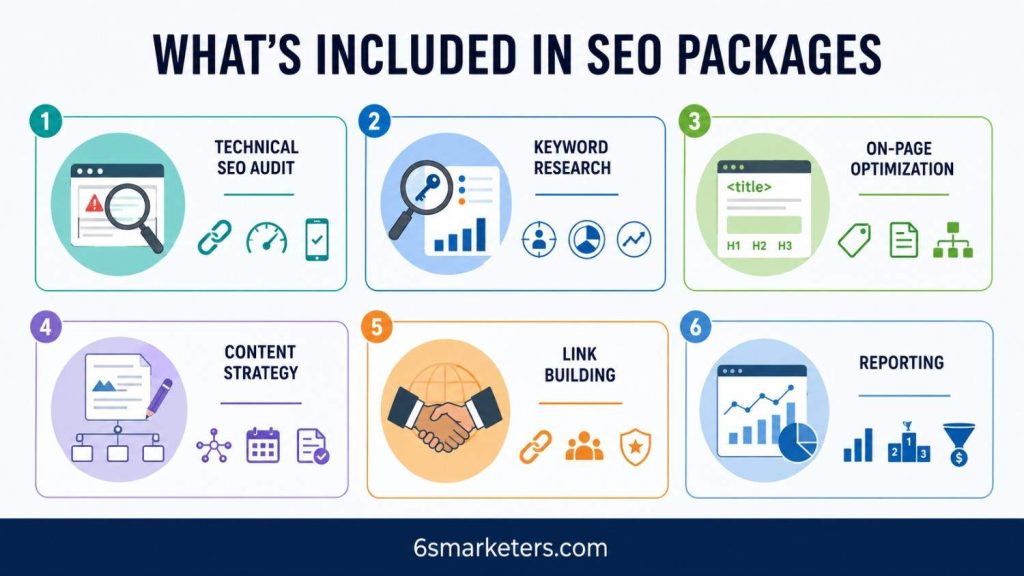
At a minimum, any credible engagement should include:
- Technical SEO Audit: Crawl errors, Core Web Vitals, mobile usability, indexation gaps. If this isn’t month one, ask why.
- Keyword Research: Not just a list of keywords — intent mapping, competitor gap analysis, and long-tail opportunity identification tied to your actual funnel.
- On-Page Optimization: Title tags, meta descriptions, header hierarchy, internal linking. The basics that many “entry-level” packages claim to include but rarely finish properly.
- Content Strategy: Topic clusters, editorial planning, and existing page optimization. Content without strategy is just publishing.
- Link Building: Outreach-based acquisition from relevant, authoritative domains. Not directory submissions. Not link exchanges.
- Reporting: Traffic, rankings, and conversion attribution — tied together. A report that shows rankings going up while leads stay flat is missing half the picture.
One thing worth calling out specifically: “500 directory submissions” appearing in a 2026 SEO package is not a deliverable. It’s filler. Any vendor still leading with submission-based link building hasn’t updated their approach since 2015.
Explore what a full-service SEO engagement actually looks like before committing to any scope.
Red Flags to Avoid
These aren’t warnings pulled from a checklist. These are things that come up repeatedly in the Indian SEO market — sometimes subtly, sometimes not at all.
Guaranteed #1 rankings
This one should end the conversation immediately. Nobody controls Google’s algorithm. An agency promising position 1 is either planning to use tactics that will eventually earn you a manual penalty, or they’re defining “ranking” in a way that doesn’t match what you’re thinking. Either way — walk away.
No written scope
“We’ll take care of everything” is not a contract. If a vendor can’t give you a clear list of what they’re doing each month, they’re unlikely to be accountable for it either. Get it in writing before anything else.
Backlinks from anywhere and everywhere
Link building is still one of the highest-leverage SEO activities — but volume without relevance is dangerous. Spammy link profiles trigger manual actions from Google that take months to recover from. Ask specifically where their links come from and how they qualify prospects.
No technical work in the first month
If month one is meta tags and keyword research only, that’s a flag. Technical SEO issues — crawl errors, indexation problems, site speed bottlenecks — often have the most immediate ranking impact. A strong team prioritizes this early.
Reports full of impressions, short on outcomes
Impressions climbing while clicks stay flat means something structural is broken — poor title tags, wrong keyword targeting, or zero CTR optimization. Don’t accept a report that doesn’t connect activity to business results.
How to Choose the Right SEO Plan
Don’t start with the package. Start with the problem you’re trying to solve.
A few questions worth answering before any vendor conversation:
- What’s the actual goal — leads, e-commerce revenue, brand authority? Each requires a different SEO architecture.
- How competitive is your category? Open an incognito tab, search your primary keyword, and look at what’s ranking. How old are those domains? How much content do they have? That’s what you’re up against.
- What’s your organic baseline today? Existing traffic, backlink profile, and indexed pages — all of this shapes the scope required.
- Can you produce content internally, or does that need to be part of the retainer? This affects the cost significantly.
Here’s where most businesses go wrong: they pick an SEO cost per month in India based on what feels reasonable, rather than what the competitive gap actually requires. A ₹15,000/month retainer for a SaaS company chasing “project management software India” is not a conservative choice — it’s a wasted spend. The keyword is too competitive for that budget to move anything.
The right investment level is the one that matches your category difficulty and your timeline expectations. Anything below that threshold isn’t SEO — it’s the appearance of SEO.
Connect with a team that can properly assess your current organic position and map out what’s actually needed — not just what fits a standard package tier.
Conclusion
Here’s the blunt version: SEO pricing in India is not arbitrary — but it is widely misunderstood. Businesses that treat it as a commodity expense tend to cycle through vendors every eight or nine months, frustrated by flat results and vague reports. The ones that treat it as a growth channel — with a scope matched to their actual competitive landscape, realistic timelines, and outcome-linked accountability — see a very different story.
The question to ask isn’t “What’s the cheapest SEO package?” It’s “What does it actually take to win organic traffic in my category, and am I funding that?” Those are different questions. The second one leads to better decisions.
Actionable takeaways:
- Get a technical audit before committing to any monthly retainer.
- Demand outcome-linked reporting — not just activity logs and ranking screenshots.
- Match your SEO investment to the keyword competition level, not to industry averages.
- When evaluating agencies, ask about their execution process — not their case studies.
What’s the biggest pricing or quality mismatch you’ve run into when evaluating SEO vendors in India? It’s a conversation the business community doesn’t have openly enough — would like to hear it in the comments.
External Reference