

Introduction to Ad Creatives
Every individual is overwhelmed by content. Each scroll, swipe, and tap is a moment they decide to stay or move off. In the year 2026, the level of budget burn compared to the level of actual growth is most often a factor of the ad creative strategy you follow.
To scale results, you cannot depend on targeting alone anymore. The real difference lies in your messaging, visuals, and story. Automation has evened the playing field for most advertisers. Yet the ad creative itself, or what people actually see, feel, and connect with, is still the one edge that’s difficult to replicate.
The reality? Most campaigns don’t fail because they reached the wrong people. They fail because the ad itself gave those people no reason to care.
If performance matters, creatives can’t be an afterthought. It has to be the strategy.
Key Takeaways
- Creatives bring the majority of performance outcomes.
- Attention spans demand instant visual clarity.
- Emotion influences clicks more than logic.
- Iteration beats perfection in ad performance.
- Platform context shapes creative effectiveness.
Why Ad Creatives Matter More
Advertising platforms have changed not just how ads are delivered, but how they choose who sees them.
The algorithms of the present day observe authentic behaviour: how long someone looks, whether they engage, and the relevance. Even if you have great targeting and bidding, a weak creative will still silently sink the campaign.
Things that happen backstage:
- Platforms are optimizing distribution, not persuasion
- Users are filtering faster than ever
- Creative fatigue sets in within days, not weeks
In this environment, high converting ad creatives are not about one “winning ad.” They’re about a system of constant testing, learning, and refreshing.
A strong ad creative strategy acknowledges this shift. It treats creatives as dynamic assets, not static deliverables.
Want to build campaigns that don’t just reach but convert? Connect with the campaign specialist
Key Elements of High-Converting Ad Creatives
Well-performing ads all have clear patterns in common. It’s not luck, it’s structure.
1. A Strong Hook (First 2 Seconds)
If the opening doesn’t stop the scroll, nothing else matters. The hook should disrupt expectation—visually or contextually.
2. Clear Value Proposition
Not features. Not claims. Clear, specific outcomes.
“What changes for me if I click?”
3. Native Platform Feel
The best social media ad creatives never seem like ads. They blend into the feed while subtly standing out.
4. Visual Simplicity
Clarity beats complexity. Overdesigned creatives often underperform because they demand too much cognitive effort.
5. Proof Over Promise
Testimonials, metrics, screenshots—anything that builds credibility wins attention and trust.
This follows with one deep truth that people don’t click because they understand your product. They click because they feel confident enough to explore it.
Psychology Behind Clickable Ads
Clicks are emotional decisions justified by logic—not the other way around.
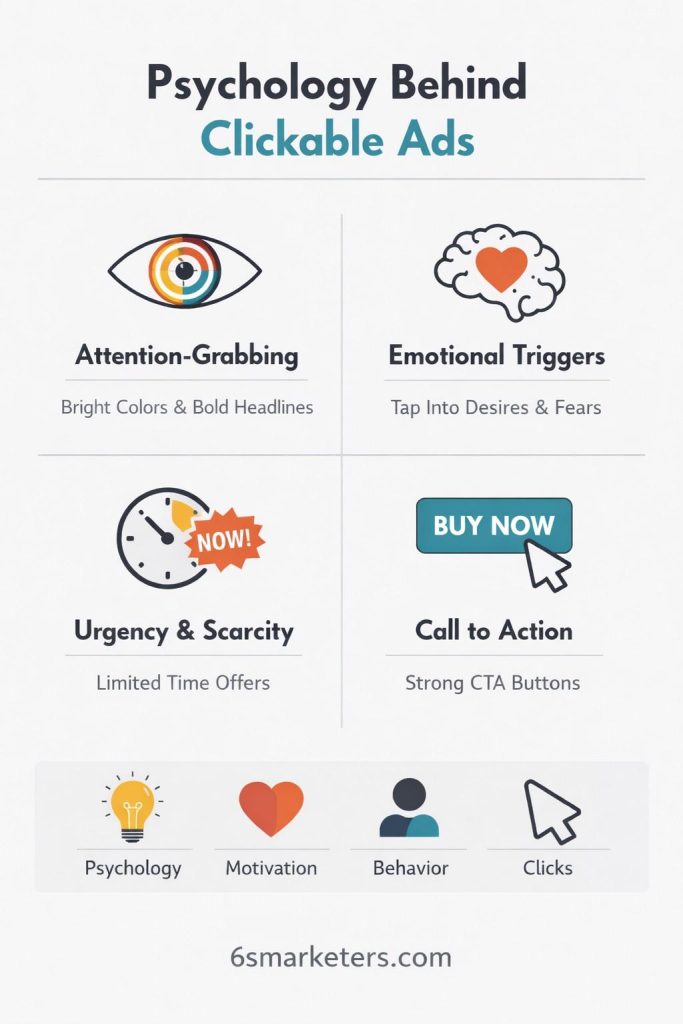
Here’s what actually drives action:
Curiosity Gaps
Ads that hint but don’t fully reveal trigger engagement.
Example: “Your advertisement is failing for this one reason…”
Pattern Interrupts
Unexpected visuals or statements break habitual scrolling.
Relatability
People click when they see themselves in the problem. Specificity increases relevance.
Cognitive Ease
The easier an ad is to process, the more likely it is to be trusted.
Social Proof
Numbers, usage stats, or endorsements reduce perceived risk.
Modern ad creative best practices are rooted in behavioral psychology—not just design trends.
If your ads aren’t performing or generating leads, it’s not about the targeting. It’s psychology.
Visual vs Copy: What Works Best
This debate is outdated. It’s not visual versus copy—it’s visual with copy.
Here’s how the balance works in 2026:
- Visuals stop the scroll
- Copy drives the decision
If your visual doesn’t capture attention, the copy never gets read.
If your copy doesn’t deliver clarity, then the click won’t take place.
But there’s a nuance:
- On short-form platforms, visuals carry more weight
- On high-intent platforms, copy becomes decisive
The real question isn’t which is more important. It’s whether they work together seamlessly.
Strong ad creatives treat visuals and copy as one unit—not separate components.
Platform-Specific Creative Strategies
One-size-fits-all creatives don’t perform anymore because each platform rewards different behaviors.
Meta (Facebook & Instagram)
- Relatable, user-generated style content performs best
- Short-form videos with quick hooks dominate
- Authenticity outperforms polish
Google Ads (Display & YouTube)
- Intent-driven messaging works better
- Clear value and direct CTAs outperform vague storytelling
For a deeper breakdown of platform performance dynamics: Google Ads vs Meta Ads for Lead Generation.
- Insight-led creatives perform better than emotional hooks
- Data points, industry trends, and strong opinions drive engagement
Remarketing Campaigns
- Focus on improvements, not awareness
- Address objections, not just benefits
Explore how remarketing ties into creative strategy:
Remarketing Strategies that Convert.
The best ad creative strategy adapts to platform psychology—not just format requirements.
Common Mistakes to Avoid
Even if you are experienced, you may fall into predictable traps.
1. Overloading the Message
Trying to say too much kills clarity.
2. Designing for Approval, Not Performance
Internal stakeholders aren’t your audience. The market is.
3. Ignoring Creative Fatigue
Performance drops fast when the same creative is overused.
4. Copy-Pasting Over All Platforms
What performs well on one platform often doesn’t perform on another.
5. Chasing Trends Blindly
Not every trend aligns with your brand or objective.
The biggest mistake? Treating creativity as a one-time task instead of an ongoing process.
If your creatives feel stagnant, it’s time to rethink the system. Connect with us.
Conclusion
In 2026, the edge doesn’t come from better targeting or bigger budgets. It comes from better creative thinking.
A strong ad creative strategy is not about finding a perfect ad. It’s about building a repeatable system that consistently produces high converting ad creatives.
The advertisers that win are those who:
- Test faster
- Learn quicker
- Adapt constantly
Because in a world where attention resets every second, relevance is the only currency that matters.
The question isn’t whether your ads are running. It’s whether they’re earning attention.