

You have not followed up. Potential prospects are visiting, exploring, and even showing interest in making a purchase. Then they just leave. It’s not that they don’t want to engage, but nothing is relevant enough to pull them in. It is the point at which most remarketing strategies fail.
By bombarding high-intent users with the same advertising that was shown when a user was less likely to buy, there is no context. What happened? Unwise expenses and lost income. Remarketing strategies that help convert do the opposite. They’re built around real user behavior and designed to re-engage with purpose, not just add more noise.
If your current remarketing strategy sounds like you are running behind the users instead of converting them, then you need to rethink how remarketing should work. Let’s find out more about remarketing plans.
Key Takeaways
- Remarketing converts high-intent lost visitors
- Segmentation drives relevance and ROI
- Timing matters more than frequency
- Creative fatigue kills conversion rates
- Personalization beats generic ad messaging
- Cross-channel remarketing amplifies results
- Data-driven optimization is non-negotiable
What is Remarketing
Remarketing is a strategy of digital marketing to reach out to users who’ve previously visited your website or engaged with your brand. They have been on your website, interacted with your content, or clicked on your ads, but have not converted.
By using Google Ads remarketing, you can show ads to these people when they browse the web, watch videos, or search again.
The objective is easy: you have to pick up where the buying journey dropped off and take it forward.
But here’s the nuance: remarketing works only when it feels like a continuation, not a repetition.
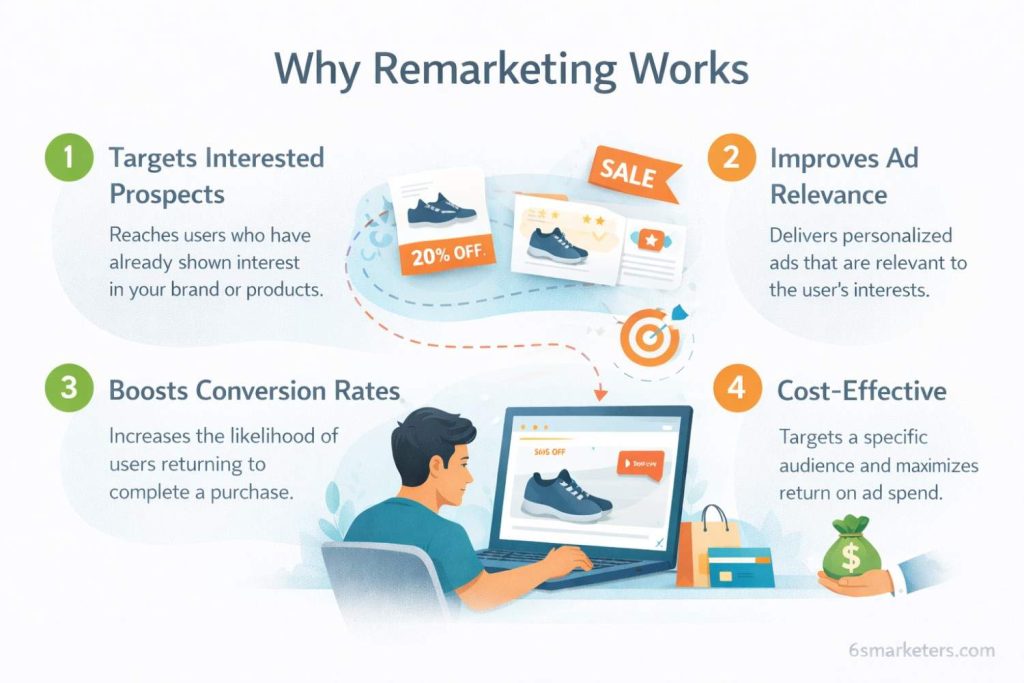
Why Remarketing Works
Remarketing works because it aligns with how decisions are actually made.
People usually don’t take action the first time. Buyers validate, compare, delay, and return, particularly in high-consideration purchases.
Effective remarketing strategies tap into three core fundamentals:
1. Intent is Already Established
You’re not targeting cold traffic. You’re engaging someone who already showed interest. That drastically reduces friction.
2. Familiarity Builds Trust
Repeated exposure—when done right—creates credibility. It signals consistency, not desperation.
3. Timing Captures Opportunity
The difference between a lost lead and a converted one is often timing. Smart remarketing ensures you show up when the intent resurfaces.
If your campaigns aren’t converting despite strong traffic, it’s worth revisiting your fundamentals: Connect with us.
Remarketing vs. Retargeting
These terminologies are frequently used interchangeably, but they’re not the same.
| Aspect | Remarketing | Retargeting |
| Definition | Re-engaging past users across channels | Typically ad-based targeting via cookies |
| Channels | Email, ads, CRM, social | Primarily display and paid ads |
| Approach | Broader, multi-touch strategy | More focused on ad delivery |
| Use Case | Lifecycle marketing, nurturing | Bringing back site visitors |
| Example | Email follow-up after demo | Display ad after product view |
In practical terms, remarketing and retargeting work best together. Retargeting brings users back. Remarketing nurtures them toward conversion.
Types of Remarketing Strategies
Not all remarketing is created equal. The strategy should match the intent stage.
1. Standard Remarketing
Targets all past visitors with generic messaging. Easy to implement—but often underperforms due to lack of personalization.
2. Dynamic Remarketing
This is where things get powerful. With dynamic remarketing examples, users see ads featuring the exact products or services they viewed.
This works because it removes decision friction. You’re not reminding them—you’re helping them continue.
3. Search Remarketing (RLSA)
With Google retargeting ads, you can adjust bids and messaging when past visitors search again.
This is high-intent territory. If someone returns to search, they’re closer to a decision than before.
4. Email Remarketing
Triggered emails based on behavior—like abandoned forms or incomplete actions—can outperform ads in certain cases.
5. Video Remarketing
Re-engage users who interacted with your video content. Great for storytelling and deeper persuasion.
Many campaigns fail because they rely on just one type.
If that sounds familiar, this breakdown will hit home: Why PPC Campaigns Fail.
Advanced Remarketing Tactics for Maximum ROI
This is where average campaigns separate from high-performing ones.
1. Segment by Behavior, Not Just Visits
A homepage visitor is not the same as someone who checked pricing.
Build segments like:
- Pricing page visitors
- Product viewers
- Cart abandoners
- Repeat visitors
Each needs different messaging.
2. Control Frequency Aggressively
Too many impressions kill performance. Users don’t convert faster—they tune out faster.
Smart campaigns cap exposure and rotate creatives.
3. Layer Intent Signals
Combine audience lists with contextual signals like:
- Search keywords
- Time since last visit
- Engagement depth
This creates precision targeting.
4. Sequential Messaging
Instead of repeating the same ad, tell a story:
- First ad: Problem awareness
- Second: Solution positioning
- Third: Proof or case study
- Fourth: Offer or CTA
This mimics a real sales conversation.
5. Align Landing Pages with Ad Context
Most remarketing campaigns fail here.
If your ad references a specific solution, your landing page must continue that exact narrative rather than redirect to a generic homepage.
If your SEO and paid efforts aren’t working together, you’re missing out on real revenue.
SEO and PPC Marketing Combine Strategies.
Platforms Specific Remarketing Strategies
Different platforms demand different approaches.
Google Ads
Google Ads remarketing remains the backbone for many businesses.
- Use audience layering for precision
- Combine display + search remarketing
- Leverage advanced bidding with intent signals
Detailed insights from industry data always show that combining automated bidding with well-segmented audiences enhances conversion rates significantly. This is only when inputs are clean and structured.
Facebook & Instagram (Meta)
The platforms work best for visual storytelling and mid-funnel engagement.
- Use video-first remarketing
- Retarget based on engagement depth
- Test short vs. long-form creatives
Higher cost, but stronger intent in B2B environments.
- Retarget website visitors with thought leadership
- Use lead gen forms for frictionless conversion
- Focus on credibility over urgency
YouTube
Underrated for remarketing.
- Target viewers who watched key videos
- Use minimal but high-impact messaging
- Reinforce brand authority
Looking to turn paid insights into organic growth? Discover how PPC Data to Improve Organic Traffic.
Common Mistakes You Can Avoid
Your remarketing campaigns are not failing because of the budget. The execution method is the reason.
1. Treating All Visitors the Same
No segmentation = no relevance.
2. Repeating the Same Creative
Ad fatigue is real. Performance drops faster than expected.
3. Ignoring Time Windows
A user from yesterday is different from one from 30 days ago.
4. Weak Value Proposition
“Come back” isn’t a strategy. Give a reason.
5. Poor Attribution Understanding
Remarketing is frequently undervalued because attribution models don’t show its true impact.
Conclusion
Remarketing is never about visibility. It is more about timing, context, and persuasion. The best remarketing strategies do not have to interrupt. They should continue the conversation.
They know that buyers don’t move in straight lines. They revisit, rethink, and re-evaluate. Your job is to meet them there with the precise relevance.
If your current approach feels like repetition, it’s time to rethink it as a journey. Because the difference between wasted spend and predictable conversions isn’t traffic—it’s how you follow up.
Ready to build remarketing that actually converts? Get help.
External Reference
Search Engine Land: Maximize Google Ads Remarketing Campaigns