

The February 2026 Discover Core Update, according to Google, is a very large update that changes how content appears in Google Discover, which is Google’s personalized feed. According to Google and industry reporting, this core update emphasizes enhancing content relevance, freshness, explanation, and trust signals within Discover rather than traditional blue-link rankings alone.
This article lays out what is different, why it is important, who it affects, and how to adjust. Plus, practical recommendations with real SEO workflows.
What is Google’s February 2026 Discover Core Update
The Discover Core Update, which was announced on 5th February 2026, is a Google core update to improve Discover’s ability to show content that aligns with user interests based on freshness, topical authority, and engagement signals.
The algorithm does not punish websites. It does re-weight content signals. So, some sites gain visibility, while others lose Discover traffic. That usually depends on content quality, relevance, and trust.
Key Takeaways:
- What Google’s February 2026 Discover Core Update actually changed
- Why Discover visibility now matters more than ever for brands
- Which sites and industries saw the biggest impact
- How Discover content signals are evolving under this core algorithm update
- How to accurately track Discover traffic in Google Search Console
- Proven recommendations to protect and grow Discover visibility
- How expert SEO agencies like 6S Marketers help businesses adapt confidently
What Is Google’s February 2026 Discover Core Update?
Google officially announced the February 2026 Discover Core Update as part of its ongoing efforts to refine personalized content discovery. Unlike traditional Google Search updates, this core algorithm update focuses specifically on how content appears in the Discover feed (where users scroll without actively searching).
According to Google, Discover aims to surface content that aligns with a user’s interests at the right moment, even before they search for it. This update strengthens that goal by reassessing how signals such as topical depth, freshness, engagement, and perceived expertise influence Discover eligibility.
Pages that perform well in Discover often show strong engagement metrics, visual appeal, and clear authority on a topic. The February 2026 update fine-tunes how Google evaluates those signals at scale.
Why This Update Matters for Businesses and Publishers
Discover is no longer an “extra” traffic source. For many publishers, Discover drives over 10–20% of total organic traffic, according to Search Engine Land reporting on past Discover-focused updates.
This Google core update matters because Discover traffic behaves differently. Users are not searching; they are browsing. That means brand perception, content timing, and emotional relevance play a bigger role. If your content drops out of Discover, impressions can decline overnight without any ranking changes in Google Search.
For businesses evaluating SEO agencies, this update highlights a key truth: modern SEO is beyond keyword rankings. It is about visibility across ecosystems like Search, Discover, and Google surfaces. Agencies that still optimize only for keywords will struggle to protect long-term growth after this core update.
Key Changes in the February 2026 Discover Core Update
Google did not release a checklist, but confirmed themes across official communication and industry analysis point to clear shifts. The February 2026 core algorithm update refined how Discover evaluates content across several dimensions.
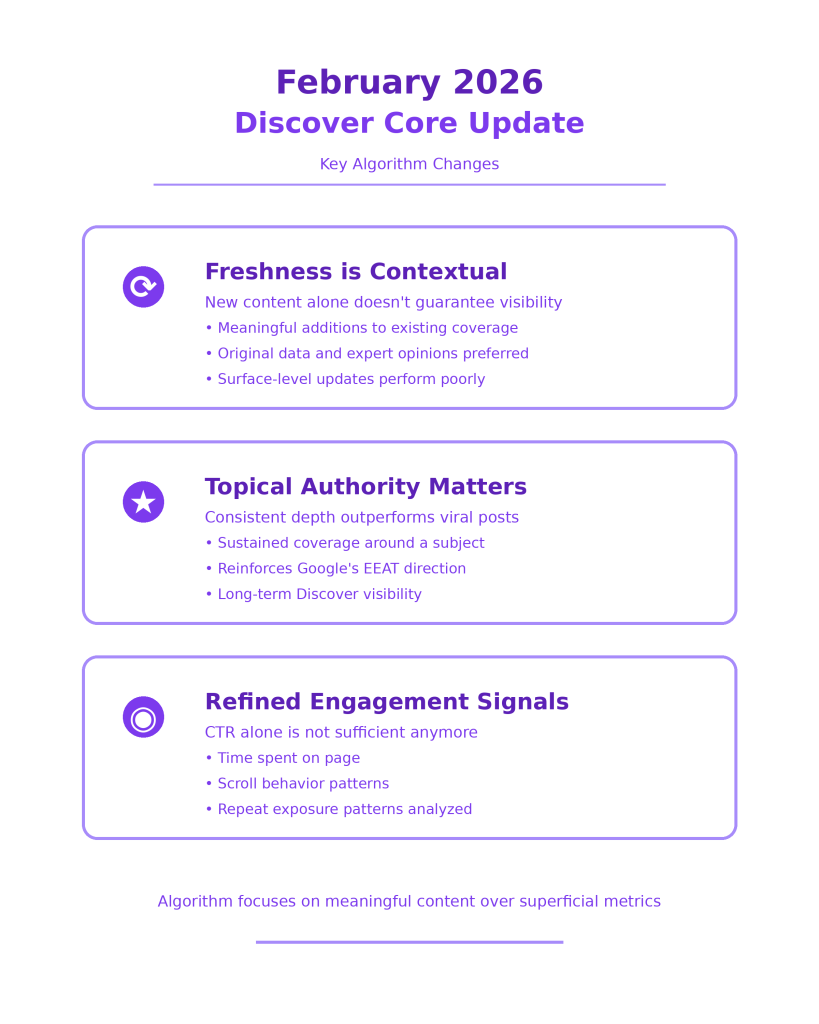
Freshness is now contextual, not absolute
New content alone does not guarantee Discover visibility. Rather, Google checks whether content meaningfully adds to existing coverage. Updated information, original data, or expert opinions perform better than surface-level updates.
Topical authority carries more weight.
Sites that demonstrate consistent depth around a subject—rather than isolated viral posts—are more likely to sustain Discover visibility. This reinforces Google’s broader EEAT direction across every core update.
User engagement signals are refined,
Only the click-through rate is not sufficient. Time spent, scroll behavior, and repeat exposure patterns now help Google decide whether content deserves continued Discover placement.
Which sites are most affected by this update?
According to Google, the February 2026 Discover Core Update mostly affects sites with a lot of content, especially newsy and trend-based sites. Publishers of news media, SaaS blogs, B2B thought leadership sites, and ecommerce brands with editorial sections all saw shifts after rollout.
Sites that relied on clickbait headlines or shallow summaries became volatile. Though these techniques could sometimes work before, with this Google core update, substance, clarity, and relevance matter more than hype. Discover users engage differently, and Google now reflects that behavior more accurately.
Brands that incorporate expertly led content, strong visuals, and a consistent publishing cadence are seeing more stable Discover traffic.
How Discover Content Signals Are Changing
Discover content signals now mirror Google’s broader quality framework—but with added emphasis on intent and emotion. The February 2026 core update aligns Discover more closely with real user curiosity rather than algorithmic triggers.
One major change is how Google interprets visual-first content. Images are no longer decorative; they influence eligibility. Clear, original, and contextually relevant visuals improve Discover performance. Generic stock images weaken content signals under this update.
Another change is author clarity and expertise. Google continues to reward content with transparent authorship, clear credentials, and real-world experience. This reflects EEAT principles already reinforced across every recent Google update.
How to Track Discover Traffic in Google Search Console
Tracking Discover performance remains straightforward—but interpretation matters more after this core algorithm update. Google Search Console offers a dedicated Discover Performance report for eligible sites.
In this report, focus on impression trends rather than daily clicks. Discover traffic naturally fluctuates, but sustained drops after the February 2026 update indicate content alignment issues—not technical SEO problems.
Also, review URL-level performance. Identify which topics gained visibility and which declined. This insight helps recalibrate editorial strategy based on Discover signals, not assumptions. Agencies that understand this nuance deliver far better outcomes after a core update.
Recommendations for Publishers After the February 2026 Core Update
To adapt effectively, publishers must move beyond reactive fixes. This Google core update rewards proactive strategy grounded in quality and relevance.
Start by auditing Discover-performing content. Identify patterns in topics, formats, and depth. Expand what works rather than chasing new trends blindly. Consistency now matters more than volume.
Next, strengthen topical authority. Publish clusters, not one-off articles. Link related content naturally. Show Google—and users—that your site deserves sustained Discover visibility.
If Discover traffic matters to your business, 6S Marketers helps brands align content, SEO, and authority signals with Google’s evolving standards. Connect with our team to build Discover-ready content strategies that scale with confidence.
Conclusion
For businesses searching for reliable SEO agencies, this update is a litmus test. Agencies that understand core update behavior, Discover dynamics, and EEAT principles deliver lasting value, not temporary spikes.
If your growth depends on organic reach, this is the time to get in touch.
External References
Google Releases Discover Core Update – Search Engine Land
February 2026 Discover Core Update – Search Engine Roundtable