

If you’ve spent any time in Google Search Console wrestling with regex filters just to separate your branded traffic from organic discovery queries, your life just got measurably easier. Let us learn more about “Google expands search console branded filter to all eligible sites”.
On March 11, 2026, Google confirmed that the Search Console branded queries filter is now available to all eligible sites. Originally announced at the Google Search Central event in Tel Aviv back in November 2025, this feature spent several months in a gradual rollout before reaching its full audience. For marketing leaders, content strategists, and SEO professionals who have long struggled to get a clean read on SEO branded vs unbranded performance, this is a meaningful upgrade — not just a checkbox feature.
Let’s break down what this actually means, why it matters, and how smart teams should act on it.
The Problem This Google Update Solves — And Why It Took So Long
Here’s a challenge every SEO team knows well: your traffic dashboard shows growth, but you have no idea whether it’s because your content is reaching new audiences or because your paid brand campaigns are just driving more branded searches. These two signals look identical in aggregate data — and they require completely different strategic responses.
The old workaround? Manually setting up regex filters inside Search Console to exclude or isolate terms containing your brand name. It worked, technically. But it was brittle, time-consuming to maintain, and impossible to scale — especially for brands with multiple product lines, regional naming variations, or common words embedded in their name.
Google’s GSC brand filter changes this by using an AI-assisted classification system that automatically identifies which queries are branded. It catches not just your exact brand name, but also misspellings, phonetic variations, and brand-related product or service names. If a user searches “Gogle” instead of “Google,” that still gets flagged as branded. If someone searches for “Gmail” without mentioning Google, the system still classifies it correctly.
That level of nuance is something regex simply couldn’t reliably deliver.
What the Search Console Branded Queries Filter Actually Does
The feature lives inside the Performance Report in Google Search Console. Once enabled for your property, you’ll see a new filter option that lets you toggle between branded and non-branded query views. The segmentation applies across impressions, clicks, click-through rate (CTR), and average position — giving you a complete picture of how each query type is performing.
A few important technical notes to set expectations:
The GSC brand filter is only available for top-level domain properties — not sub-properties like example.com/blog/ or subdomain-level properties. Sites with low impression volume don’t qualify either, as the AI classification system needs sufficient data to function reliably. Google’s John Mueller has confirmed these eligibility thresholds, and while the exact numbers haven’t been published, the guidance is clear: if your property has meaningful traffic, you almost certainly qualify.
The AI classification is automatic. You don’t define what counts as a branded query — Google’s system does, based on your brand identity, product associations, and query patterns. This is both a strength and a minor limitation: a handful of queries may be misclassified, particularly for brands whose names include common dictionary words (think “Apple” or “Square”). There’s currently no way to manually adjust classifications, though this is an area the community has flagged to Google.
Want to understand the mechanics behind how Google processes and classifies search data? This explainer is worth your time: How Google Search Works
Why SEO Branded vs Unbranded Data Is a Strategic Asset — Not Just a Reporting Metric
Let’s talk about the real business value here. When you can cleanly separate branded from non-branded traffic, you’re not just cleaning up a dashboard. You’re unlocking two fundamentally different conversations about your marketing performance.
Branded traffic tells you about loyalty and recognition. Growth in branded query volume typically signals that your brand awareness campaigns, PR efforts, word-of-mouth, or offline marketing is working. People who already know you are actively seeking you out.
Non-branded traffic, on the other hand, is your discovery engine. These are users who found you because your content answered a question, your page ranked for a relevant topic, or your SEO strategy surfaced at the right moment in the buying journey. For most businesses, non-branded traffic is where long-term sustainable growth lives — and historically, it’s been the harder number to isolate.
Consider a real-world example: a SaaS company runs a major brand campaign in Q4. Traffic spikes. Everyone celebrates. But is that spike coming from new audience discovery, or from existing users searching directly for the product by name? Without clean branded/non-branded segmentation, you genuinely cannot answer that question with confidence. With the Search Console branded queries filter active, the answer becomes visible in minutes.
This distinction also fundamentally affects how you allocate a paid search budget. Bidding on branded keywords serves a different purpose than bidding on non-branded terms. When your organic data is cleanly segmented, your SEM strategy gets sharper by default.
Google’s Take on Smarter Search Console Analytics
It’s worth zooming out for a moment. Google Expands Search Console branded filter isn’t happening in a vacuum. It’s the third significant analytics enhancement Google has shipped in quick succession.
In December 2025, Google introduced Query Groups, which allows you to organize search queries into custom-defined categories for comparative analysis. In February 2026, Google rolled out an AI configuration tool that lets users describe the performance reports they need in natural language — rather than manually building filter sets. And now, the branded queries filter completes a trio of updates that together make Search Console significantly more powerful for anyone trying to do serious SEO analysis.
The direction is clear: Google is investing in making Search Console a genuine analytics platform, not just a diagnostic tool. For teams that have relied on third-party tools or complex data exports to do basic segmentation work, these native capabilities reduce friction and cost.
That said, there’s a counterpoint worth acknowledging. AI classification systems, however sophisticated, introduce a layer of opacity. When regex does the filtering, you know exactly why a query was included or excluded. When AI makes the call, you’re trusting the model — and occasional misclassifications will happen. For high-stakes reporting, especially at the board or executive level, teams should treat branded query data as directionally strong rather than definitively precise, and cross-reference with their own keyword tracking setups.
How to Activate and Use the Filter — A Practical Starting Point
Access is straightforward.
Log into Google Search Console, navigate to Performance > Search Results, and look for the branded/non-branded filter option under the query filter controls.
If your site is eligible, the option will be visible. If it isn’t showing yet, confirm you’re looking at a top-level domain property and that your site meets the impression threshold.
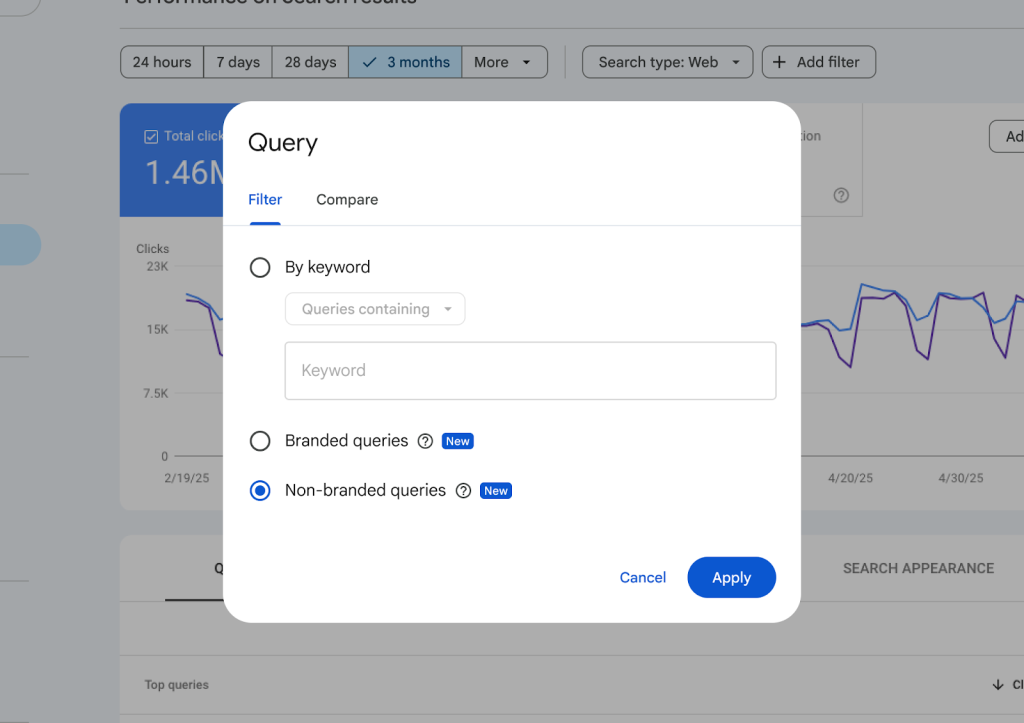
Once you have access, the highest-value first step is to establish a baseline. Run a 90-day view of your non-branded traffic and document your click volume, average position, and CTR by query type. This becomes your benchmark for measuring whether your content strategy is actually expanding your organic reach to new audiences.
From there, consider integrating this data into your regular SEO audits and monthly reporting cadence. The filter is most powerful when it’s not a one-time curiosity but a standing part of how you evaluate SEO performance over time.
For context on what Google originally announced when this feature first launched, see our earlier coverage: Google Search Console Added Branded Queries Filter
Actionable Takeaways for Marketing Leaders and Content Strategists
1. Audit your baseline now. Before the next campaign cycle, document your current branded vs non-branded traffic split. This gives you a clean reference point for future attribution conversations.
2. Recalibrate how you define SEO success. If your KPIs currently measure total organic traffic, build in a non-branded traffic goal as a separate metric. Non-branded growth is the truest signal of content strategy effectiveness.
3. Use branded query trends as a brand health indicator. Spikes in branded search volume often precede or follow major brand moments — product launches, press coverage, social virality. Tracking these trends over time gives your brand team a new signal to work with.
4. Align SEM and SEO teams around shared data. With clean branded/non-branded organic splits available natively, there’s no longer a credible reason for paid and organic teams to be working with fundamentally different datasets. Use this as an opportunity to build shared reporting.
5. Don’t over-rely on AI classification for executive reporting. Where precision matters most, supplement the GSC brand filter data with your own keyword tracking to validate the classification accuracy for your specific brand.
Conclusion
Google Expands Search Console branded filter access to all eligible sites is one of those updates that sounds incremental but carries real strategic weight. For teams that have spent years managing the branded vs non-branded problem through workarounds, this brings clarity that was previously expensive to maintain.
The feature isn’t perfect, the AI classification has edge cases, and eligibility requirements will leave some smaller sites on the sidelines for now. But for any brand with meaningful search volume, the ability to natively segment branded and non-branded performance data inside Google Search Console is a genuine upgrade to how you can understand and prove the value of your organic marketing efforts.
Need help with SEO services? Connect with us!
External Reference
Google Developers: Search Console Branded Filter
Search Engine Land: Google Search Console Branded Queriers Filter Expands