

For over two decades, the Google search box sat quietly at the center of the internet — a plain white rectangle that billions of people typed their questions into every single day. It barely changed. A few characters wide, autocomplete suggestions, and a button. That was it.
On May 19, 2026, at Google I/O, that era will end now!.
Google officially unveiled what it calls the Google Intelligent Search Box — and Liz Reid, Google’s Head of Search, described it as the biggest upgrade to the search box in over 25 years. This isn’t a cosmetic refresh. It’s a structural rethinking of how search works, how users interact with it, and critically, what it means for every business that relies on organic traffic to grow.
If you’re leading marketing at a scaling digital business — fintech, ed-tech, e-commerce, travel, real estate, or marketplaces — this update will reshape how your customers find you. And the businesses that understand this shift early will have a meaningful advantage.
Key Takeaways
- Google’s search box just got its biggest-ever AI upgrade.
- AI Mode now has over one billion monthly users globally.
- Queries are doubling every quarter inside AI Mode.
- Conversational search is now the default, not the exception.
- Zero-click results will likely rise — content strategy must evolve.
- Google recommends being citable, not just rankable.
- Structured, authoritative content is now your most important SEO asset.
- SEO strategies need to shift from keyword ranking to AI visibility.
What Is the New Google Intelligent Search Box?
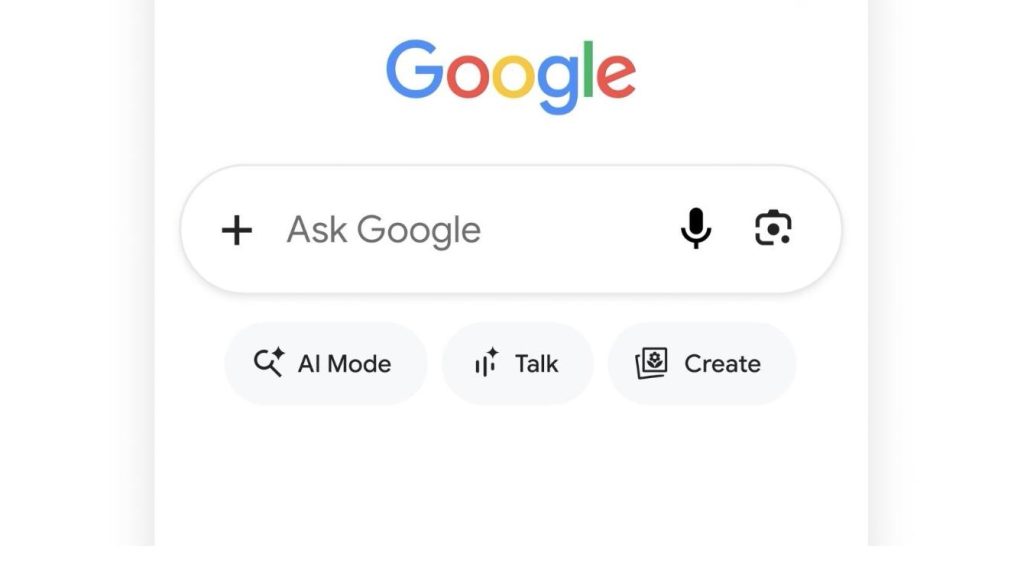
Think of it this way: the old search box was a form field. The new one is a conversation starter powered by your most sophisticated AI model yet.
Google has redesigned the search box to give users space to ask longer, deeper, more complex queries — expanding dynamically as a user types. It includes AI-powered suggestions that go well beyond traditional autocomplete, helping users formulate the right question before they even finish asking it.
And it doesn’t stop at text. Users can now search using text, images, files, videos, or even open Chrome tabs as inputs. That means a user planning a home renovation can upload a photo, describe a budget, and get a synthesized, multi-source answer — without ever clicking through to a single website.
This is the Google AI Search box. And for the first time, the entry point to Google Search feels less like a search engine and more like an intelligent assistant.
Features of the AI-Powered Google Search Experience
The new Google generative AI search experience bundles several powerful capabilities into one unified interface:
- Dynamic query expansion — the box physically grows as your query grows, signaling Google’s intent to handle longer, paragraph-length prompts rather than fragmented keywords.
- Intent-anticipating suggestions — unlike autocomplete (which predicts what you might type next), the new AI-powered suggestions help users structure better questions. It’s the difference between “best credit card” and “what’s the best credit card for someone who travels frequently and spends a lot on dining in India.”
- Multimodal input — text, images, files, videos, and Chrome tabs are all valid inputs. For industries like real estate or travel, this is especially relevant. A user can upload a photo of an apartment they like and ask for similar listings in their budget range.
- Seamless flow into AI Mode — Google has made it simpler than ever to continue a conversation from an AI Overview directly into a conversational back-and-forth with AI Mode, with context carrying over as users explore more deeply, and supporting links becoming increasingly relevant as the conversation deepens.
- Gemini 3.5 Flash at its core — Google upgraded Search with Gemini 3.5 Flash as the new default model in AI Mode for all users globally. This is not a lightweight model — it’s their frontier-level agent and coding model.
How AI Mode Changes Search Behavior — and What It Means for Google Search Changes in 2026
Here’s the number that should make every marketing leader sit up straight: AI Mode surpassed one billion monthly users just one year after its debut, with queries more than doubling every quarter since launch.
That trajectory is extraordinary. It means the majority of your potential customers are already searching in a way that may never bring them to your website at all.
The behavioral shift is clear. When someone asks a conversational Google Search query like “which ed-tech platform is best for upskilling mid-level finance professionals in India,” the AI generates a synthesized answer. It cites sources. It may not send the user anywhere. The search ends inside Google.
For an e-commerce marketplace or a fintech SaaS company running content marketing, this changes the fundamental metric you should be tracking. Ranking #1 is no longer enough if the AI answer never clicks through.
Now the question is beyond “can Google find my content?” It is more about “Does Google cite my content?”
Want to rethink your SEO and content strategy for the AI Search era? Let’s talk — we work with scaling digital businesses across fintech, ed-tech, travel, and more.
SEO Impact of the Google Intelligent Search Box
The impact of the Google Search AI update 2026 on SEO is both direct and structural.
Direct impact: expect a further rise in zero-click searches. The new search box may lead to more people jumping to AI Mode sooner from traditional Google Search, leading to more AI Overviews with deeper answers — and fewer clicks to websites than before.
Structural impact: the nature of “ranking” is changing. Traditional SEO optimized for position in a list of ten blue links. Now you’re also optimizing for inclusion in an AI-synthesized paragraph. Those are very different games.
Businesses that have invested in thin, keyword-stuffed content will feel this pain acutely. If you have built genuine, in-depth subject matter with real expertise, original data, and first-person insights, then you will find yourself cited more often in AI responses.
This is where sectors like fintech and real estate have an inherent advantage, if they lean into it. A lending platform that publishes genuinely useful, data-backed content on EMI calculations or credit score improvement isn’t just doing content marketing — it’s building the kind of authoritative resource Google’s AI will lean on for answers.
What Google Recommends for Publishers in the AI Search Experience
Google’s own guidance, reflected across their I/O announcements and documentation, points consistently toward a few core principles.
Be genuinely useful. Google’s AI is trained to surface content that actually answers questions, not content that performs the appearance of answering questions. Padding, vague generalities, and formulaic listicles get filtered out.
Build structured authority. Use clear headings, organized content hierarchies, and schema markup. The AI needs to understand your content’s structure to extract and cite it accurately.
Think in topics, not just keywords. The Google AI Mode experience rewards topical depth. A travel company that covers “family travel to Rajasthan” thoroughly — budgets, logistics, seasonal advice, itineraries — is far more citable than one with ten thin pages targeting ten keyword variations.
Be citable, specifically. Include statistics, named experts, original data points, and clear factual claims. These are the elements an AI picks out to synthesize an answer.
How Businesses Should Adapt Their SEO Strategy for Google Search Changes 2026
The SEO strategies that worked in 2022 won’t carry you through 2026. Here’s what the shift actually demands.
- Move from keyword optimization to question optimization. Think about the full questions your customers ask — long, messy, contextual questions — and create content that answers them completely. Not in 300 words. In as much depth as the question deserves.
- Invest in original data and proprietary insights. AI responses heavily cite unique, hard-to-replicate information. If your business has internal data — transaction trends, user behavior, market patterns, publish it. A fintech company sharing data on how UPI adoption is changing spending behavior in Tier 2 cities in India is producing content that no AI will have elsewhere.
- Build for the citation, not the click. Structure your key pages so that a specific answer is easy to extract. Use concise, factual statements followed by elaboration. Lead with the answer, then provide the context.
- Optimize for AI Mode specifically. This means structured data markup, clear entity definitions in your content, and ensuring your brand is consistently referenced across authoritative third-party sources. Brand authority — not just topical authority — increasingly determines AI visibility.
Not sure how your current SEO setup holds up against the new AI search experience? Get in touch with our team and let’s do a strategic review.
Risks & Challenges for Websites in the AI-Powered Google Search Era
It would be dishonest to frame this purely as an opportunity without acknowledging the real tension here.
Traffic cannibalization is real. If Google synthesizes an answer from your content without sending users to your site, your content is being leveraged without the business benefit. That’s a genuine challenge, particularly for publishers and content-heavy businesses.
Attribution becomes murky. When a user gets an answer in AI Mode and then converts elsewhere, tracing the role your content played in the buyer journey gets harder. Businesses that depend on last-click attribution models will find their numbers increasingly misleading.
Brand perception without brand ownership. Your brand may be cited — but the framing is Google’s, not yours. A poorly phrased AI summary of your product could shape first impressions before a user ever sees your website.
Small and mid-sized businesses that lack the content depth or domain authority to be cited regularly face the very real risk of being effectively invisible in the new search paradigm, even if they currently rank well in traditional results.
The Future of Search After Google I/O 2026: Agents, Personalization, and Agentic Workflows
The Google Intelligent Search Box is not the end of the journey — it’s the beginning of a new one. What Google announced at I/O 2026 goes further than a redesigned input field.
Google introduced the concept of search agents — allowing users to create, customize, and manage multiple AI agents for ongoing tasks directly in Search. These information agents operate in the background, monitoring the web continuously to surface updates relevant to a user’s specific question or goal.
For a real estate marketplace, this means a prospective buyer can set an agent to notify them the moment a property matching their exact criteria hits the market. For a travel platform, it means customers can set a flight-price alert that synthesizes real-time data and delivers a recommendation — all without ever opening a browser tab.
Google is also expanding personal intelligence capabilities to nearly 200 countries and territories, allowing users to connect Gmail, Google Photos, and soon Google Calendar to their search context — giving AI Mode access to personal data to make responses more contextually relevant.
The search box has become the front door to an agentic ecosystem. This means your brand’s visibility won’t just depend on where you rank — it will depend on whether you’re the answer an agent recommends when asked.
Conclusion
The Google Intelligent Search box is not a feature update. It’s a paradigm shift. The search engine is becoming a conversational AI assistant backed by the world’s most comprehensive index, powered by Gemini 3.5 Flash, and capable of taking autonomous action on behalf of users.
For scaling digital businesses, whether in fintech, ed-tech, travel, real estate, or e-commerce, the window to adapt is now. The businesses building deep, authoritative, structured content today are positioning themselves to be cited, recommended, and discovered in an AI-first search world tomorrow.
Traditional SEO isn’t dead. But it’s no longer sufficient on its own. The businesses that will win are those that treat content as expertise made visible — and understand that in the age of the Google AI Search box, being helpful and being findable are, finally, the same thing.
Explore how 6s Marketers helps growth-focused businesses build search visibility in the AI era, from content strategy to technical SEO.
External Sources: