

Search just changed — quietly, but significantly. In May 2026, Google published its official guide for optimizing websites for generative AI features in Google Search, including AI Overviews and AI Mode. It’s not a set of tricks. It’s a philosophical shift in how Google wants publishers, content teams, and digital businesses to think about visibility in an AI-first search environment.
If you run paid acquisition at scale, manage an SEO function for a digital brand, or sit in a marketing leadership role, this guide directly affects how your content performs — and how your competitors will start eating your lunch if you ignore it.
Here’s what Google actually said, and more importantly, what it means for you.
Key Takeaways
- Traditional SEO remains the foundation for generative AI search.
- Google’s AI uses RAG to pull content from its core index.
- Non-commodity, first-hand content performs better in AI Overviews.
- llms.txt files and “chunking” content are confirmed unnecessary by Google.
- Crawlability and page experience still directly influence AI visibility.
- Structured data alone won’t guarantee placement in AI-generated responses.
- Inauthentic link-building and mentions won’t fool Google’s AI systems.
Google’s New Generative AI Search Guide: What It Actually Says
Google released this guide as a formal resource under Google Search Central, positioned alongside their SEO Starter Guide. That placement alone tells you something: this isn’t a bolt-on afterthought. Google is folding generative AI optimization directly into its core guidance for webmasters and content teams.
The guide addresses a fundamental anxiety that’s gripped digital marketers for the past two years: “Does SEO even matter anymore if AI is generating the answers?” Google’s answer is clear: yes, absolutely. Their generative AI features are built on the same ranking and quality systems that power traditional search.
Specifically, they rely on Retrieval-Augmented Generation (RAG) — a method where the AI doesn’t hallucinate answers but instead retrieves relevant, indexed web pages and then synthesizes a response from them.
This is not a small detail. It means your content needs to be indexed, crawlable, and quality-assessed by Google’s existing systems before it can even be considered for an AI Overview. You can’t “optimize for AI” without first optimizing for search.
Key Recommendations from Google for AI Search Optimization
Google’s core generative AI SEO best practices largely reframe what good SEO teams were already doing — but the framing clarifies why certain things matter more now.
The guide explicitly asks publishers to create non-commodity content. Google uses a contrast that’s worth sitting with: the difference between “7 Tips for First-Time Homebuyers” (commodity — available anywhere, adds nothing) and “Why We Waived the Inspection & Saved Money: A Deep Insights Into the Sewer Line.” This is non-commodity content. It is a specific, experienced perspective that only an expert who lived through it can write. AI systems are scanning for unique points of view, not summaries of what’s already been said.
The guide also emphasizes organizing content for human readers — clear headings, logical flow, and well-structured paragraphs. AI systems follow human readability patterns. If a person can quickly glance through your page and understand it, an AI can too.
How AI Overviews Impact SEO and Organic Visibility
AI Overviews are not stealing your traffic. That’s the counter-narrative Google pushes — users who click through from an AI Overview are more engaged, more likely to convert, more likely to spend time on-site. The argument is that AI Overviews filter out casual browsers and deliver higher-intent visitors.
Whether you fully buy that argument or not, the mechanics of AI Overviews optimization require you to be present in the index, cited as a reliable source, and produce content that adds something the AI itself can’t generate from thin air.
One thing most people miss: Google’s AI uses query fan-out, where a single user question triggers multiple related sub-queries behind the scenes. If someone searches “best payment gateway for Indian startups,” the AI may internally query “payment gateway latency India,” “Razorpay vs Cashfree comparison,” and “fintech API integration ease.” Your content doesn’t need to target every variation — but it does need to be substantive enough to surface across multiple relevant interpretations of your topic.
Understanding how GEO differs from traditional SEO is increasingly critical for teams managing digital acquisition in AI-first search environments.
What Google Says About Content Quality for SEO for Generative AI
This is where Google’s guide gets particularly pointed. They distinguish between content that is genuinely useful and content that looks like it was produced to game AI systems. And they have a name for the bad version: scaled content abuse.
Specifically, Google warns against creating separate pages for every “fan-out” query variation you can imagine. This is a tempting strategy — if the AI generates sub-queries, why not create a page for each one? Google’s guidance calls this out as a spam-adjacent tactic. Their systems have become better at understanding relevance even when exact keyword matches don’t exist.
The more defensible path is straightforward: write from experience. If you’re an edtech platform, write about what your instructors have seen work in specific cohort formats. If you’re in real estate, document an actual deal scenario. If you’re in fintech, analyze a real regulatory challenge your compliance team navigated. First-hand, specific, opinionated content is what AI systems are built to surface. Generic listicles are not.
Want to understand which SEO fundamentals still beat AI-generated search disruption? These SEO fundamentals still outperform AI-driven changes — and they align directly with what Google’s new guide recommends.
Technical SEO Recommendations for Generative AI Search
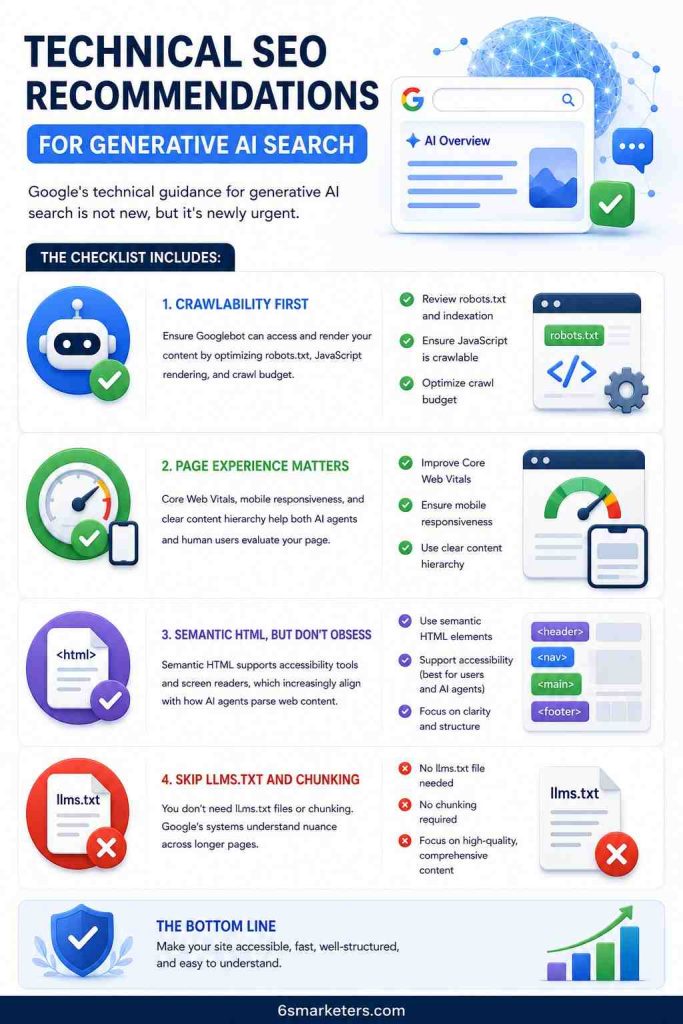
Google’s technical guidance for generative AI search is not new, but it’s newly urgent. The checklist includes:
- Crawlability first. If Googlebot can’t access and render your content, no AI system will include it in a response. This means revisiting your robots.txt, JavaScript rendering configuration, and crawl budget — especially for large e-commerce or marketplace sites with thousands of indexed pages.
- Page experience matters. Core Web Vitals, mobile responsiveness, and clear content hierarchy aren’t just ranking signals — they’re how AI agents (and human users) evaluate whether your page is worth processing. Google’s guide now explicitly mentions browser-based AI agents that analyze screenshots and DOM structures. A slow, poorly structured page fails both audiences.
- Semantic HTML, but don’t obsess. Google clarifies that perfectly valid HTML isn’t required — the web broadly isn’t valid HTML — but semantic structure helps screen readers and accessibility tools, which increasingly overlap with how AI agents parse web content.
- Skip llms.txt and chunking. Google’s guide directly debunks two widely circulated AI SEO myths. You do not need to create a llms.txt file. You do not need to break your content into small AI-digestible chunks. Google’s systems understand nuance across longer pages. These tactics are wasted effort that some agencies are actively charging clients for.
How Publishers Should Adapt to the Google Search AI Update
The most practical reframe from Google’s guide is this: stop optimizing for the machine and start optimizing for the satisfied visitor.
Google’s own heuristic for content decisions is asking: “Is this something my visitors would find satisfying after reading?” If the answer is yes, Google’s systems are designed to surface it. That simplicity is deceptive — it’s hard to produce genuinely satisfying content at scale. But it’s the correct direction.
For digital businesses managing multi-channel acquisition — paid + organic — this creates an interesting alignment. Content that satisfies a high-intent visitor also tends to convert better from paid channels. Good AI search optimization and good landing page strategy converge on the same principles: specificity, authority, and relevance.
Businesses exploring how to appear in ChatGPT and other AI-driven discovery surfaces will find that Google’s new guide covers parallel territory — and the content principles are nearly identical across platforms.
Ready to realign your content and SEO strategy with how AI search actually works? Let’s talk.
Common SEO Mistakes to Avoid in AI Search Optimization
Based on Google’s guide and patterns that are already visible in search performance data, here are the mistakes worth flagging:
Chasing inauthentic mentions
Some marketers are hiring services to generate blog references, forum posts, and “brand mentions” across the web, betting that AI systems will treat this as authority signals. Google addresses this directly — their spam systems apply to generative AI features too. Manufactured mentions don’t build the kind of topical authority that actually influences AI responses.
Treating structured data as an AI shortcut
Structured data remains useful for rich results and specific SERP features. But Google clarifies it isn’t required for AI Overviews, and there’s no special schema that unlocks AI placement. Overinvesting in schema while underinvesting in content quality is a misallocation.
Keyword-stuffing for “fan-out” queries
Creating thin pages targeting every possible sub-query variation Google’s AI might generate is the 2025 equivalent of keyword-stuffed content farms. It triggers spam policies, and it doesn’t reflect how AI ranking actually works.
Blocking Googlebot from rendering JavaScript
For SaaS platforms, marketplaces, and edtech products built on JavaScript-heavy frameworks, this is a live risk. If your content isn’t visible to Googlebot after rendering, it won’t be cited in AI responses.
Conclusion
Google’s new guide doesn’t offer a shortcut. It offers clarity. And what it makes clear is that the businesses best positioned for generative AI search are the ones already doing foundational SEO well — producing content rooted in real experience, maintaining clean technical structure, and building genuine topical authority over time.
The noise around AEO, GEO, llms.txt, and chunking is mostly a distraction. For marketing leaders managing acquisition efficiency in competitive digital verticals, the priority is simple: create content your specific audience would find genuinely satisfying, keep your technical house in order, and don’t let agencies sell you optimization tactics Google has explicitly debunked.
If your current SEO and content strategy can withstand the question — “Is this something only we could have written?” you are doing better than most.
Talk to us about building an AI search-ready content strategy for your business.
External Sources: