

Google’s AI Overviews now appear in roughly 47% of searches, according to data tracked by SE Ranking. ChatGPT crossed 400 million weekly active users in early 2025. Perplexity is expanding massively, which is making traditional search marketers worried. And yet, the majority of content strategies being executed right now are still laser-focused on ranking on page one of a ten-blue-links results page.
That disconnect is where answer engine optimization (AEO strategies) comes in — and frankly, it’s where the next wave of organic growth is being won or lost.
If your business operates in fintech, travel, real estate, edtech, ecommerce, or any marketplace model, this shift is happening to your category right now. The question isn’t whether AI answers will matter to your pipeline. It’s whether your content shows up in them.
Key Takeaways
- AEO targets AI-generated answers, not just rankings.
- Structured, direct content wins more AI citations.
- E-E-A-T signals heavily influence AI answer selection.
- Schema markup makes your content machine-readable.
- FAQ and conversational formats get featured more.
- Brand authority across the web improves AI visibility.
- AEO and SEO overlap but require different content logic.
What is AEO, and why does it matter for AI Overviews Optimization
Answer Engine Optimization is the practice of structuring and positioning your content so that AI-powered tools — Google’s AI Overviews, ChatGPT, Perplexity, Bing Copilot — pull from it when generating responses to user queries.
It’s distinct from SEO in an important way: traditional SEO puts your page in front of a person who then decides to click. AEO puts your content inside the answer itself — often without the user ever visiting your page. This can feel counterintuitive. Why optimize for something that might reduce your clicks?
The reality is more nuanced. Businesses that consistently appear in AI-generated answers build what’s essentially a reputation layer — one that influences trust, recall, and eventual purchase decisions. In B2B and high-consideration verticals, especially, being cited in an AI answer positions you as an authority before a prospect even reaches your website.
Explore how to appear in ChatGPT answers with this detailed breakdown.
How AI Search Engines Choose Answers
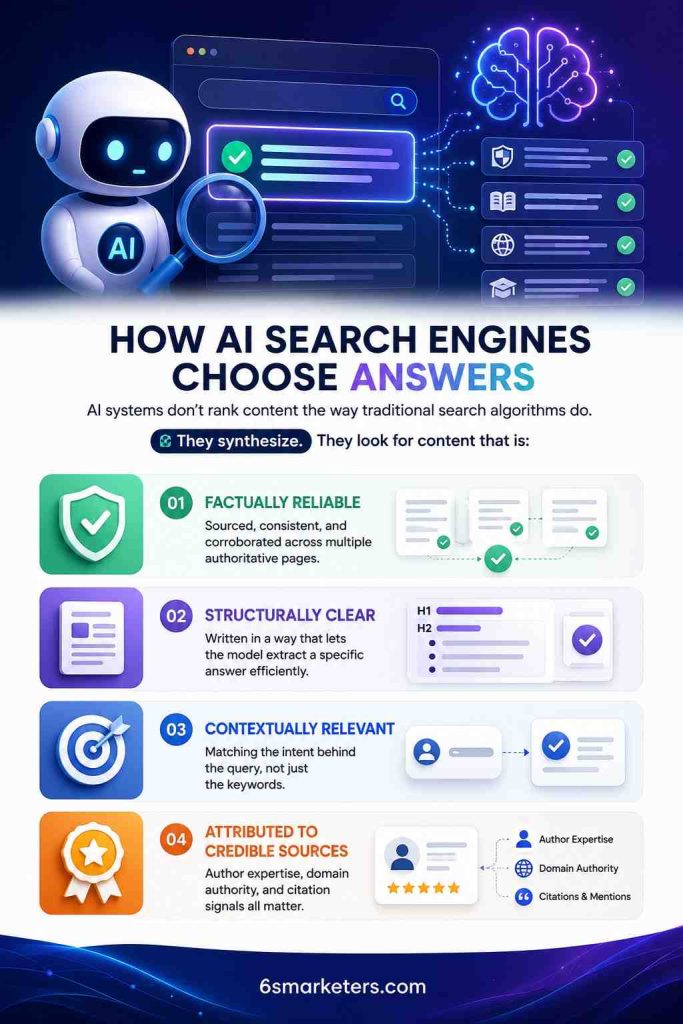
AI systems don’t rank content the way traditional search algorithms do. They synthesize. They look for content that is:
- Factually reliable — sourced, consistent, and corroborated across multiple authoritative pages
- Structurally clear — written in a way that lets the model extract a specific answer efficiently
- Contextually relevant — matching the intent behind the query, not just the keywords
- Attributed to credible sources — author expertise, domain authority, and citation signals all matter
Google’s systems, in particular, tie heavily into E-E-A-T (Experience, Expertise, Authoritativeness, Trustworthiness). ChatGPT and Perplexity pull from indexed web content and show a preference for content that is direct, well-structured, and widely cited or linked.
15 Proven AEO Strategies to Win AI Answer Mentions
1. Write Direct, Question-Led Content
Start sections with the exact question a user would type, then answer it in the first two sentences. Don’t write to answer; lead with it. AI systems prioritize content that delivers value immediately.
2. Use Structured Data Markup (Schema)
Implement FAQ schema, HowTo schema, and Article schema wherever applicable. This isn’t about gaming an algorithm — it’s about speaking the language AI systems use to parse and classify content. Google’s own documentation confirms that structured data helps Google better understand your page’s content.
3. Target Conversational Long-Tail Queries
Phrases like “how does EMI calculation work for home loans” or “what’s the best travel insurance for international trips from India” are the kinds of queries generating AI answers. Map your content to these — not just head terms.
4. Build Topical Authority
One comprehensive resource on a topic signals depth. A cluster of interconnected pages signals mastery. AI systems are increasingly rewarding sites that demonstrate end-to-end coverage of a subject — which is a structural editorial decision, not a one-time content task. Visit 6smarketers.com to explore how a full-funnel content strategy can be built for your vertical.
5. Add Real Author Credentials and Bios
Anonymous content is getting devalued fast. If a fintech blog is written by a professional with 12 years of lending experience, that expertise carries weight—not only with readers but also with AI systems evaluating E-E-A-T signals.
6. Get Cited on Third-Party Sites
When other credible domains reference your content, your authority score with AI systems improves. This means PR, digital earned media, co-authored pieces, and data studies that others naturally link back to.
7. Publish Original Data and Research
A report on, say, cart abandonment rates in Indian ecommerce that’s based on your own analysis? That becomes a primary source. Primary sources get cited. Original research is one of the highest-leverage AEO strategies available.
8. Optimize for “Definition + Depth” Pages
AI engines love content that defines a concept and then expands into nuance. A webpage answering the question, “What is dynamic pricing in travel?” that defines the term, explains the mechanics, offers real-world use cases, and addresses common misconceptions is structured precisely for AI answer extraction.
9. Keep Paragraphs Short and Answers Modular
Dense paragraphs are extraction-resistant. Short paragraphs, clear headers, and modular sections — where each subsection answers one distinct question — dramatically improve your chances of being quoted.
10. Refresh Content Regularly with Current Data
AI systems show a preference for recently updated content, especially on fast-moving topics. A 2021 guide on UPI payment trends in India is going to lose to a 2025 update that includes current stats. Treat evergreen content as a living document, not a published-and-forgotten asset.
11. Use FAQ Sections on Every Key Page
FAQs aren’t just good UX — they’re structured answer blocks that AI systems lift almost verbatim. Take the most common real questions your sales team hears and build FAQ sections around them.
12. Ensure Your Technical SEO is Solid
Fast load times, mobile-first design, crawlability — these affect whether your content even gets indexed properly. AI systems can’t feature content they can’t reliably access. This is table stakes.
13. Build Brand Mentions Across the Web
Citations in AI answers aren’t always hyperlinked. Unlinked brand mentions — in news articles, forums, review platforms, and industry publications — still contribute to the entity authority that AI models use to assess your credibility.
14. Align Content with the Full Buyer Journey
AI answers appear at different intent stages. Someone searching “best real estate CRM for developers” is further down the funnel than someone searching “how does real estate CRM work.” Your content architecture should address both, and AEO strategies should be applied at every stage.
Talk to 6smarketers about mapping your content to AI discovery.
15. Monitor Your AI Visibility, Not Just Rankings
Tools like Perplexity, ChatGPT, and Google AI Overviews can be manually tested to see whether your brand surfaces for key queries. Build this into your reporting cadence. You can’t improve what you’re not tracking.
AEO vs Traditional SEO: Understanding the Real Difference in AI Overviews Optimization
SEO puts you on a list. AEO puts you in the answer.
That’s a simplification, but it holds up. Traditional SEO is about visibility within a results page — click-through rate, ranking position, title, and meta optimization. AEO is about content architecture and authority signals that inform what an AI model chooses to synthesize.
They’re not in opposition. A technically sound, well-structured, authoritative page is good for both. But AEO adds a layer that SEO alone doesn’t address: the content needs to be written for extraction, not just discovery. A page ranking third on Google but hiding its key answer deep within the content may perform worse for AEO than a page ranking eighth that presents a clear, easily citable answer upfront.
The businesses winning at answer engine optimization right now, across fintech, travel, edtech, and ecommerce — are largely those that already invested in content depth and E-E-A-T. They’re not doing AEO as a separate effort. They’re adding precision to what they already built.
See which answer engine optimization companies are setting the standard.
Conclusion
Here’s where most content strategies stall: they treat AEO as a tactic rather than a structural shift in how content needs to be created, organized, and maintained.
The businesses that will win AI answer placement over the next two to three years won’t be the ones that published the most content. They’ll be the ones whose content infrastructure was built to answer questions clearly, demonstrate credible expertise, and earn trust across multiple touchpoints on the web.
If you’re scaling a digital business in India, the US, or Singapore — and you’re already running paid acquisition but feeling the pressure to improve organic efficiency — answer engine optimization is one of the highest-ROI investments you can make right now.
The AI answers being generated today are shaping how your potential customers understand your category. You can either show up in those answers or let your competitors define the narrative.
Ready to build an AEO strategy for your business? Let’s talk.
External Sources
- Search Engine Journal — A Step-By-Step AEO Guide For Growing AI Citations & Visibility.
- Google Search Central — Structured Data Documentation.