

A redesign is one of the most common reasons ecommerce rankings collapse overnight, and one of the most fixable. If your rankings dropped right after a launch, the cause is usually technical, not algorithmic, and it’s almost always traceable back to specific changes made during the process.
An ecommerce brand redesign touches nearly everything Google uses to rank a page: URLs, internal links, content depth, technical signals like canonical tags and indexing directives. Change enough of those at once, and even a better-looking website can lose rankings it spent years building. Most drops follow a predictable pattern with a predictable fix.
This playbook walks through the exact diagnostic sequence to find the cause, correct it, and restore your rankings.
Key Takeaways
- Most redesign-related ranking drops are fixable.
- Check Google Search Console first to confirm the drop date lines up with your launch date, not an algorithm update.
- Missing 301 redirects are the most common culprit.
- Content depth matters as much as design.
- Fix your highest-revenue pages first.
- Recovery speed depends on the cause.
The Brand, the Redesign, and What Went Wrong
A mid-sized Australian ecommerce retailer selling hiking and camping gear. An e-commerce brand relaunches its website on a new platform, moving from an ageing custom build to Shopify to modernise checkout and speed up page load times.

The new site looks sharper and loads faster. But in this illustrative scenario, three things happen during the migration that go unnoticed until after launch:
- The URL structure changes from /category/product-name to /collections/category/products/product-name, and only some of the old URLs get redirected
- Long-form buying-guide content on category pages gets replaced with shorter, more visual copy
- The old mega-menu’s internal links to seasonal collection pages don’t carry over to the new navigation
Within 10 days of launch, organic sessions drop by roughly 55% compared to the pre-launch baseline. This steep, sudden fall looks alarming on a traffic dashboard, but, as the diagnosis below shows, it traces back to identifiable, fixable causes. You may also explore the SEO checklist for website redesign.
Day 1–3: Emergency Diagnosis — What We Found
The first move is confirming the drop is actually redesign-related, not an algorithm update. Manual Actions in GSC show no penalty.
The technical audit over the next three days turns up four issues, in this order of discovery:
- Broken redirects: roughly 60% of previously indexed product and category URLs return a 404 instead of redirecting to their new equivalent
- Indexing errors: a batch of category pages carries a stray noindex tag left over from the staging environment — a common cause of pages silently dropping out of search entirely
- Thin content: the top 20 category pages by pre-launch revenue have roughly 70% less on-page content than before
- Lost internal links: the new navigation and footer no longer link to eight seasonal collection pages that previously ranked well
Ecommerce Brand Redesign: SEO Recovery Playbook: 8 Steps We Executed in Order
We worked through the issues in priority order. Starting with technical fixes first, since they’re fastest to implement and fastest for Google to recrawl, then content and structural fixes.
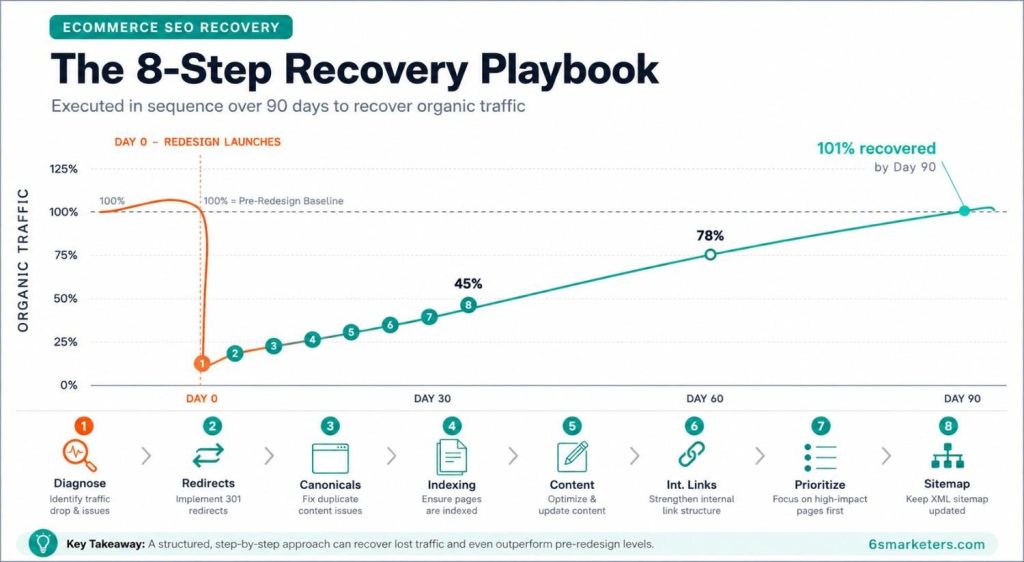
Step 1: Diagnose and confirm the cause (Day 1). GSC comparison of drop date vs. launch date, manual action check, and algorithm update check.
Step 2: Restore missing 301 redirects (Days 2–3). Mapped every old URL to its new equivalent and implemented redirects site-wide.
Step 3: Remove stray noindex tags and fix canonical URLs (Day 4) cleared the leftover staging directives; see Google’s own guidance on canonicalization for the underlying mechanics.
Step 4: Resolve indexing and crawl errors (Days 5–7). Resubmitted affected URLs for recrawl once the noindex issue was fixed.
Step 5: Restore lost content depth on priority pages (Days 8–14), rebuild buying-guide content on the top 20 category pages.
Step 6: Rebuild internal navigation links (Days 10–14, run in parallel), restored the eight seasonal collection pages to the main navigation and footer.
Step 7: Reprioritise and stabilise pages by revenue (Days 15–21), working down the list by pre-launch revenue contribution rather than by traffic volume alone.
Step 8: Resubmit sitemap and monitor full recrawl (Days 21–30). Submitted an updated XML sitemap and tracked indexing status in GSC through to full recovery.
SEO Ranking Drop Recovery Milestones: What We Fixed and When
| Step | Executed (Day X) | Immediate Impact | Traffic Recovery Contribution* |
| 1. Diagnose and confirm the cause | Day 1 | Root cause identified; no traffic change yet | 0% |
| 2. Restore missing 301 redirects | Days 2–3 | Google began recrawling redirected URLs | ~35% |
| 3. Fix canonical tags and noindex errors | Day 4 | Previously blocked pages became indexable | ~20% |
| 4. Resolve indexing and crawl errors | Days 5–7 | Category pages are fully crawlable again | ~10% |
| 5. Restore lost content depth | Days 8–14 | Search intent match improved on the top pages | ~15% |
| 6. Rebuild internal navigation links | Days 10–14 | Authority flowed back to priority pages | ~10% |
| 7. Reprioritise pages by revenue | Days 15–21 | Highest-value pages stabilised first | ~5% |
| 8. Resubmit sitemap, monitor recrawl | Days 21–30 | Full site reindexed | ~5% |
*Contribution percentages are illustrative estimates.
The Recovery Timeline: Traffic at 30, 60, and 90 Days
The organic sessions track back toward the pre-redesign baseline roughly as follows:
- Day 30: ~45% of pre-redesign organic sessions recovered: the redirect and indexing fixes are live, but Google hasn’t fully recrawled the site yet.
- Day 60: ~78% recovered: the content and internal-linking fixes have had time to take effect, and rankings on the highest-revenue pages are largely stable.
- Day 90: ~101% recovered: traffic slightly exceeds the pre-redesign baseline, which reflects the rebuilt content actually matching search intent better than the original pages did.
The shape of that curve, a fast partial recovery from technical fixes, followed by a slower climb driven by content and internal links, is a common pattern in real redesign recoveries, even though the specific percentages here are invented for illustration.
How an Ecommerce Brand Redesign Fueled SEO Recovery and Organic Growth
Regardless of the specific brand or platform, a few patterns tend to hold in real recoveries:
- Technical fixes buy you the fastest partial recovery, but they rarely get you all the way back on their own.
- Content depth is not optional: a page that answers less of the searcher’s question than it used to will usually rank lower, no matter how it looks.
- Internal links are a recovery lever, not just a UX decision. Restoring them redistributes authority back to the pages that need it.
- Recovery is not linear. Expect a fast initial jump from technical fixes, then a slower, steadier climb.
- The root cause is often organizational, not purely technical, as Search Engine Land has pointed out, ranking problems frequently trace back to decisions made outside the SEO team, which is why SEO needs a seat at the table during redesign planning, not just cleanup after launch.
- Recovery doesn’t mean traffic is a lost cause during the process; organic traffic is still growing for most brands willing to fix the underlying issue, rather than something to write off after a bad launch.
Conclusion
A redesign-related ranking drop looks alarming, but it’s rarely permanent. The pattern that matters is diagnosis before action: confirm the cause, fix the technical issues first, restore content and internal links, and prioritise by revenue rather than raw traffic.
Need help diagnosing an ecommerce ranking drop? Our SEO team can run a full technical audit and build your recovery plan.