

Every few months, a new wave of panic sweeps through marketing teams. “SEO is dead.” “AI killed search.” “Clicks are gone.” And yet, the data keeps telling a different story.
Organic traffic is not what it was five years ago. The SERP looks different. The user behaviour has shifted. But “dead”? Not even close. The brands growing through search right now aren’t the ones that gave up. They’re the ones who adapted fast, focused on what actually works, and stopped chasing old playbooks.
This post breaks down exactly what’s happening with organic traffic in 2026, and nine approaches that forward-thinking brands are using to grow it, right now.
Key Takeaways
- Organic traffic declined just 2.5% YoY, not the collapse headlines suggest.
- AI Overviews appear in 30% of searches, mostly informational queries.
- Largest websites grew organic traffic by 1.6%; size and authority matter.
- Organic clicks still dominate paid, roughly 90% vs. 10%.
- Content depth and E-E-A-T signals drive rankings more than volume.
- Zero-click optimisation is now a non-negotiable part of SEO strategy.
- Brand search and community content are powerful new organic growth levers.
The State of Organic Traffic in 2026
Let’s start with the actual numbers, because the narrative has outrun reality.
A large-scale analysis by Graphite using Similarweb data from more than 40,000 of the largest U.S. websites found that organic search traffic declined just 2.5% year over year, a far cry from the 25% to 60% collapses being cited in some corners of the marketing world.
The trend breaks down sharply by site size. The top 10 largest sites actually grew organic traffic by around 1.6%. The steepest declines happened in the middle sites ranked roughly between positions 100 and 10,000.
What does this tell us? Scale and authority are compounding advantages. If your brand has invested in topical depth, trust signals, and consistent publishing, the algorithm is still rewarding that. If you’ve been producing thin content to chase volume, yes, you’re feeling the squeeze.
AI Overviews do reduce click-through rates when they appear, but their presence is more limited than many assume. They show up in roughly 30% of searches, and those are predominantly informational queries, not commercial or transactional ones.
For B2B brands targeting buyers in consideration or decision mode? That’s actually good news.
So, Is Organic Traffic Really Dead?
No. But it’s fragmenting, and that distinction matters enormously for how you allocate budget and effort.
Search engine traffic overall grew 0.4% in 2025. Google traffic specifically rose 0.8%. And organic results still account for approximately 90% of all search clicks, compared to just 10% for paid ads.
The real shift isn’t death, it’s distribution. More towards SERP features, AI-generated answers, and competition for visibility on informational queries. The brands losing ground are those that have an entire strategy on high-volume, low-depth content. The brands winning are those who build content that answers real questions from real buyers at every stage of the funnel.
Here’s the honest trade-off: informational organic traffic has gotten harder to convert because users are increasingly getting answers without clicking. But transactional and commercial intent traffic? Still very much alive, still very much valuable.
9 Ways Brands Are Growing Organic Traffic in 2026
1. Prioritising Depth Over Breadth in Content Strategy
The era of “publish more” is over. What’s working now is publishing less, but making each piece genuinely authoritative.
One B2B SaaS brand in the project management space trimmed its blog output by 40% in 2025 and focused resources on building 10 comprehensive pillar pages with supporting cluster content. Within six months, those 10 pages were driving more organic traffic than their previous 80-post archive combined.
The lesson: Google’s Helpful Content system rewards topical completeness. A single page that covers a topic end-to-end with examples, data, practical steps, and a clear structure always outperforms five shallow posts on the same theme.
Build an SEO content strategy that drives leads around depth, not volume.
2. Optimising for Zero-Click and Featured Snippet Visibility
Zero-click searches feel like a loss, but they’re actually a brand-building opportunity. When your content consistently appears in featured snippets, AI Overviews, and People Also Ask boxes, you build familiarity even without the click.
Several enterprise brands are now explicitly writing “snippet bait” sections: short, direct answers in 40-60 words immediately below each subheading. The structure signals to Google that this block is a complete, self-contained answer.
This is how to increase organic search traffic to your website indirectly through visibility that drives brand searches downstream.
3. Using Brand Search as an Organic Growth Signal
Here’s something most content strategies ignore: branded search volume is itself an SEO signal. When users search for your company name directly, Google interprets that as a trust signal, and it influences how your non-branded pages rank.
Several demand gen teams are now running LinkedIn thought leadership campaigns not to drive direct traffic, but to increase branded search. The downstream effect on organic traffic is measurable and often underreported in attribution models.
4. Building Topical Authority Through Structured Clusters
Random publishing hurts more than it helps. What works is a structured content cluster, one pillar topic, multiple supporting subtopics, all internally linked to a central hub.
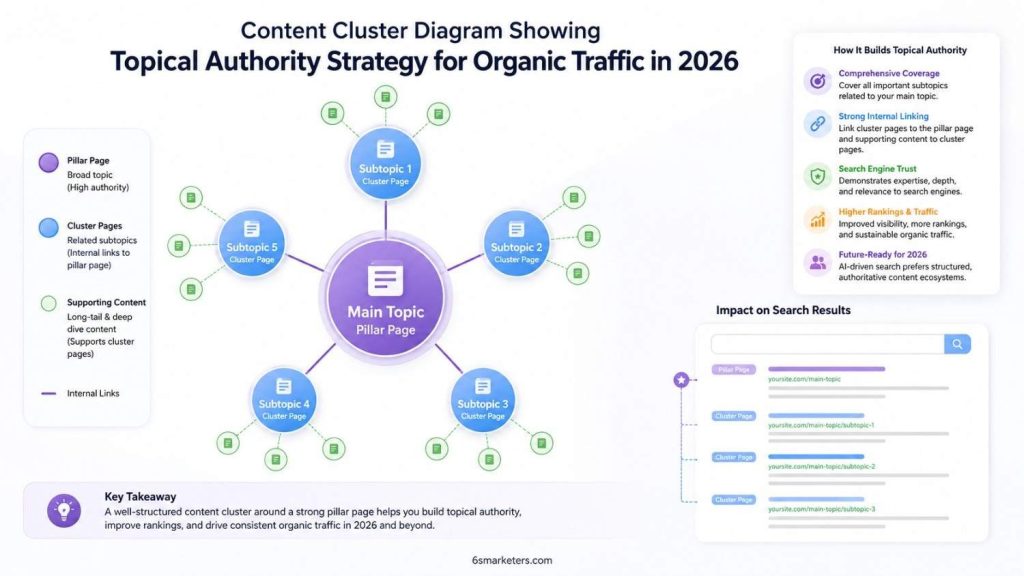
A professional services firm targeting CMOs built a cluster around “B2B demand generation” with 14 supporting articles. Within four months, the pillar page ranked on page one for six high-intent queries, none of which it had targeted before. The cluster created enough topical mass that Google began associating the domain with authority on that subject.
This is the foundation of any serious approach to how to grow organic traffic in competitive B2B markets.
5. Investing in Original Research and Proprietary Data
Nothing earns backlinks, citations, and authority like data nobody else has.
Brands that commission original research, even small studies, and publish the findings create content that others reference. That drives both links and brand awareness. In 2026, original data is the clearest differentiator in a sea of AI-generated content.
One content team ran a 200-person survey with their customer base, published the results as an annual report, and earned 140 referring domains within 90 days. That’s an organic traffic flywheel: links drive authority, authority drives rankings, rankings drive more traffic.
6. Optimising for AI-Assisted Search Without Abandoning Traditional SEO
AI Overviews tend to appear for informational queries, and commercial and transactional keywords are far less affected. So the playbook is to protect transactional rankings aggressively while adapting informational content to earn AI Overview citations.
What earns an AI Overview placement? Structured, factual, well-cited content. Short paragraphs. Clear answers. Named sources. The same E-E-A-T signals that help with traditional rankings also help with AI inclusion.
Smart brands aren’t choosing between traditional SEO strategies and AI search — they’re building content that works for both.
7. Leveraging Community and Forum Content for Organic Reach
Reddit, Quora, LinkedIn comments, and industry Slack communities are now ranking in Google results with significant frequency. Savvy brands are actively participating not with spam, but with genuine expertise.
A SaaS brand’s head of content started answering detailed questions in five niche LinkedIn groups and two Reddit communities in their space. Within three months, several of those posts ranked in Google for long-tail queries. The organic search traffic from community content costs nothing and builds trust in ways paid ads never could.
8. Refreshing Existing Content to Recapture Lost Rankings
One of the fastest ways to grow organic traffic is to stop ignoring what you already have. Content decay is real; pages that ranked well 18 months ago often slip as fresher, more comprehensive content enters the market.
A systematic content refresh programme, auditing pages by ranking position, updating statistics, expanding thin sections, and improving internal links, can recover significant ground in 90 days or less.
If you want to know how to get organic traffic to your website faster than publishing new content, start with what’s already ranking on pages two and three. Pushing those pages to page one is often far more efficient.
9. Integrating Technical SEO With Content Strategy
Great content on a slow, poorly structured website doesn’t rank. In 2026, technical SEO and content strategy have to be treated as one discipline, not separate workstreams.
Core Web Vitals, crawl efficiency, schema markup, and internal link architecture. These aren’t “IT problems.” They’re ranking factors. Brands that embed technical SEO thinking into their content calendar, considering indexation, page speed, and schema from the moment a brief is written, consistently outperform those that treat technical SEO as a quarterly cleanup task.
Work with a team that integrates both, explore our search engine optimisation solutions to see what a connected approach looks like.
Organic vs Paid Traffic in 2026 — Which Should You Prioritise?
Both channels serve different purposes at different stages. Here’s a clear comparison:
| Factor | Organic Traffic | Paid Traffic |
| Cost | Investment in time and content | Direct spend per click |
| Speed | Slower to build (3–6 months) | Immediate results |
| Longevity | Compounds over time | Stops when the budget stops |
| Trust | Higher — users trust organic results | Lower, users know it’s an ad |
| Scalability | Scales with authority | Scales with budget |
| Click Share | ~90% of all search clicks | ~10% of all search clicks |
| Best For | Long-term growth, brand authority | Launches, promotions, fast lead gen |
| AI Overview Impact | Moderate, affected by informational queries | Minimal on commercial intent |
The honest answer: you need both. But organic traffic builds the foundation that makes every other channel more efficient. Brands with high organic authority spend less on paid because their brand recognition converts better.
How to Measure Organic Traffic Growth the Right Way
Most marketing teams measure organic traffic by raw sessions. That’s incomplete. Here’s what actually matters:
- Measure by intent segment. Split your organic traffic into informational, navigational, and transactional. Declining informational traffic is less alarming than declining transactional traffic.
- Track rankings by cluster, not individual keywords. If your B2B demand generation cluster is gaining positions across 20 related queries, that’s more valuable than one keyword moving from position 8 to 6.
- Watch branded vs. non-branded organic separately. Growth in branded search is often evidence that your content and campaigns are working — even if it doesn’t show up in standard SEO reporting.
- Use Google Search Console as your primary source. Third-party tools estimate traffic. Google Search Console shows you actual impressions, clicks, and click-through rates from Google’s own data. For a full breakdown of how to use it effectively, Google Search Console’s official documentation is the most reliable reference.
- Set a 90-day baseline before concluding. Organic traffic fluctuates. Algorithm updates, seasonal patterns, and indexing delays all create noise. Trend lines over 90+ days tell you what’s actually happening.
Conclusion
Organic traffic isn’t dead. It demands more expertise, depth, trust, and strategic thinking than it did three years ago. That’s not a crisis. It’s actually a barrier to entry that rewards brands that invest seriously.
The nine approaches outlined here aren’t theories. They’re what’s working for brands right now, in markets where competition is intense, and budgets are scrutinised. The brands winning organically in 2026 are the ones who stopped treating SEO as a volume game and started treating it as an authority-building discipline.
If your organic growth has stalled and you’re not sure where to start, get in touch with our team and let’s build a strategy that compounds over time.
External Sources:
- Search Engine Land — Organic search traffic is down 2.5% YoY, new data shows
- Google Search Console — Official Documentation