

A dental group in Birmingham called us last spring with a problem that did not sound like a problem. Three clinics. Rankings that had climbed all year. Organic traffic is up nearly 60% over eighteen months. On every dashboard the founder opened, the arrows pointed up.
The chairs told a different story. New patient bookings had barely moved. Two years of budget had gone into building visibility, and the visibility was real. It just was not turning into appointments. That gap between visits and bookings is where a lot of SEO strategy for dental practices falls apart, and it is exactly where we asked them to stop and rethink the whole approach.
So we gave them advice their previous agency would have hated: stop chasing more traffic. The traffic was already there. The job now was to convert it. Here is what we changed, what was behind each decision, and what happened over the next 90 days.
Key Takeaways
- Traffic without bookings is a conversion problem.
- Google Business Profile drove the biggest gains.
- Service pages must target booking intent.
- Local schema helped clinics surface faster.
- Removing booking friction lifted conversions immediately.
- Consistent reviews rebuilt trust across all clinics.
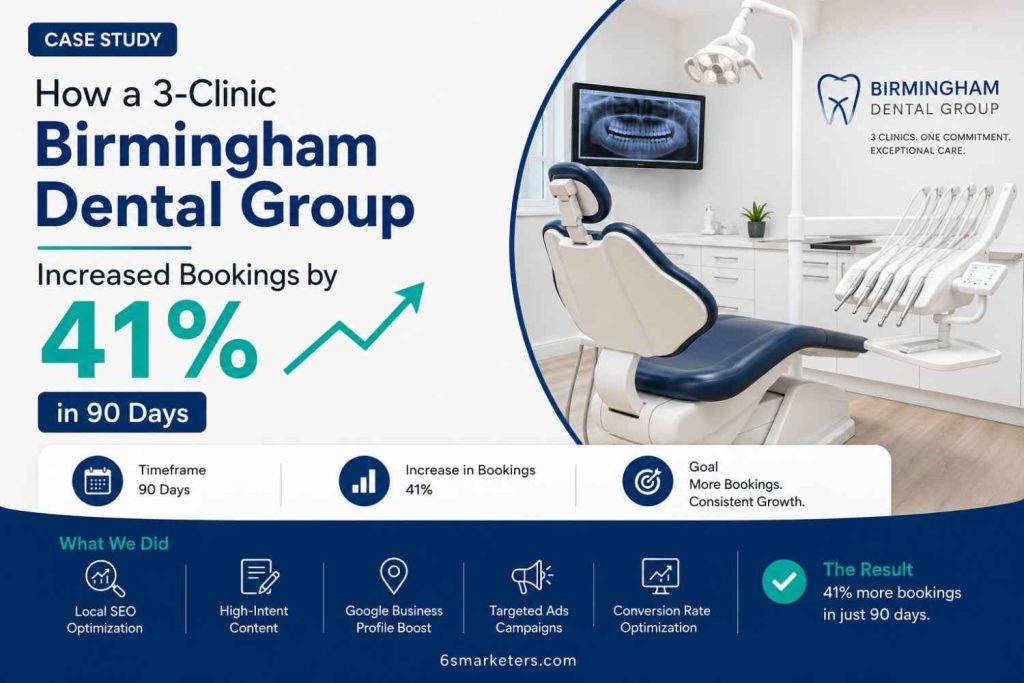
Over 90 days, we moved a three-clinic Birmingham dental group away from traffic growth and toward booking conversion. An audit showed strong rankings sitting on top of a weak local presence: confusing service pages, missing schema, thin reviews, and a clunky booking flow. We rebuilt the Google Business Profile for each clinic, restructured service pages around patient intent, added local schema, launched a review system, and stripped friction out of the booking process. Traffic stayed roughly flat. New patient bookings rose 41% across the three locations by day 90. Below is the full playbook that covers the fixes, the reasoning, the sequence, and the numbers, so any multi-location practice can see where the real gains hide and how to reach them without spending more on traffic.
A 3-Clinic Dental Group with a Traffic Problem
The group ran three clinics across Birmingham, each with its own catchment, its own competitors, and its own reputation locally. General dentistry paid the bills. Implants and cosmetic work were where the founder wanted to grow. All three sites shared one website and, as it turned out, one set of blind spots.
Their previous agency had done what a lot of agencies do: published blog posts, chased keywords, and reported healthy-looking sessions every month. The founder only started asking questions when the accountant did. Traffic was up. Revenue per clinic was flat. Something in the middle of the funnel was leaking, and nobody had gone looking for the hole.
That is the trap with dental marketing. Rankings feel like the finish line. For a local practice, they are closer to the starting gun.
What the Audit Revealed: Traffic Was Fine. Everything Else Wasn’t.
We spent the first ten days pulling the whole thing apart. The traffic audit came back clean, genuinely clean. Good rankings for the terms that mattered, decent authority, no technical disasters. If the goal had been visibility, the job was already done.
Everything downstream of the click was a mess.
The Google Business Profiles were a wreck. Two clinics had duplicate listings floating around. One had the wrong opening hours. None had a booking link, and the photos were sparse and years old. With roughly half of Google searches carrying local intent, these profiles were doing almost none of the work they should have.
The service pages were worse. Three clinics, dozens of treatments, and a single generic “Our Services” page carrying all of it. Someone searching for implants in one part of Birmingham landed on a page that mentioned implants in passing, between whitening and check-ups. No local signal. No clear next step. No reason to book here over the practice down the road.
There was no local schema anywhere on the site. Reviews were thin and, worse, mostly unanswered — including a couple of unhappy ones sitting in plain view. And the booking process asked a nervous new patient to fill in a five-field form or call during office hours. Half of them did neither.
The Strategy Shift: From Traffic to Booking Intent
Here is the conversation we had with the founder. More traffic to a leaky funnel just fills the bucket faster while it drains out the bottom. The smarter move was to fix the funnel first, then let the existing traffic do more work.
That reframed the entire SEO strategy for dental practices that we put in front of them. We stopped measuring success in sessions and started measuring it in booked appointments per clinic. Every recommendation had to answer one question: Does this help a real person in Birmingham go from searching to sitting in a chair? If a task did not move that needle, it came off the list — including a content calendar the previous agency had lined up for the next six months.
Google’s own guidance points the same way. A complete, accurate Business Profile makes searchers far more likely to view a business as reputable and to actually visit. We treated that as the spine of the plan.
Want a second opinion on where your own funnel is leaking? Talk to our team, and we will walk through it with you.
What We Changed and Why (The Full Playbook)
Five fixes, run in sequence over 90 days. We led with the changes that were fast to ship and quick to convert, then layered in the ones that compound over time.
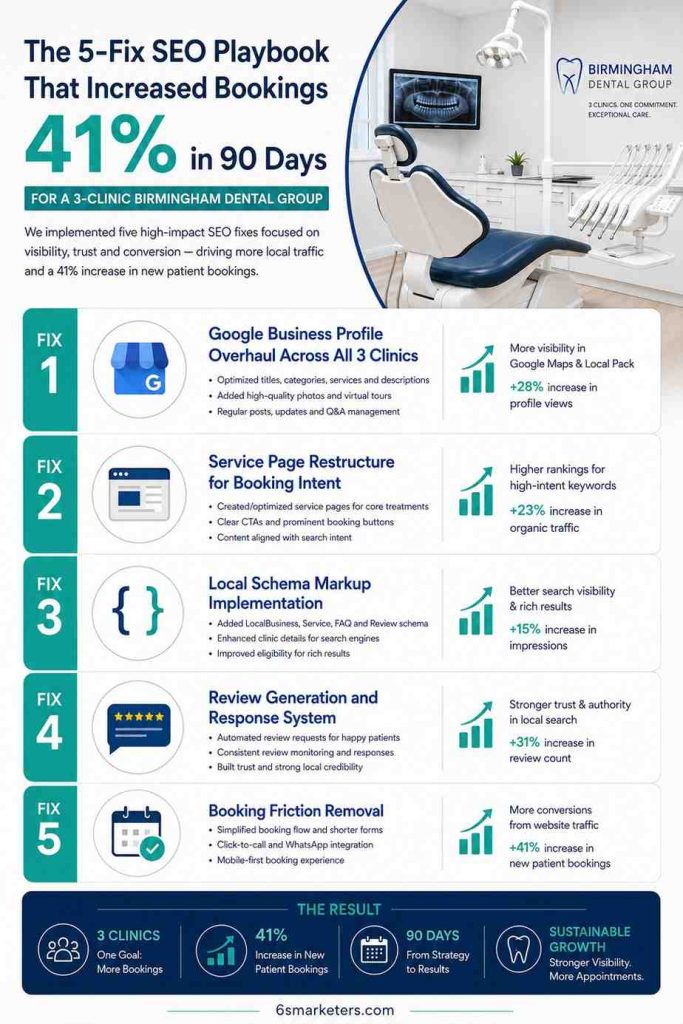
Fix 1: Google Business Profile Overhaul Across All 3 Clinics
We started here because it was broken and because it was free. We claimed and verified all three profiles, killed the duplicates, and rebuilt every field: correct categories, accurate hours, a proper description, fresh photos of each actual clinic, and a direct booking link on every one. We worked through a full Google Business Profile optimization checklist for each location so nothing got skipped.
Within a few weeks, all three clinics were surfacing more often in the local map pack and, more importantly, giving searchers a way to act the moment they found them.
Fix 2: Service Page Restructure for Booking Intent
We retired the single services page and built a dedicated page for each core treatment at each clinic. Implants in one area got their own page, written for someone who already knows they want implants and is choosing where to go. Each page named the location, answered the practical questions people actually ask — cost range, recovery, what the first visit looks like — and ended with an obvious way to book.
This is the part most dental sites get wrong. Good SEO for dental practices is not about ranking a homepage. It is about matching the exact page to the exact moment someone is ready to commit.
Fix 3: Local Schema Markup Implementation
We added LocalBusiness and Dentist schema for every clinic, with correct name, address, phone, geo-coordinates, hours, and services. Schema does not win rankings on its own. It helps Google understand three separate locations under one brand and feed the right clinic into local results and, increasingly, into AI-generated answers. For multi-location groups, that clarity matters more than most people expect.
Fix 4: Review Generation and Response System
Reviews were the trust gap. We set up a post-appointment request — a text with a direct link — so happy patients could leave a review in seconds, and gave the front-desk teams a response playbook: reply inside 48 hours, warmly to the good ones and calmly to the critical ones. Fresh, well-managed reviews are a genuine local ranking factor, and for a dentist, they are often the deciding vote when a patient compares two practices.
Fix 5: Booking Friction Removal
This one delivered the fastest. We replaced the five-field form and phone-only option with online scheduling, placed the booking button above the fold on every page, and made the whole thing work in a couple of taps on a phone. Google reports that roughly three-quarters of people who run a local search on mobile visit a business within a day. Those people were already arriving. We simply stopped making them work to book.
Here is how the five fixes lined up, along with what each one moved.
| Fix | What Was Broken | What We Changed | Booking Impact | Time to Effect |
| GBP Overhaul | Duplicate listings, wrong hours, no booking link | Claimed, verified, full fields, photos, booking link | +18% new bookings | 2–4 weeks |
| Service Page Restructure | One generic page for all treatments | Dedicated intent-led page per treatment, per clinic | +9% new bookings | 4–6 weeks |
| Local Schema | No structured data on site | LocalBusiness + Dentist schema per location | +6% local visibility to bookings | 3–5 weeks |
| Review System | Few, stale, unanswered reviews | Request system + 48-hour response SOP | +5% new bookings, higher trust | 6–8 weeks |
| Booking Friction | Five-field form, phone-only | One-tap online scheduling, above the fold | +12% new bookings | 1–2 weeks |
The Results: Bookings at 30, 60, and 90 Days
The curve was not a straight line, and we would not trust it if it had been.
By day 30, new patient bookings were up around 12%, driven almost entirely by the two fastest fixes: the Business Profiles and the booking flow. These were the changes that needed no ranking movement to pay off.
By day 60, bookings were up roughly 27%. The service pages had started to rank and convert, schema was helping the right clinic surface for the right search, and the first wave of fresh reviews was landing.
By day 90, new patient bookings across the three clinics were up 41% against the pre-project baseline. Organic traffic over the same period moved by less than 5%. Almost every gain came from converting the audience they already had.
What Every Multi-Location Healthcare Brand Can Learn From This
The specific fixes matter, but the mindset matters more. A strong SEO strategy for dental practices — or for any local, multi-location healthcare brand — starts at the point of booking and works backward, rather than starting at the keyword and hoping the rest sorts itself out.
A few lessons travel well beyond this one client:
- Audit conversion before you buy more traffic. If your funnel leaks, more visitors just leak faster.
- Treat each location as its own entity. Separate profiles, separate pages, separate reviews. One blended presence dilutes all three.
- Make booking the easiest thing on the page. Every extra click, field, or phone-only barrier costs you, real patients.
- Sequence for momentum. Ship the fast, high-intent fixes first so early wins fund patience for the slower ones.
Sensible SEO for dental clinics is rarely about doing something exotic. It is usually about doing the unglamorous middle-of-the-funnel work that most competitors skip. If you run multiple locations and suspect your traffic is out-earning your bookings, our local SEO services team is built for exactly this kind of problem.
Conclusion
Traffic is easy to celebrate because it is easy to measure. Bookings are harder, slower, and the only number that actually pays the staff. This Birmingham group had spent two years being told visibility was the goal, when visibility was only ever the first step. Once we pointed the same effort at conversion, a 41% lift showed up in 90 days without a single new stream of traffic and without a bigger budget.
The takeaway for any multi-location practice is simple. Before you spend another pound getting found, make sure the people already finding you can actually book. Audit the funnel, fix the fastest leaks first, and let momentum fund the slower work. A conversion-first SEO strategy for dental practices almost always uncovers growth that was sitting there the whole time, unspent.
So here is the question worth sitting with: if your rankings vanished tomorrow, how many bookings would you actually lose, and how many are you leaving on the table right now?
Sources
- Google Business Profile Help — Tips to improve your local ranking on Google:
- Google Search Central — Local business (LocalBusiness) structured data: