

Last year, a mid-sized Indian EdTech company came to us with a familiar complaint. Their blog pulled decent traffic, their ultimate guides ranked well, and almost none of it turned into demo requests. Their whole EdTech content strategy was built to win rankings, and it was winning them while the sales team sat waiting for a pipeline that never arrived. We spent three months tearing the approach down and rebuilding it around the one thing the guides ignored: buyers who were ready to decide. Here is what we changed, what broke, and what happened to demo requests afterward.
Key Takeaways
- Ultimate guides pull researchers, rarely real buyers.
- Decision-stage content drives real demo requests.
- Problem-led content beats topic-led for the pipeline.
- Comparison and ROI pages convert best.
- India-specific use cases build buyer trust.
- Prune, redirect, and repurpose old guides.
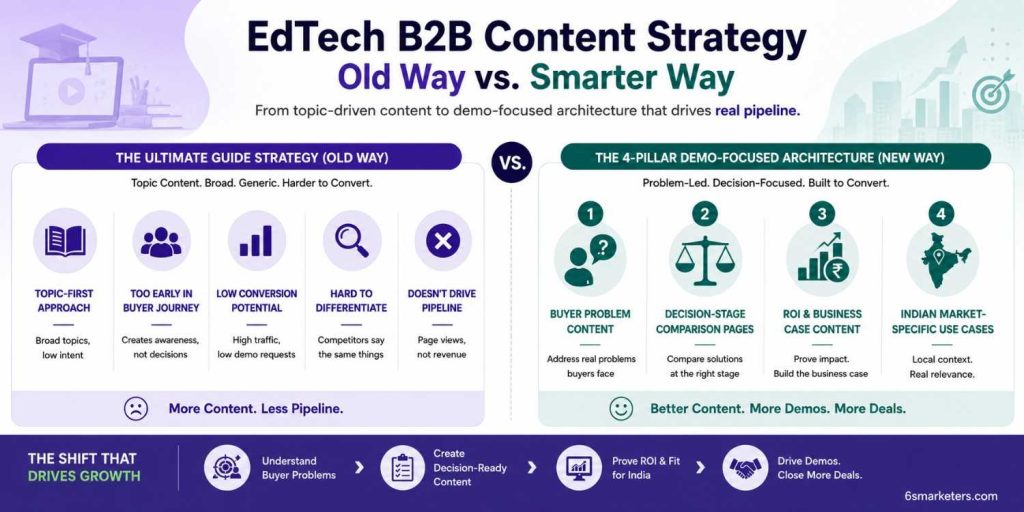
A single Indian EdTech brand, a library of ultimate guides, and a sales team starved of demos, that was the starting point. Their content ranked for broad informational terms, drew top-of-funnel readers, and stalled there. Over one quarter, we replaced a topic-led EdTech content strategy with four content pillars aimed at buyers closer to a decision: problem content, comparison pages, ROI and business-case material, and use cases built for the Indian market. We kept the guides that earned links, redirected the ones that did not, and rewrote the rest with a purpose. Demo requests from organic content moved from a trickle to a steady flow. Below is the full breakdown of what we built and why it worked.
The Brand, the Guides, and the Demo Problem
The client sells a learning-management platform to Indian colleges, training institutes, and corporate L&D teams. Before we started, their blog held about forty articles, and roughly a third were long “ultimate guide” pieces, 4,000-word explainers on topics like blended learning and student engagement. On paper, the program looked healthy. Organic sessions grew month over month. Two guides sat on page one for competitive terms.
The sales team told a different story. Demos booked through content were rare, and the ones that came through were often students or curious teachers with no budget authority. The traffic was real. The buyers were not. Their EdTech content strategy was optimized for a reader who would never sign a contract, and everyone had mistaken movement for progress.
Why Ultimate Guides Were Failing This EdTech Brand
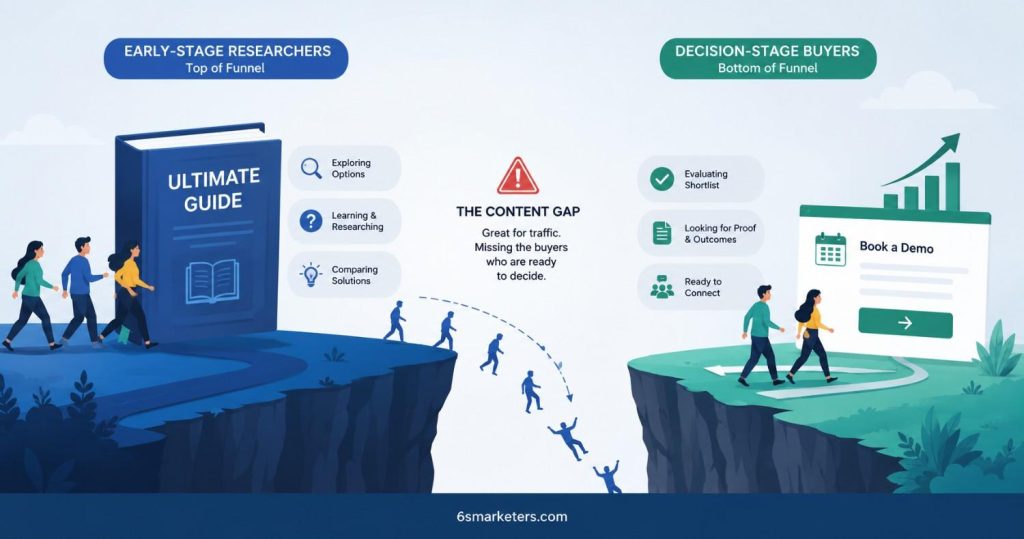
Ultimate guides are built to rank, and they do that job well. The trouble shows up after the click. Someone searching “what is blended learning” is usually early in their thinking, often a practitioner or a student, and rarely the person who approves software spending. A 4,000-word primer answers their question completely and sends them on their way. Readers leave informed, but not ready to take action.
Gartner’s research on the B2B buying journey helps explain the gap. Buyers now spend only about 17% of their total purchase time meeting with potential suppliers, and they work through jobs like problem identification and supplier selection in no fixed order. Content that serves only the earliest job never earns a place in the later ones. Our guides showed up for problem identification and vanished everywhere after that, a costly place to be invisible when your audience is decision-makers, and where a lot of content marketing for EdTech ends up stalling.
What We Built Instead: A New EdTech Content Strategy
The rebuild started with one reorganizing principle: map every piece to a decision a buyer makes before booking a demo. Four content pillars came out of that, and together they became the backbone of the new program.
Pillar 1: Buyer Problem Content (Not Topic Content)
Topic content answers “What is an LMS?” Problem content answers “why our LMS rollout stalled last semester.” We interviewed the client’s sales and support teams and pulled the real objections buyers raised: implementation fear, faculty adoption, and data migration from legacy systems.
Each objection became an article written for someone who already knows the category and is worried about getting the purchase wrong. These pieces ranked for lower-volume terms, and the people reading them had budgets and deadlines.
Pillar 2: Decision-Stage Comparison Pages
Indian EdTech buyers compare relentlessly before they commit, usually with a spreadsheet and a shortlist. We built honest comparison pages: the client versus named alternatives, the client versus building in-house, and one page on switching from a free tool to a paid platform.
We wrote the trade-offs plainly, including the cases where the client was the wrong choice. That candor did more for trust than any feature list, and these pages became the most dependable source of qualified EdTech lead generation in the whole program.
Pillar 3: ROI and Business Case Content
Someone has to justify the spend internally, often to a finance lead who never reads the blog. We gave our champion the ammunition: a cost-of-inaction piece, a simple ROI framework for L&D software, and a one-page business case template they could adapt. This is where a strong EdTech content strategy earns its keep, because it keeps selling after the reader has closed the tab. These assets rarely ranked for much, yet they surfaced in demo notes again and again.
Pillar 4: Indian Market-Specific Use Cases
Global EdTech content assumes budgets, buying cycles, and infrastructure that do not match the Indian market. Our client’s buyers dealt with tight budgets, patchy connectivity in tier-2 cities, regional-language requirements, and procurement rules specific to Indian institutions.
We built use cases around those realities — a study of a Pune training institute, a guide to offline-friendly features, a piece on UGC and AICTE compliance. This local grounding is what separates our B2B EdTech content marketing from the generic advice competitors import wholesale.
If your content pulls traffic but not pipeline, it is worth a hard look. You can book a content audit with our team and pressure-test where readers drop off.
How We Handled the Existing Ultimate Guides
We did not delete everything, which is the reflex some teams have. We ran an audit of all forty pieces against two questions: does it earn links or rankings we would lose, and does it serve any real buyer job? Guides that brought authority and backlinks stayed, and we added decision-stage sections plus internal links pointing toward the new comparison and ROI pages.
Weak guides with no traffic and no links were merged or redirected into stronger pieces. A few were rewritten from the ground up. The goal was to turn a set of dead-end explainers into a network that carried readers toward a decision. A lot of that work leaned on the middle-of-funnel content ideas we reuse across B2B clients.
The Results: Demo Requests Before and After
The rebuild took a quarter to implement and another two quarters to show its full effect, because decision-stage content compounds slowly. The numbers below are the shape of what we saw. Organic traffic dipped slightly at first, since the new pages targeted lower-volume terms. Demo requests told the opposite story. The comparison and ROI pages, modest in traffic, drove the bulk of qualified conversions. Six months in, content-sourced demos had become a dependable line in the pipeline review — the first time this EdTech content strategy produced real revenue conversations from organic content. Sales stopped dreading content leads.
| Metric | Before (range) | After (range) |
| Organic sessions/month | 14,000–18,000 | 12,000–15,000 |
| Demo requests from content/month | 2–5 | 10–16 |
| Content-sourced qualified leads/month | 5–9 | 18–28 |
| Sales-rated lead quality (1–10) | 2–3 | 7–8 |
What Indian EdTech Brands Can Learn From This Playbook
A few principles travel beyond this one account. Treat rankings as a means to an end; content that ranks but never books a demo drains budget without returning to the pipeline. Map every piece to a buyer job, and give the later jobs comparison, justification, validation — as much attention as the early ones. Write for the Indian buyer’s actual constraints, and skip the imported global playbook. Treat your existing library as raw material you can reshape whenever a piece stops earning its place. And measure content against the pipeline first, letting pageviews sit as a secondary signal. If you want to see how this fits a wider system, our approach to SEO content strategy that drives leads and our B2B SEO services both start from the same premise.
Conclusion
Killing the ultimate guides felt risky. They ranked, they pulled traffic, and traffic is easy to celebrate in a monthly report. What they never did was put qualified buyers in front of the sales team, and that was the only number that paid the client’s bills. Rebuilding their EdTech content strategy around decision-stage pillars — buyer problems, honest comparisons, ROI cases, and India-specific use cases — changed the kind of reader the blog attracted and, with it, the kind of conversations sales had. The traffic charts looked less impressive for a while, and the pipeline charts looked a great deal better. For a B2B EdTech brand, that is the trade worth making every time. If your content is busy ranking while your demo calendar stays empty, the fix is rarely more guides. It is a program built for the buyer who is ready to move. Talk to our team if you want a second opinion on yours.
Over to you — if you audited your best-performing blog post tomorrow against one question, “Does this actually book demos?”, how many of your pages would pass?
Sources
- Gartner, The B2B Buying Journey