

A prospect downloads your ebook, reads three blog posts, then goes quiet for six weeks. That gap is where most B2B pipelines lose momentum, and it’s exactly the space middle of funnel content is supposed to fill. Buyers here aren’t asking “what’s the problem” anymore — they’re comparing vendors and trying to convince stakeholders who haven’t even seen your homepage. The right content removes the friction that stalls B2B sales cycles for weeks at a time. Below are ten formats that do exactly that, and where each one fits in a buyer’s evaluation.
Key Takeaways
- Middle of funnel content closes evaluation gaps fast.
- Buyer-specific pages beat generic solution overviews.
- ROI calculators turn interest into internal budget cases.
- Objection hubs cut short repeat sales objections.
- Peer validation content shortens vendor shortlist decisions.
- Map content to each stakeholder’s decision timeline.
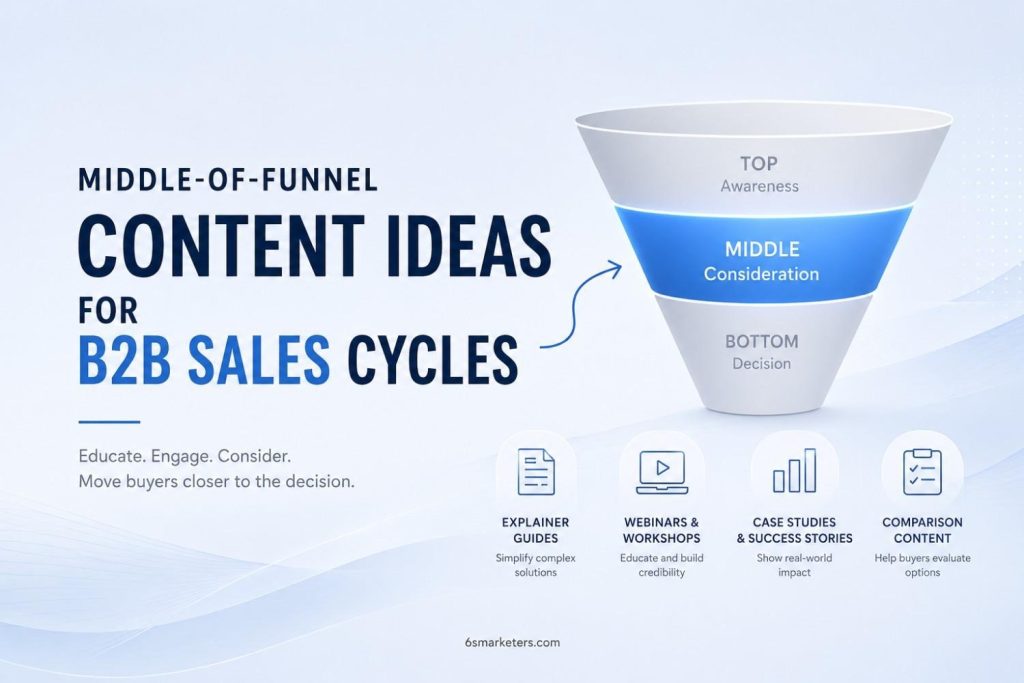
Most funnel advice treats the middle stage as one block of strategy, but it isn’t one thing. A buyer comparing vendors needs different proof than one building an internal business case, and both differ from someone trying to get the budget signed off. This guide breaks down ten formats built for those specific moments, not the funnel in the abstract — the buyer problem each one solves, where it sits in the evaluation, and how it shortens the sales cycle rather than just generating another download. The table below gives you the full picture first.
Why Most B2B Content Stalls at the Middle of the Funnel
TOFU content earns the visit. BOFU content earns the signature. The middle stage earns something quieter: trust from people who never read your ad and never will — the finance lead or compliance officer who only ever sees a slide deck your champion put together without you in the room.
Most teams either skip this stage or fill it with the wrong thing. Some publish more top-of-funnel blog posts, which pull in traffic but do nothing for someone already three calls into an evaluation. Others jump straight to demos and pricing, which spooks a buyer who hasn’t finished building their internal case. Building topical authority in B2B SEO gets people to your site, but it does little to get a champion through procurement review — that’s the gap this content has to close.
What Middle-of-Funnel Content Actually Needs to Do
So what content works best in the middle of the B2B funnel? Honestly, it depends on which decision the buyer is making at that exact moment. Sometimes that’s “is this vendor even a serious option?” and sometimes it’s “can I get my CFO to approve this line item?”
Search behavior at this stage shifts toward commercial, comparison-style queries — brand names side by side, or “best [category] for [use case]” instead of broad informational terms. That shift matters because it tells you the buyer already understands the problem. What they need now is proof, structure, and a way to bring their team along without needing you on every call.
10 MOFU Content Ideas That Shorten B2B Sales Cycles
Here are ten middle of the funnel content examples worth building, grouped by the specific job each one does inside a real evaluation.
Table: 10 MOFU Content Ideas — Buyer Problem × Stage × Format
| Content Idea | Buyer Problem It Solves | MOFU Sub-Stage | Format | Sales Cycle Impact |
| Buyer-Specific Use Case Pages | Generic solution pages don’t match their exact situation | Early comparison | Landing page/use-case doc | Cuts research time before the first call |
| Competitor Comparison Pages | Buyer doesn’t know how you differ from Vendor X | Active comparison | Comparison page or PDF | Shortens the vendor shortlist stage |
| ROI Calculators and Value Estimators | Champion can’t justify the budget internally | Business case building | Interactive tool | Speeds up internal approval |
| Problem-Framing Case Studies | Buyer isn’t convinced the problem is worth solving now | Early consideration | Long-form case study | Moves buyer from “maybe” to “yes” |
| Objection-Handling Content Hubs | Same objections resurface in every deal | Active comparison | Resource hub / FAQ | Reduces repeat sales calls |
| Vendor Evaluation Guides and RFP Templates | The buyer doesn’t know what criteria to compare | Structured evaluation | Guide/template | Set your criteria as the standard |
| “How We Do It” Process Explainers | Buyer worries about implementation risk | Late consideration | Explainer page/video | Lowers perceived onboarding risk |
| Integration and Compatibility Guides | Will this work with our existing stack | Technical vetting | Technical documentation | Removes IT and procurement blockers |
| Peer Validation Content | Buyer wants proof from someone like them | Active comparison | Customer story / review roundup | Builds trust without a sales call |
| Internal Stakeholder Enablement Kits | Champion must sell it internally without you present | Business case building | Slide deck / one-pager kit | Speeds up multi-stakeholder buy-in |
1. Buyer-Specific Use Case Pages
A single “Solutions” page trying to speak to five roles usually speaks clearly to none of them. Buyer-specific use case pages break that apart — one page for the ops leader cutting manual work, another for the finance buyer reducing spend leakage, each with its own language and proof points. A mid-market manufacturer might need a page framed around inventory accuracy, while an enterprise version of the same product gets framed around audit readiness. Same product, two arguments, both shorter than making the buyer translate a generic pitch themselves.
2. Competitor Comparison Pages
Buyers compare you with whether or not you help them do it. Skip the comparison page, and they’ll build their own version from review sites and half-remembered demo notes, with no input from you. A well-built comparison page names the tradeoffs plainly: where a competitor genuinely does something better, where your approach fits a different kind of team. That honesty is what makes the page worth sharing within a buying committee.
3. ROI Calculators and Value Estimators
This is the format most teams underinvest in relative to its impact. An ROI calculator turns “I think this could save us money” into a number a finance team can sit with. Picture a workflow-automation vendor whose champion needs to justify a five-figure contract to a skeptical CFO. A calculator that turns current headcount hours into projected annual savings moves that deal further than another case study, because it hands the champion a document they can forward without editing.
4. Problem-Framing Case Studies
Most case studies open with the solution. Problem-framing case studies spend real time on how bad the problem got before anyone acted, because that’s often what a buyer needs to justify prioritizing it now over next quarter. A cybersecurity vendor might walk through how a mid-sized firm delayed a fix for months because the risk felt abstract, then detail what changed their mind. That specificity separates a useful case study from a generic success story nobody remembers by the next meeting.
5. Objection-Handling Content Hubs
Every sales team fields the same objections on repeat: too expensive, too complex to implement, and not enough proof that it works at our scale. An objection-handling hub tackles these head-on instead of hoping they don’t come up. Done well, it reads less like a defensive FAQ and more like a straight answer from someone who’s had the conversation many times. This is also where B2B sales enablement software often gets involved, since reps need quick access to the answer that matches whatever objection just landed on the call.
6. Vendor Evaluation Guides and RFP Templates
If a buyer is going to build a scorecard anyway, you want a hand in shaping what’s on it. A vendor evaluation guide lays out the criteria that actually matter for the category, such as security posture, implementation timeline, and support model, that are framed in a way that plays to your strengths without being obviously self-serving. Providing a ready-to-use RFP template adds even more value by helping procurement teams avoid hours of unnecessary preparation.
7. “How We Do It” Process Explainers
Buyers this deep into evaluation aren’t just asking what your product does. They’re asking what happens after they sign and how much of their own team’s onboarding time it will eat up. A process explainer that walks through week one, week four, and month three of a typical rollout takes a vague fear and replaces it with a concrete picture. That’s often the difference between a buyer who feels ready to commit and one who quietly asks to “revisit next quarter.”
8. Integration and Compatibility Guides
For any buyer with an existing tech stack, “Will this actually work with what we already have?” is a make-or-break question, and it’s usually IT’s question, not the champion’s. A clear integration guide, listing supported platforms and known limitations honestly, lets a technical stakeholder self-serve that answer instead of routing it through a sales call. Skipping this step is one of the quieter ways deals stall in procurement for weeks over something that could have been a single page.
9. Peer Validation Content
A glowing testimonial on your own site carries less weight than an unscripted comment from a peer on a review site or in a private Slack community. Showcasing review roundups, analyst endorsements, and public customer feedback helps skeptical buyers evaluate your business using trusted external voices. It’s one of the few formats that can move a deal forward while you’re not in the room.
10. Internal Stakeholder Enablement Kits
Your champion has to pitch this internally, often to people who’ve never spoken to your team. An enablement kit that includes a short slide deck, a one-pager, and a summary email template that gives them something polished to forward instead of explaining your product from memory in a meeting you’re not part of. This is a clear example of how to use content to accelerate B2B buying decisions: you’re equipping the person who has to convince everyone else.
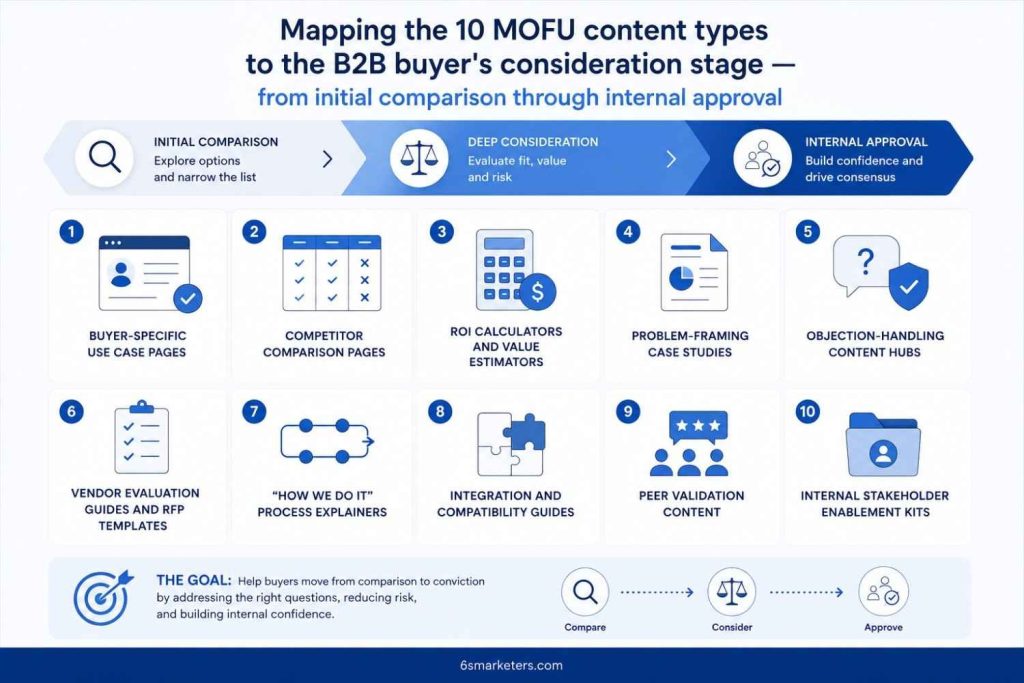
Mapping the 10 MOFU content types to the B2B buyer’s consideration stage — from initial comparison through internal approval.
How to Map MOFU Content to Your Buyer’s Decision Timeline
The mistake most teams make is treating MOFU as one stage instead of a sequence of smaller decisions: recognizing you as a real option, narrowing a shortlist, building an internal case, then getting final sign-off. Each step benefits from a different asset, not just more content in general.
Map your existing library against those four moments instead of generic funnel labels. You’ll likely find plenty built for “early interest” and almost nothing built for “help my champion get this approved.” A fintech vendor selling into compliance-heavy enterprises runs into this constantly, especially as more early research now happens inside AI tools before a human visits the site, a shift covered in our piece on demand gen for fintech in a zero-click world. Once a buyer clears the middle stage, a different kind of proof takes over, which is where BOFU content ideas for B2B SaaS pick up.
If you want a second set of eyes on where your current content actually falls short, you can reach out to our team, and we’ll walk through it with you.
Conclusion
Shortening a B2B sales cycle rarely comes down to one clever asset. It comes down to removing friction at the exact moments a buyer gets stuck in comparing options, justifying budget, or convincing colleagues who’ve never spoken to you directly. That’s the purpose of middle-funnel content, which is why these ten formats address buying decisions rather than broad topics.
Start small if you need to. Pick the one moment where deals in your pipeline currently stall the longest, whether that’s budget approval or internal buy-in, and build a single asset for it before trying to overhaul the whole funnel. A focused ROI calculator or one honest comparison page often does more for your close rate than another dozen blog posts aimed at the top of the funnel.
Where does your own pipeline tend to stall in the middle stage, and what would it take to fix just that one moment? We’d genuinely like to hear how other teams are handling it.
External Reference
- Search Engine Land, MOFU keywords: Your secret shortcut for converting prospects into purchases
- Google Search Central, Creating Helpful, Reliable, People-First Content