

Local search moved further in the last eighteen months than in the five years before it. AI Overviews now sit above the map pack on a large share of local queries, and much of what they say about a business comes straight from its Google Business Profile. Google also quietly retired features that plenty of agencies still build strategies around, and nobody sent a memo. This piece separates the eight ranking factors that genuinely shifted in 2026 from the four that have held steady since the Google My Business days. We checked every claim against Google’s documentation or against profiles we manage. Skip to the checklist for the compressed version.
Open almost any current guide to local search, and you will still find advice about replying to Google messages quickly. Google switched messaging off on 31 July 2024. Chat is gone. Call history went with it. That advice has been wrong for two years, and publishers keep recycling it anyway.
That gap between the received wisdom and the live product is the real problem with Google Business Profile advice right now. So here is a working list, built from the profiles we manage. Eight signals shifted this year. Four have barely moved since 2019.
Key Takeaways
- AI Overviews now cite Business Profile data
- Review recency beats lifetime review totals
- Posting frequency no longer moves local rankings
- Google removed native messaging in 2024
- Service catalogues feed Maps AI answers
- Primary category remains the single strongest lever
- Proximity still caps your realistic ranking radius
How Google Business Profile Rankings Actually Work in 2026
Google still describes local ranking with three inputs: relevance, distance, and prominence. That framework did not change this year. The weighting underneath it did, along with which profile fields now feed Google’s generative layer as well as the map pack.
Read Google’s help page closely, and you get a small tell. The opening line calls the three factors relevance, distance, and popularity, then the heading below it says Prominence. Google has never published the sub-signals inside those buckets, which is why the useful work happens in testing.
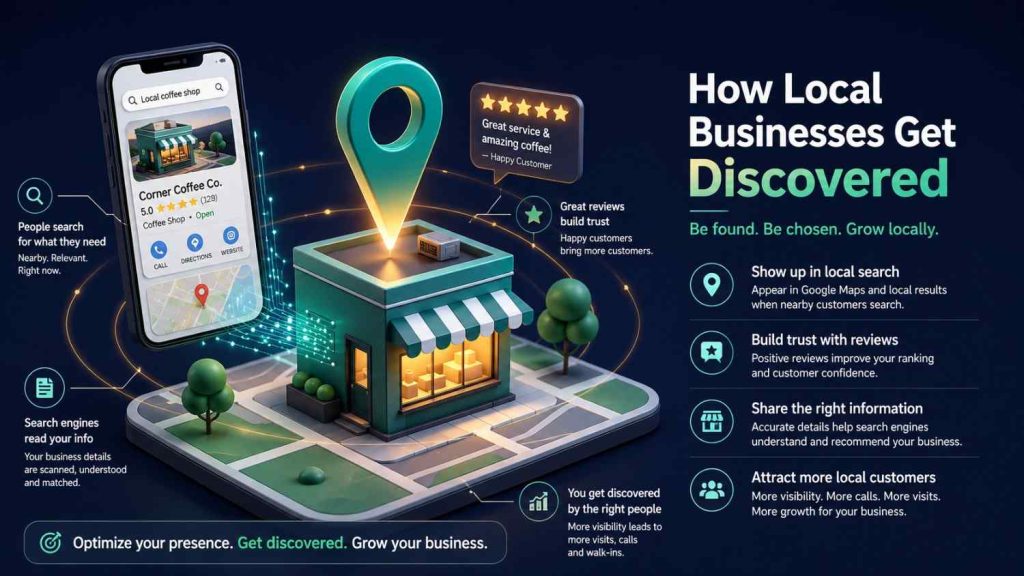
The practical version: your Google Business Profile fields tell Google what you are, reviews and citations tell Google how well-known you are, and your address decides who you can realistically serve. 2026 added a fourth question. Can a language model quote this profile without hedging?
The 8 Google Business Profile Ranking Factors That Changed
These are the shifts we have watched play out across client profiles since late 2025. Some carry a product announcement and a date. Others we tracked before anyone announced anything.
1. AI Overview Visibility: GBP as Citation Source
Business Profile data now feeds Google’s AI Overviews directly, so your categories, services, hours, and review text can reach a searcher who never opens the map pack.
The uncomfortable part is concentration. An AI Overview names one to three businesses where the map pack showed three plus a “more places” link. Fewer slots, same competitors. The model skips thin profiles because nothing in them is specific enough to quote, then moves to the profile that gives it a confident answer.
2. Review Velocity Outweighs Total Review Volume
A profile earning four reviews a month for six months now tends to outperform one sitting on 400 reviews collected three years ago. Recency carries the signal.
Acquired locations show this most clearly. A business buys a competitor, inherits a large review file, and expects that history to carry into its own Google Business Profile rankings. It rarely does. Steady collection beats the lifetime total, which puts review requests in the service workflow.
3. GBP Posts: The Frequency Signal Has Weakened
Posting more often does not lift your position in the local pack. It has not for a while, and 2026 made that plainer.
Posts do widen the queries you can appear for, because Google indexes post text. A restaurant post about Thursday trivia can surface for that exact phrase. Most of the lift people credit to weekly posting comes from the review collection and photo activity running alongside it. Google added native scheduling and a copy-to-all-locations tool for accounts under 100 listings, though it does not support unique URLs per location, so multi-location teams still fix branch links by hand.
4. Service and Product Catalogue Completeness
Filling out services and products with individual descriptions matters more than it did in 2024, because Google Maps now pulls catalogue entries into its AI answers.
Ignore the Profile Strength meter while you do it. That widget measures completeness against Google’s definition of complete, which includes prompts to enable Google Ads and features you may not want. It scores nothing that ranks. A profile can sit at amber indefinitely and hold the top slot.
5. Photo Freshness Over Raw Photo Volume
Uploading 200 photos on day one and nothing afterwards reads as a dormant listing. A handful of new images each month reads as an operating business.
Geo-tagging photos before upload does nothing. That myth has outlived its expiry date by about eight years, and clients still ask us for it. What helps: images matching your primary category, shot on a phone, showing the work.
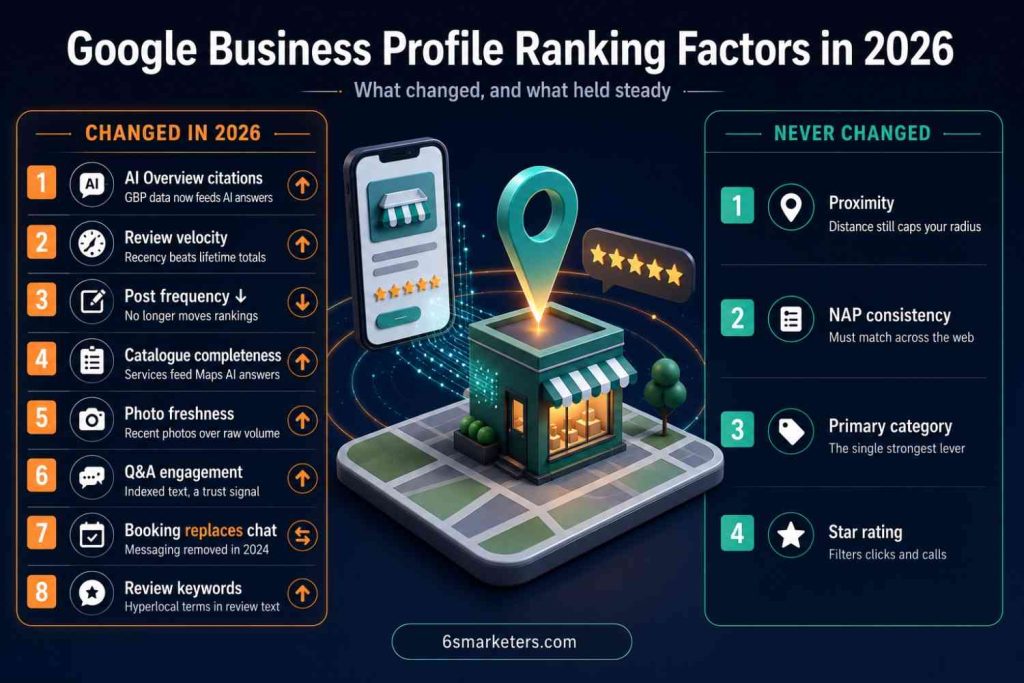
6. Q&A Engagement Now Works as a Trust Signal
Google indexes the Q&A section on your profile, and most businesses leave it to strangers. Anyone can answer a question about your business, correctly or otherwise.
Seed it yourself. Post the eight questions your phone team fields every week, then answer them from the business account. An unanswered question sitting on a Google Business Profile for months signals neglect, and that costs conversions before it costs rankings.
7. Booking Integration Replaced Messaging Entirely
This one catches people out. Google removed native messaging and call history from Business Profiles on 31 July 2024. No chat button remains to optimise, and no response-time metric remains to chase.
Booking took over as the in-profile conversion path. Google integrates with a long list of scheduling platforms, and a live booking link keeps the transaction inside the profile. If your reporting still carries a Google messages column, that number has read zero since 2024. Worth reviewing alongside your local SEO services scope.
8. Hyperlocal Keyword Usage Inside Review Text
When a customer writes “they did our kitchen remodel in Jubilee Hills”, Google connects that phrase to your business and can surface it as a justification snippet under your listing.
You cannot script this without breaking review policy. You can prompt it honestly. Asking “what did we do and where?” in the review request produces service and location language far more often than “how did we do?” Same request, better density.
Getting this right across a portfolio is a workflow problem before it is a Google Business Profile problem. Talk to our local SEO team if you want the audit done properly.
The 4 Local Search Ranking Factors That Never Changed
Four things survived every algorithm shift, rebrand, and AI feature launch since Google My Business existed. We still start here when a profile stalls.
1. Proximity to the Searcher Still Dominates
Distance to the person searching remains the hardest ceiling in local search. A profile can be immaculate and still lose to a mediocre competitor three streets closer.
No Google Business Profile setting expands that radius. Strong prominence stretches it slightly, and that is the whole of it. Service-area businesses and multi-location brands work around the constraint by opening real locations.
2. NAP Consistency Across the Web Still Matters
Name, address and phone number have to match everywhere Google finds them. A stale number on an old directory listing still weakens entity confidence in 2026, and it now also lowers your odds of an AI citation. Suite numbers, abbreviations and legacy tracking numbers cause most of the damage. Audit quarterly.
3. Primary Category Selection Beats Everything Else
The primary category remains the highest-impact field on your Google Business Profile. Local SEO practitioners rank it first in the annual local search ranking factors survey, year after year.
Choose the narrowest accurate option. Moving a firm from “Lawyer” to “Personal Injury Attorney” shifts visibility more than any other single edit available to you, and it takes thirty seconds.
4. Overall Star Rating Still Holds Its Weight
Rating still decides who gets clicked and who gets called. It also gates AI citation softly, because a generative answer recommending a 3.4-star business is a bad answer. Nothing clever here. Fix the operational problem behind the one-star reviews, then reply to every review, positive and negative.
What to Prioritise: A 2026 Google Business Profile Checklist
If you have one afternoon, work down this order. It weighs effort against likely return, based on the sequence we run for new accounts.
| Priority | Action | Effort | Why it matters now |
| 1 | Audit primary category against top three competitors | 30 min | Highest-impact single field |
| 2 | Fix NAP mismatches across major directories | 2–3 hrs | Feeds rankings and AI citation |
| 3 | Write individual service descriptions | 2 hrs | Maps pulls these into AI answers |
| 4 | Set a monthly review collection cadence | Ongoing | Velocity outweighs volume |
| 5 | Seed and answer eight Q&A entries | 1 hr | Indexed text most businesses ignore |
| 6 | Add a live booking link | 30 min | Replaces retired messaging |
| 7 | Schedule monthly photo uploads | Ongoing | Freshness signals an active business |
| 8 | Drop posting to weekly | — | Frees time for items 1 to 7 |
Our full Google Business Profile optimization checklist covers the fields this table skips.
Conclusion
The eight changes share a theme. Google’s generative layer wants specific, current, verifiable information, so profiles that supply it get quoted and profiles that hedge get skipped. The four stable factors come down to being a real business at a real address that real people rate well.
If your 2026 plan still budgets time for daily posts, geo-tagged images and message response times, you are optimising for a product that no longer exists. Move those hours into your Google Business Profile categories, service descriptions and review velocity. The compounding runs slower, and the results hold.
One honest caveat. Proximity means some rankings are simply unavailable from your current address, and no amount of Google Business Profile work changes that. Knowing which battles you cannot win is worth as much as knowing which levers to pull.
Sources
- Google Business Profile Help: Tips to improve your local ranking on Google.