

Six weeks. That’s the window in which a US EdTech client watched more than 60 keywords shift positions after we rebuilt their blog around topic clusters. We didn’t touch the domain or chase new backlinks. We reorganized what they already had. The blog held roughly 120 published posts, most of which competed against each other for the same searches. We grouped them, connected them, and gave Google a map it could read. This is the full account of how we did it, what broke along the way, and which decisions made the difference. If you run content for a growing business and your traffic has stalled, the structural fix here may matter more than another round of publishing.
Key Takeaways
- Flat blog structure caused keyword cannibalization.
- Topic clusters group content around pillars.
- Internal links signaled topical relationships to Google.
- Consolidating duplicate posts stopped self-competition.
- 60+ keywords moved within six weeks.
- Structure lifted rankings without new backlinks.
A US-based EdTech company came to us with a blog that was often published and ranked poorly. The content was there. The structure was not. We ran an audit, found dozens of posts targeting overlapping keywords, and mapped everything into eight core topics. Each topic got a pillar page and a set of supporting articles that linked back to it with clear anchor text. We merged the duplicates, redirected the weak pages, and tightened the internal linking. Within six weeks, more than 60 keywords improved their positions, several landed on page one, and organic sessions climbed by roughly a third. This topic cluster SEO case study breaks down every stage below, including the parts that felt uncomfortable.
The EdTech Blog Challenge Before Topic Clusters
The client sells a learning platform to schools and corporate training teams across the US. Their marketing lead had done the sensible thing for two years: publish consistently. Two or three posts a week that are on SEO-relevant subjects, all technically good.
The problem showed up in the numbers. Around 120 posts, and organic traffic sat almost flat month after month. A handful of pages carried most of the visits. The rest hovered somewhere on page three or four, invisible for practical purposes.
When we pulled their Search Console data, the pattern was hard to miss. Multiple posts ranked for the same query; none of them ranked strongly. One week, Google showed post A for “corporate LMS features,” the next week, post B, then back again. The blog was competing against itself, and every page paid the price.
Auditing the Blog’s Topical Authority Gaps
We started where we always start: a full crawl and a keyword map. Screaming Frog for the crawl, Search Console, and Ahrefs for the ranking picture.
Three findings stood out.
- First, cannibalization was everywhere. At least 14 groups of posts competed for near-identical keywords. Google kept swapping which one it favored, so no single page built lasting authority.
- Second, the internal linking was thin and random. Posts linked out to a few others, usually the most recent ones, rarely the most relevant. Some strong articles had almost no inbound links. We counted 11 orphan posts with zero internal links pointing to them.
- Third, there was no hierarchy. Every post sat at the same level. Nothing told Google which pages were the anchors for a subject and which were the supporting details. To a crawler, it reads as 120 loosely related pages rather than an organized library.
Why the Blog Lacked SEO Topic Clusters
Volume was never the issue. The team published more than most of its competitors. Quantity without structure simply gives search engines very little to work with.
Consider how a crawler reads a site. It follows links, weighs the anchor text, and builds a model of what your pages cover and how they relate. When 14 posts all shout “LMS pricing” and link to each other at random, that model gets muddy. Google cannot tell which page deserves to rank, so it splits attention, and none of them win.
There was a depth problem, too. The blog covered a wide subject surface but rarely went deep into any one theme. A visitor researching “student engagement analytics” would find three shallow posts instead of one authoritative resource. That caps how far any page can climb for competitive terms, and it weakens the trust signals that Google leans on.
Our Topic Cluster Strategy
The fix was to give the blog a shape. We chose the topic clusters model: a small number of broad pillar pages, each surrounded by supporting articles that go deep on one subtopic and link back to the pillar.
We mapped their content into eight core topics, drawn from what buyers searched for and what the platform actually did:
- Learning management systems
- Corporate training and L&D
- Student and learner engagement
- Course creation and authoring
- Assessment and analytics
- Compliance training
- Onboarding and employee training
- EdTech integrations
Each topic became a cluster. The pillar page would target the broad head term. The supporting posts would target the longer, more specific queries and funnel authority upward through internal links. This is the same logic behind building topical authority in any competitive B2B space: real depth on a subject, connected cleanly, beats scattered one-off posts.
We did not need 120 new articles. We needed the existing ones organized and a few gaps filled.
Restructuring an established blog takes a careful hand, and the sequencing matters. If you’d rather not experiment on live rankings, our team can map your content into topic clusters and handle the migration for you.
Content Consolidation and Internal Linking Strategy
Strategy is easy to draw on a whiteboard. The messy part is execution, and this is where most of the six weeks went.
Consolidation first. For each cluster, we identified the strongest existing post and made it the pillar, or wrote a new pillar where nothing suitable existed. We built three pillars from scratch and promoted five. The duplicate and thin posts that had been cannibalizing each other were merged into the pillar, and the leftovers were 301-redirected. Fourteen posts collapsed into cleaner, stronger resources.
Then, the internal linking strategy. We set one rule that the whole team could follow. Every supporting article links up to its pillar with descriptive anchor text. The pillar links down to every supporting article. Related supporting posts link to each other where it genuinely helps a reader. No more random links to whatever was published last.
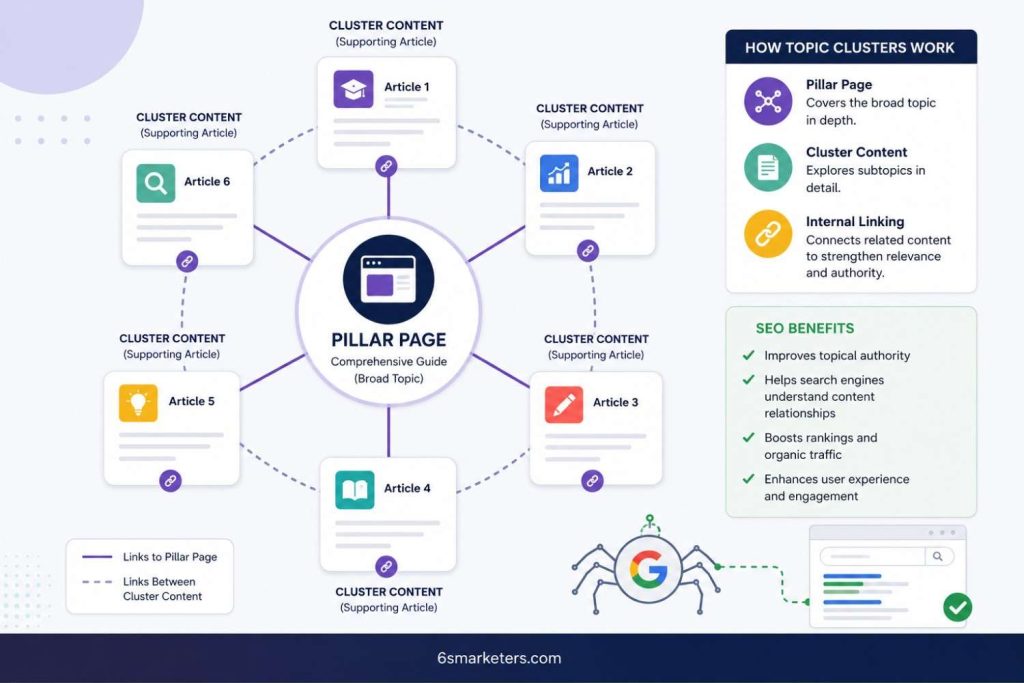
Anchor text did a lot of the heavy lifting. Instead of “read more” or “click here,” a compliance post linking to its pillar used “corporate compliance training software.” Google reads that anchor as a signal about the destination page’s subject. Multiply it across a full cluster, and the pillar’s relevance for its head term strengthens quickly. We apply the same discipline we detail in our guide to internal linking for topical authority, and it transferred cleanly to this project.
We also fixed the orphans. All 11 were pulled into a cluster and given inbound links. Pages Google had barely crawled started getting indexed attention within days.
Results After Six Weeks
Six weeks after the restructure went live, the movement was clear in Search Console.
More than 60 keywords improved their positions. Not all of them jumped to the top, but the direction was consistent. Eighteen keywords moved onto page one after sitting on page two or three. The “corporate LMS” pillar climbed from position 22 to position 6. Organic sessions rose by about 34% compared with the six weeks before.
The cannibalization noise settled down. Because each query now had one clear page built to answer it, Google stopped swapping and started ranking the intended pillar steadily. Impressions grew alongside positions, which told us the pages were becoming eligible for a wider set of related searches.
What surprised the client most was the speed. Topic clusters are often sold as a long game, and the compounding benefit does take months to fully arrive. The early lift came fast here because the content already had age and authority. We were not building from zero. We were clearing the confusion that had been holding good pages down.
Key Takeaways for SEO Teams
If you’re weighing a similar restructure, a few lessons carry the most weight:
- Audit before you publish more. If existing pages compete with each other, adding posts makes the tangle worse. Map what you have first.
- Pick pillars deliberately. The pillar should target the broad term and earn the most internal links. Everything else supports it.
- Anchor text is a ranking lever. Descriptive, consistent anchors teach Google what each page covers. Generic anchors waste the link.
- Consolidate without fear. Merging and redirecting weak posts almost always beats letting five thin pages fight over one keyword.
- Give it a full quarter to mature. Six weeks showed movement. The larger gains kept arriving over the following months.
Done well, topic clusters turn a pile of posts into a system that compounds. Pair the structure with a genuine SEO content strategy, and each new article strengthens the cluster it joins.
Not sure where your blog is losing ground? A structural audit is usually the fastest way to find out. Talk to our SEO team, and we’ll show you which of your pages are competing for the same keywords.
Conclusion
The takeaway from this project is straightforward. Most blogs don’t underperform because the writing is bad. They underperform because nobody gave the content a structure that search engines can follow. This client had two years of solid posts doing half their job.
Reorganizing everything into topic clusters lets those posts finally support one another. We consolidated the duplicates, built clear pillars, and connected the whole library with anchor text that meant something. Six weeks later, more than 60 keywords were moving, and the trend held into the following months.
If your content calendar is full but your rankings are stuck, resist the urge to simply publish more. Look at the shape of what you already own. The structure is often the missing piece, and it’s usually sitting in the archive you built long ago, waiting to be connected properly.
Have you looked at your blog as a connected system lately, or is it still a list of separate posts? I’d be curious how other teams are approaching this.
Sources
- Google Search Central: Links best practices.
- HubSpot: Topic Clusters: The Next Evolution of SEO