

Google no longer ranks pages only by keywords. It ranks entities.
Google confirms that its systems move beyond strings to things. The company shifted from matching words to understanding real-world objects, concepts, brands, and people through the Knowledge Graph introduced in 2012. Today, Google’s Knowledge Graph holds over 500 billion facts about 5 billion entities, according to Google Search Central and public company statements.
Google prioritizes entity-first content optimization because it helps the search engine understand context, relationships, and intent rather than isolated keywords.
This transition makes entity seo critical for businesses that want visibility in AI-driven search, featured snippets, and knowledge panels.
What Is Entity SEO?
Entity SEO is the practice of optimizing your brand, website, and content so Google recognizes you as a distinct entity within its Knowledge Graph.
It focuses on:
- Structured data
- Context and relationships
- Brand authority signals
- Entity consistency across the web
Unlike keyword SEO, entity based seo builds long-term authority and improves visibility across search, AI summaries, and knowledge panels.
Key Takeaways
- Google ranks entities, not just keywords.
- Entity based search connects topics, brands, and intent.
- The Knowledge Graph powers modern search results.
- Entity SEO improves visibility in AI search experiences.
- Structured data and brand consistency strengthen recognition.
- Agencies that understand knowledge graph seo drive long-term growth.
What Is Entity SEO?
Many businesses still ask, what is entity seo and how is it different from traditional SEO?
Entity SEO focuses on optimizing your brand as a recognized “thing” in Google’s ecosystem. An entity can be a company, person, product, organization, or concept. Google identifies entities using unique IDs in its Knowledge Graph.
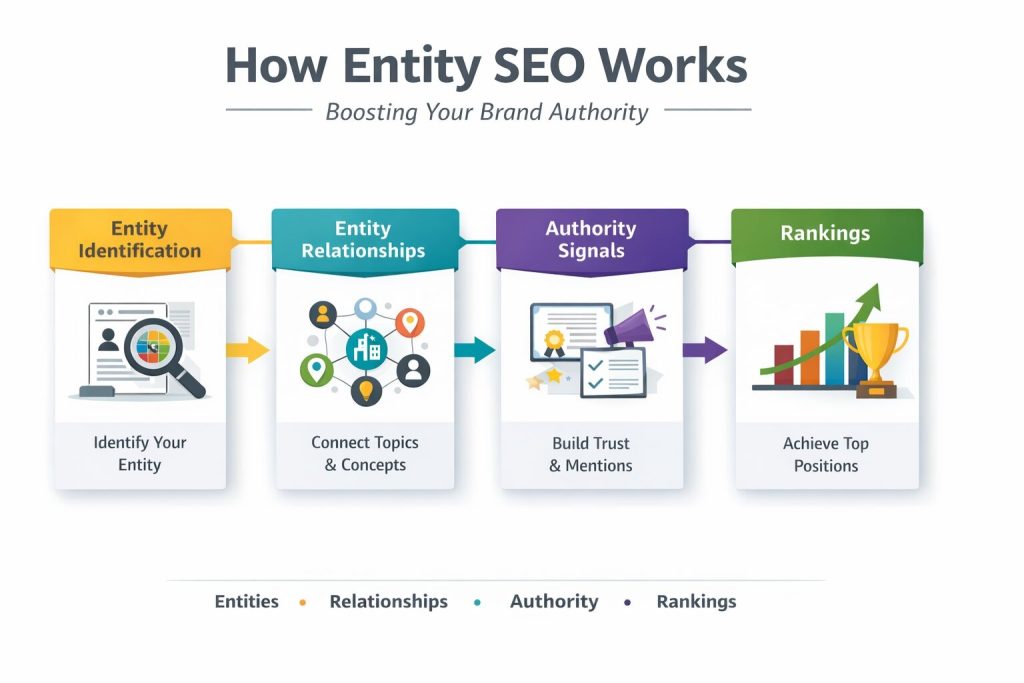
When Google understands your business as an entity, it connects you with:
- Industry topics
- Competitors
- Services
- Locations
- Customer intent
Entity based seo improves topical authority because Google understands relationships between entities rather than isolated keywords.
This approach supports semantic seo and strengthens your long-term visibility.
How Google Understands Entities
Google uses multiple systems to identify entities:
- Knowledge Graph
- Natural Language Processing
- Structured Data
- Author and Brand Signals
When Google crawls your website, it analyzes:
- Schema markup
- Internal linking structure
- Contextual relationships
- External mentions
Google’s NLP models identify named entities such as organizations, people, and products. It then connects them to its database of known entities.
For example, if your company publishes content about SaaS marketing, Google connects your brand to the SaaS entity cluster. Over time, entity based search strengthens your authority within that cluster.
This explains why knowledge graph seo is powerful. It aligns your brand with recognized concepts.
Keywords vs Entities: What Changed?
Google has evolved from keyword matching to entity recognition because language is ambiguous.
A keyword can mean many things. An entity has a clear meaning.
For example, “Apple” could mean fruit or the company. Google resolves this through entity understanding.
Here is the difference:
| Aspect | Keyword SEO | Entity SEO |
| Focus | Exact match keywords | Recognized entities |
| Strategy | Optimize for phrases | Optimize for meaning |
| Authority | Page-level | Brand-level |
| Intent Matching | Keyword-based | Context-based |
| Longevity | Short-term | Long-term compounding |
Entity SEO supports semantic seo because it focuses on relationships and context instead of repetition.
Businesses that rely only on keyword density lose visibility when Google updates its algorithms. Businesses that build entity authority remain stable.
Types of Entities Google Recognizes
Google recognizes many entity types, including:
- Organizations
- Local Businesses
- Products
- People
- Events
- Locations
- Concepts
If your brand appears consistently across authoritative sources, Google strengthens your entity profile.
Signals that help include:
- Google Business Profile
- Wikipedia references
- Structured schema markup
- Consistent NAP details
- Author bios
- Industry citations
Entity based seo connects all these signals. It tells Google that your business exists beyond a single webpage.
How the Knowledge Graph Works
The Knowledge Graph is Google’s entity database. It connects entities through relationships.
For example:
Your company → offers SEO services → operates in India → serves SaaS brands
Google stores these connections as structured data.
Knowledge graph seo ensures your brand data is:
- Accurate
- Structured
- Consistent
- Connected
When optimized correctly, your brand may earn:
- Knowledge panels
- Featured snippets
- AI-generated summaries
- Rich results
Entity SEO improves your eligibility for these placements because Google understands your identity clearly.
How to Optimize for Entity SEO
Businesses searching for agencies need practical steps. Here is how to implement entity seo effectively:
1. Implement Structured Data
Use the Organization schema. Mark up services, founders, and locations.
2. Strengthen Topical Clusters
Create entity-driven content hubs. Cover related subtopics deeply.
3. Build Author Authority
Include expert bios. Demonstrate real experience. Follow EEAT principles.
4. Maintain Brand Consistency
Ensure your brand name, address, and messaging match across platforms.
5. Earn Entity Mentions
Get listed in reputable directories and industry publications.
6. Internal Linking Strategy
Link related content to reinforce entity relationships.
If you need expert support, explore professional SEO services.
Entity SEO requires strategic planning. It demands technical expertise and content authority.
Entity SEO Examples
Consider a B2B SEO agency. Instead of targeting only “SEO services,” the agency builds entity authority around:
- Technical SEO
- SaaS SEO
- Content marketing
- Knowledge Graph optimization
It publishes structured guides, earns backlinks from reputable publications, and implements schema markup.
Over time, Google associates the brand with SEO expertise. Rankings improve across related queries.
Another example involves local businesses. When Google clearly recognizes your business entity, your visibility improves in local pack results.
This is how entity based search strengthens discoverability.
Comparison: Keyword SEO vs Entity SEO
| Aspect | Keyword SEO | Entity SEO |
| Ranking Focus | Specific phrases | Recognized brand entities |
| Content Strategy | Keyword density | Topic authority |
| Google Understanding | Text strings | Real-world entities |
| AI Visibility | Limited | Strong |
| Sustainability | Vulnerable to updates | Compounding growth |
How Entity SEO Builds Authority
Step 1: Define your core entity
↓
Step 2: Implement a structured schema
↓
Step 3: Build topic clusters
↓
Step 4: Earn authoritative mentions
↓
Step 5: Strengthen Knowledge Graph signals
↓
Result: Higher trust, better rankings, AI visibility
Does Entity SEO Help with AI Search Results?
Yes. AI-driven search systems rely heavily on entity understanding. Large language models interpret context through entity relationships.
Entity SEO improves your chances of appearing in:
- AI summaries
- Generative search experiences
- Voice search results
This makes entity based seo essential for future-proof visibility.
If your brand struggles to gain consistent search visibility, it signals weak entity recognition. A structured, strategic approach solves this.
Learn how experts implement knowledge graph SEO
Conclusion: Why Businesses Must Invest in Entity SEO
Search evolves toward understanding meaning. Entity SEO positions your brand as a recognized authority. It builds durable rankings. It strengthens trust. It aligns with semantic seo and AI search trends.
Businesses that invest early gain a competitive advantage.
If you want measurable growth, work with specialists who understand entity based search and long-term strategy.
6s Marketers delivers structured, data-driven SEO solutions that align with Google’s entity framework. Explore their SEO services.
Ready to strengthen your brand entity? Connect directly.