

Instead of browsing travel portals first, many travellers now turn to AI chat tools to plan their journeys. They ask for a quiet hotel near the old town with a courtyard and good coffee, and an AI model answers with three or four named properties. Depending on which survey you trust, somewhere between 37% and 91% of travellers are already planning this way. Chains have spent years building the brand signals that feed those answers. Boutique hotels have something better: specificity. This post covers how an AI travel recommendation gets assembled inside Google’s generative features, the five content signals that decide which properties get named, and the mistakes that keep good hotels invisible.
Here is the number that should worry any independent operator. In the first four months of 2026, 68.01% of US Google searches ended without a single click to any website, up from 60.45% in 2024, according to SparkToro’s analysis of Similarweb clickstream data. The traveller still finds a hotel. They just find it inside the answer.
We test this constantly. Run the same prompt fifty times across four assistants for a boutique property and the pattern repeats: the winner is rarely the biggest site. In one recent test for a client in Los Angeles, a smaller competitor two streets away appeared in almost every answer. That competitor had a page describing which rooms catch morning light, what the walk to the metro feels like at 11 pm, and a two-line answer to “is there parking.” That gap is what an AI travel recommendation rewards, and it is fixable in weeks.
Key Takeaways
- Specificity beats polish in AI answers.
- Google’s systems fan out into subqueries.
- Structured data helps, but content decides.
- Business Profile accuracy feeds local recommendations.
- Guest review language shapes model summaries.
- Vague brand copy gets skipped entirely.
How AI Models Recommend Hotels vs Traditional Search
Traditional search returns a ranked list and lets the traveller sort it out. Generative features do the sorting first, then show a shortlist with supporting links. Google describes two mechanics behind this. The first is retrieval-augmented generation, where the model pulls current pages from the Search index and grounds its answer in them. The second is query fan-out, where the model issues a set of concurrent related searches to gather more information than the original question contained.
Fan-out is the part that matters for hotels. A traveller types one sentence. The system quietly runs eight or ten adjacent searches around it: walkability, breakfast, family suitability, noise, cancellation terms. A property that answers only the headline question loses to a property that answers the invisible ones.
The commercial stakes are already measurable. SparkToro’s research found AI Overviews now appear on more than 20% of Google searches, and when they do, click-through rates fall by roughly 60%. Being named in the answer has become worth more than the position underneath it.
The Rise of AI Travel Search in Modern Trip Planning
Adoption rates differ significantly across studies, so it’s important to examine the data carefully before making investment decisions. Allianz Partners’ 2026 Global Travel Confidence Index, polled by Ipsos across 2,001 US adults between 20 March and 14 April 2026, found that 37% of Americans planning summer trips are using AI travel search to plan. Klook’s annual survey of 11,000 global users put the figure at 91%. Both are real. They measure different things: one asks Americans about active use for a specific trip, the other asks a global travel-platform audience about reliance in general.
Treat 37% as the conservative floor for a Western market and ignore the headline percentages after that. The direction is what matters, and the direction is one-way. Google said at I/O 2026 that AI Mode had passed one billion monthly users, with query volume more than doubling each quarter.
Choosing a hotel is exactly the kind of problem these systems handle well: budget, location, vibe, and dates weighed together. Google’s own framing is that AI Mode suits queries needing exploration, reasoning, or complex comparison. It also notes that AI features can show a wider and more diverse set of links than classic web search. For a fourteen-room property that will never outrank an OTA on a head term, that widening is the opening.
Why Boutique Hotels Must Optimize for AI Travel Search
Chain hotels win generic queries because their entity data is everywhere and consistent. Boutique properties win qualified ones. “Hotel in Lisbon” belongs to the chains. “Quiet hotel in Alfama with a rooftop, walkable to Fado bars, good for a solo traveller” belongs to whoever wrote about Alfama honestly.
That second query converts far better, and it is where AI travel recommendation visibility pays for itself. The catch is that most boutique sites were built as brochures. Beautiful photography, three paragraphs of atmospheric copy, no answers.
One counterpoint worth holding on to: SparkToro found only 0.34% of searches actually transitioned into AI Mode between January and April 2026. Anyone selling you a panic-priced GEO retainer on the strength of AI Mode alone is ahead of the data. The compounding growth rate is the reason to act, and the work overlaps almost entirely with good travel SEO anyway. If you are auditing your own pages, our breakdown of which content formats win in AI search is a reasonable starting point.
Working through this for a property portfolio? Talk to our travel SEO team about a content signal audit.
How AI Chooses Which Travel Recommendations to Surface
Selection runs on the same foundations as organic ranking. Google is direct about it: there are no additional requirements to appear in AI Overviews or AI Mode, and no special optimisations necessary. A page has to be indexed and eligible to show with a snippet. That is the entry ticket.
After that, quality decides. Google’s guidance singles out non-commodity content, contrasting generic listicles with pieces built on first-hand experience. Their own example sets a commodity homebuying tips post against a specific write-up of a sewer line inspection. Hotels face that same choice every time they publish.
Traditional Travel SEO vs AI Optimization: A Practical Comparison
| Traditional Travel SEO | AI Optimization |
| Targets one primary keyword per page | Answers a cluster of fan-out subqueries |
| Success measured by position on a SERP | Success measured by inclusion in a generated answer |
| Rewards page-level authority and links | Rewards extractable, verifiable, specific claims |
| Content written to rank | Content written from first-hand operational knowledge |
| Meta description drives the click | Direct answer paragraph drives the citation |
| Reviews treated as a conversion asset | Reviews treated as a language and evidence source |
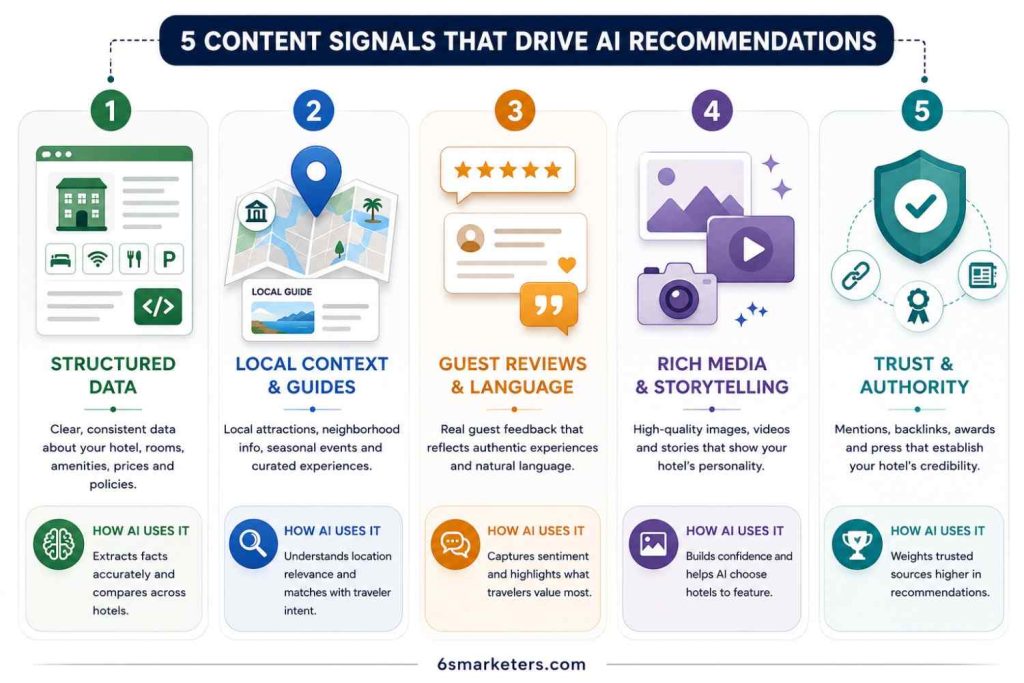
5 Content Signals AI Uses to Recommend Travel Brands
Five signals came up repeatedly across the hospitality sites we have worked on. They are ordered by how quickly they move.
Signal 1: Property Facts Written as Direct Answers
Models extract claims. Claims need to sit in clean, quotable sentences. “Check-in is from 2 pm, and we hold luggage from 9 am” gets used. “Arrive whenever the day suits you” does not.
Go through every question your front desk answers weekly and give each one a plain sentence somewhere on the site. Parking. Lift access, whether the courtyard rooms hear the bar. Pet policy with the actual weight limit. These twenty signals are likely to have a greater impact on AI travel recommendations than simply expanding your content with more narrative.
Signal 2: Hyperlocal Context Only Locals Can Write
This is the signal chains cannot copy. Fan-out queries reach for neighbourhood context, and almost nobody supplies it well.
One client rewrote a generic “explore the city” page into a walking guide with timings from their own front door: eleven minutes to the market, which stalls open before eight, which street floods after heavy rain. Their inclusion rate in local hotel prompts improved over the following 6 to 12 weeks. Nothing else on the site changed in that window. Write what you would tell a friend arriving at midnight.
Signal 3: Consistent Entity Data Across Every Platform
Conflicting information makes a property risky to recommend. If your site says 14 rooms, Booking.com says 16, and your Business Profile lists an old phone number, a model has no stable fact to state.
Google’s guidance for AI features includes keeping Merchant Center and Business Profile information current, and ensuring structured data matches the visible text on the page. Worth noting: Google also states plainly that structured data is not required for generative AI search and no special schema markup exists for it, though it remains useful for rich results. Treat schema as hygiene rather than as the strategy. Our Google generative AI search optimization guide covers the implementation detail.
Signal 4: Guest Review Language You Can Actually Shape
Models summarise sentiment, and they borrow the words guests use. If reviews repeatedly say “tiny but spotless,” that phrase enters the description of your property.
You cannot write reviews. You can influence vocabulary. A property that asks departing guests one specific question: what surprised you about the location? gets reviews about the location. Over a few hundred reviews, that steers how your hotel gets characterised in generated answers.
Signal 5: Third-Party Corroboration From Trusted Sites
Independent mentions act as verification. Independent citations across food blogs, tourism directories, and news articles provide supporting evidence that reinforces the accuracy of your website’s claims.
Google warns against chasing inauthentic mentions, and the warning is fair. Earned coverage works. Bought directory placement does not, and the systems behind AI answers also filter spam.
Common Mistakes Boutique Hotels Make in AI Travel Search
Three patterns show up in almost every audit.
Writing atmosphere where a fact belongs. “Steps from the historic quarter” is unusable. “A four-minute walk to the cathedral square” is usable. Distance, minutes, direction.
Chasing GEO for hotels as a separate discipline. Teams add llms.txt files and chop pages into fragments. Google explicitly lists both as unnecessary, and the effort would be better spent on the answers your front desk already knows.
Leaving the Business Profile to whoever set it up in 2019. Local business details feed directly into how AI responses describe you. Stale hours quietly disqualify a property.
Auditing your own pages against these patterns? Request a content signal review, and we will map the gaps.
AI Travel Recommendation Checklist for Boutique Hotels
Run this quarterly. It takes an afternoon.
- List the twenty questions your front desk answers most. Answer each in one sentence on the site.
- Rewrite one atmospheric page as a fact-dense local guide with timings and distances.
- Audit room count, address, phone, and hours across your site, Business Profile, and every OTA listing.
- Confirm structured data matches visible page text.
- Check that no robots.txt or CDN rule blocks crawling.
- Ask one specific question in your post-stay email to shape review vocabulary.
- Run your own top ten traveller prompts across two AI assistants and record who gets named.
- Open the Generative AI performance report in Search Console and track movement.
Monthly prompt testing separates hotels who are guessing from hotels who know. For the answer-formatting side, our notes on AEO strategies to get featured in AI answers go deeper.
Conclusion
AI recommendations frequently favour well-optimised properties over those with the deepest marketing pockets. They are the ones that wrote down what they actually know. How long the walk really takes. Which rooms suit light sleepers, what the neighbourhood does on a Sunday. That knowledge sits in the heads of the people running the hotel, and it almost never makes it onto the website.
Start with the twenty questions your front desk answers every week. Publish plain answers to all of them. Fix the entity data that contradicts itself across platforms. Use the same prompts each month and analyse how the outputs change as AI systems evolve. An AI travel recommendation is assembled from evidence, and evidence is something a fourteen-room hotel can produce faster than a chain can. The advantage here belongs to operators who are willing to be specific in public. Most still are not, which is precisely why the window is open.
Sources
- Google Search Central: Optimizing your website for generative AI features on Google Search.
- Google Search Central: AI features and your website:
- Search Engine Land: Google zero-click searches hit 68% in early 2026: Study
- CNBC: Travelers use AI to plan trips despite hallucinations and trust gaps (Klook survey of 11,000 global users):