

Here’s what we have noticed after working across B2B SaaS content strategies: the content that actually moves someone from “interested” to “signing the contract” is almost always underfunded, under-strategized, or completely absent. That’s the bottom of the funnel — and it’s where your pipeline lives or dies.
BOFU content (bottom of the funnel) is the content that speaks to people who are already problem-aware, vendor-aware, and actively evaluating their options. They don’t need to be educated about the industry. They need a value in your solution to choose you. That’s a completely different job — and it requires completely different content.
This post covers 12 BOFU content examples that work in real B2B SaaS environments, the mistakes that quietly kill conversion, and how to measure whether any of it is actually working.
Key Takeaways
- BOFU content converts high-intent, ready-to-buy prospects into customers.
- Comparison pages, case studies, and ROI tools are proven BOFU converters.
- Most SaaS teams underproduce BOFU content relative to its revenue impact.
- Internal champion content helps deals survive procurement scrutiny.
- BOFU success is measured in pipeline velocity, not traffic or impressions.
- Pair BOFU content with a revenue-focused SEO strategy for compounding returns.
What Is BOFU Content and Why It Deserves Its Own Strategy
BOFU content targets buyers who are already deep in the decision process. They’ve done the research. They know what category of solution they need. What they’re doing now — often across a buying committee of 6 to 10 people — is vetting vendors, building internal consensus, and trying to reduce risk before they sign.
The job of BOFU content is not to inform. It’s to reassure, validate, and accelerate. That’s a subtle but critical distinction.
Why BOFU Content Matters in B2B SaaS Content Strategy
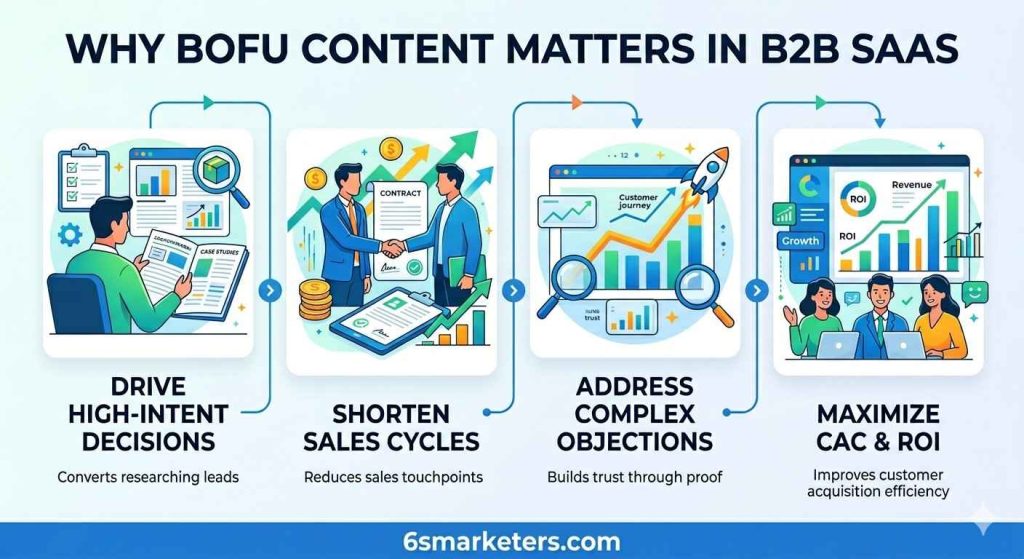
The B2B SaaS buying process has changed dramatically. Buyers now complete 60–70% of their research before speaking to a sales rep, according to Gartner. That means your content is your first sales conversation — and if your BOFU content isn’t doing the heavy lifting, your reps are starting every call at a disadvantage.
Beyond that, BOFU content does something TOFU and MOFU content simply cannot: it directly influences revenue. A well-crafted comparison page can bring in a prospect who was already leaning toward a competitor. A detailed implementation case study can help a champion sell internally. A free ROI calculator can give a CFO the number they need to approve the budget.
The investment-to-return ratio for content marketing for B2B SaaS is highest at the bottom of the funnel. You’re reaching fewer people — but the right people. An SEO content strategy that drives leads starts with understanding where in the funnel your content is actually working.
12 BOFU Content Ideas That Actually Drive B2B SaaS Conversions
BOFU Content Type vs. Goal
| BOFU Content Type | Primary Goal |
| Competitor Comparison Pages | Capture switching intent |
| Detailed Case Studies | Validate outcomes with specifics |
| ROI Calculators | Give CFOs the number to approve budgets |
| Free Trial / Demo Landing Pages | Reduce friction to the first experience |
| “Best [Category] Software” Pages | Capture high-intent BOFU keywords |
| Security & Compliance Docs | Reduce procurement risk |
| Implementation Guides | Address “what happens after I buy” fear |
| Internal Champion Decks | Help buyers sell internally |
| Objection-Handling Content | Pre-empt sales call blockers |
| Video Walkthroughs / Demo Videos | Build confidence before the sales call |
| Customer Reviews & Third-Party Validation | Borrow trust from familiar sources |
| Pricing Pages (Done Right) | Qualify intent and accelerate decision |
1. Competitor Comparison Pages Targeting High-Intent BOFU Keywords
If someone is Googling “[Your Product] vs. [Competitor],” they are not browsing. They have a budget, a shortlist, and a decision timeline. A well-constructed comparison page — one that’s honest about trade-offs, not just a feature-by-feature table designed to make you look perfect — converts at a dramatically higher rate than almost any other content type.
The key is transparency. When ClickUp built comparison pages against Asana and Monday.com, they didn’t pretend to be perfect for every use case. That honesty is exactly what built trust with buyers who were already skeptical of vendor-produced content.
2. Detailed Case Studies With Actual Numbers
“Our client saw great results” is not a case study. It’s a testimonial dressed up as content. Real BOFU case studies include specific metrics, a clear before-and-after scenario, and — crucially — the implementation context. What was the team size? How long did onboarding take? What almost went wrong?
A case study that says “reduced churn by 18% within 60 days for a 200-person SaaS company using Salesforce and Intercom” is infinitely more useful to a late-stage buyer than “Acme Corp loves our platform.”
3. ROI Calculators That Give Finance Teams a Number
Every CFO approving a SaaS spend wants one thing: a defensible number. An ROI calculator that’s built on realistic assumptions — not best-case scenarios — gives your champion exactly what they need to get budget approval.
The best ones are industry-specific. Drift’s “revenue calculator” wasn’t generic; it was built around pipeline velocity and conversion rates that matched how their target accounts actually operated. That specificity is what makes calculators credible instead of just optimistic.
4. Free Trial and Demo Landing Pages That Actually Convert
The free trial or demo request page is arguably the most important page in your entire content ecosystem — and most SaaS companies treat it as an afterthought. The copy matters. The friction level matters. What happens after someone clicks matters enormously.
A landing page that clearly answers “what will I experience in this demo” and “who is this for” will outperform a generic “schedule a call” page consistently. Show what the demo covers. Set a specific expectation. Respect the prospect’s time.
5. “Best [Category] Software” Pages Optimized for BOFU Keywords
These are one of the most underutilized bottom of the funnel marketing examples in B2B SaaS. Someone searching “best project management software for remote teams” is actively building a shortlist. A well-SEO’d page on your site that includes yourself alongside credible competitors — while clearly explaining who each tool is best for — positions you as an authoritative, trustworthy source rather than a self-promotional vendor.
This approach works because it intercepts high-intent BOFU keywords at the exact moment of evaluation.
6. Security and Compliance Documentation
This one is routinely underestimated. For enterprise and mid-market SaaS, security documentation is a conversion asset. The CISO needs to review it. The legal team wants to see data residency policies. Procurement wants your SOC 2 Type II report.
Making this content accessible, readable, and easy to share internally removes one of the biggest friction points in enterprise deals. Vanta has done this well — their trust center is public, comprehensive, and clearly designed to accelerate deals, not just satisfy regulatory checklists.
7. Implementation and Onboarding Guides (Pre-Sale)
One of the biggest fears a B2B buyer carries into a purchase decision is “what happens after I sign?” The implementation risk — disruption to current workflows, migration complexity, team adoption — is often the silent deal-killer that never surfaces on a sales call.
Pre-sale implementation guides that walk through onboarding timelines, integration requirements, and what “day one” actually looks like remove that fear before it becomes an objection. It’s proactive BOFU content that turns uncertainty into confidence.
8. Internal Champion Content
Most SaaS deals are not decided by the person you’re selling to. They’re decided in meetings you’re not in — where your champion is trying to build consensus across Finance, IT, Legal, and Operations. Internal champion content arms them with the right language, the right data, and the right objection responses to win those conversations.
This could be a one-pager, a slide deck, or an executive summary specifically formatted for sharing internally. Its content is designed not for the champion, but through the champion.
9. Objection-Handling Content
Every SaaS product faces recurring objections: “It’s too expensive,” “We tried something like this before, and it didn’t stick,” “Our current tool does 80% of this.” Most of these objections are predictable. Most companies never address them in writing, which means they keep resurfacing on calls, slowing down the sales cycle.
A dedicated FAQ page or objection-specific blog posts that directly address these concerns reduces sales friction significantly. And it signals confidence — companies that openly address objections come across as more trustworthy than those that deflect.
10. Product Walkthrough Videos and Demo Videos
The gap between what someone imagines your product looks like and what it actually is can be enormous. A well-produced demo video — not a marketing reel, but an actual walkthrough of the interface solving a specific problem — reduces that gap before the sales call.
Loom built significant adoption momentum partly because its product walkthrough videos were embedded across its BOFU content. Prospects arrived at sales conversations already having seen the product in action, which compressed the sales cycle noticeably.
11. Third-Party Validation and Review Platform Content
G2, Capterra, and TrustRadius reviews are consulted by a significant portion of B2B SaaS buyers during the final evaluation stage. Your presence on these platforms — and the quality and recency of your reviews — is effectively BOFU content you partially control.
A strategy of proactively requesting reviews from successful customers, and responding thoughtfully to critical ones, turns third-party platforms into conversion assets rather than risk factors.
12. Pricing Pages That Qualify and Accelerate
A well-designed pricing page doesn’t just list tiers. It answers the questions buyers are actually asking: “Is this within our budget range? What’s included at each level? When does it make sense to move to the next tier?” Hiding pricing to force a sales call is a declining strategy — most buyers will simply move to a competitor who’s more transparent.
A pricing page that includes use-case guidance (“Teams under 50 people typically start here”) respects the buyer’s intelligence and accelerates the decision. If this is an area you want to strengthen across your entire B2B SaaS content strategy, 6S Marketers can help you build it right.
Common BOFU Content Mistakes That Kill Conversions
Writing for the wrong stage
BOFU content that reads like educational blog content misses the point entirely. At the bottom of the funnel, buyers already know what the problem is. They need to know why your solution is specifically.
Vague social proof
Case studies without specific numbers and context are not BOFU content. They’re marketing decoration. A buyer evaluating vendors can’t do anything with “significant improvement” — they need metrics.
Ignoring the buying committee
B2B SaaS purchases involve multiple stakeholders. BOFU content that only speaks to one decision-maker — typically the business owner or end user — fails to address the concerns of Finance, IT, and Legal, who may hold veto power.
Forgetting the “what happens after I buy” question
Implementation fear is real and almost universally underdressed in SaaS BOFU content. Addressing it proactively is a significant competitive differentiator.
Not connecting BOFU content to a broader strategy
BOFU content works best when it’s part of a revenue-focused SEO strategy — not a collection of one-off pieces created reactively.
Ready to build a BOFU strategy that actually converts? Talk to the team at 6S Marketers.
How to Measure BOFU Content Success
Traffic is the wrong metric for BOFU content. The right metrics are:
- Pipeline influence: On which content assets are being viewed by contacts in active opportunities? Most modern CRMs and marketing automation platforms can track this with proper UTM tagging.
- Sales cycle velocity: Are deals where prospects engaged with specific BOFU content closing faster than deals where they didn’t?
- Assisted conversions: Not just last-touch, but also which content appeared in the conversion path before the demo or trial request?
- Internal sharing rate: Are leads sharing your content with their colleagues? This is often an overlooked signal of strong BOFU content.
- Deal close rate by content engagement: Track whether prospects who engaged with specific content types (e.g., case studies, ROI calculators) have a meaningfully different win rate.
These are pipeline metrics, not content metrics. BOFU content should be held to the same standard as any other revenue-generating activity.
Conclusion
The content that wins deals is rarely the content that gets the most traffic. BOFU content operates in a different register entirely — it’s precise, specific, honest, and built around the actual decisions buyers are trying to make.
The 12 ideas above aren’t new formats. They’re formats most SaaS companies already have — but rarely execute with the depth, specificity, and strategic intent that actually converts. A competitor comparison page that’s truly honest outperforms a self-congratulatory one. A case study with real numbers outperforms one with vague superlatives. An implementation guide that addresses real fears outperforms a marketing brochure.
The investment is the same. The conversion rate is not.
If you’re looking to build a B2B SaaS content strategy that connects the funnel to revenue — not just traffic — start a conversation with 6S Marketers here.
External Sources
- Gartner Research — The New B2B Buying Journey