

Your SEO report indicates climbing rankings, a decent uptick in organic traffic, and a shiny new batch of backlinks. Your CFO leans in and asks the one question the report can’t answer: “So what did we actually earn from this?”
That moment is uncomfortable. And it is becoming far too common.
The truth is that most SEO services are built to impress dashboards, not boardrooms. Traffic serves a purpose but is not an end in itself. The companies that are winning with search today are the ones that made a conscious decision – they treat search engine optimization like a commercial engine, not a brand-building side project.
When building your revenue-focused SEO strategy, each keyword choice, content choice, and technical improvement you make is tied to something that matters: qualified pipeline, sales conversations, and closed revenue.
Here is how to build one that holds up.
Key Takeaways
- Tie SEO decisions directly to pipeline outcomes.
- High-intent keywords outperform high-volume ones.
- Content must serve every stage of the buying journey.
- Measure organic leads, not just organic visits.
- Connect your SEO stack to your CRM data.
- Avoid vanity metrics that look great but don’t have any meaning.
- SEO compounds — consistency is your biggest advantage.
What is a Revenue-Focused SEO Strategy?
A revenue-focused SEO strategy is one where the north star is commercial outcome, not search position.
That distinction matters more than it sounds. Traditional SEO programs celebrate when a page climbs from position eight to position three. A revenue-focused program asks what happened to demo requests, lead quality, and pipeline value after that movement. If the answers are flat, the ranking improvement is interesting, not impactful.
What makes this shift genuinely powerful is that it forces alignment across teams. When your SEO program is measured by the same metrics your sales and revenue teams care about — qualified leads, opportunity creation, customer acquisition cost — it stops being a marketing activity and becomes a business growth function.
This is not about abandoning keyword research or ignoring technical health. It is about ensuring that every SEO decision flows through a commercial filter first. Does this keyword attract buyers or browsers? Does this content page serve someone who is evaluating a purchase or someone who has just discovered the category? Will this technical fix help our highest-converting pages rank better?
Those are the questions a revenue-focused SEO strategy answers every single day.
Key Components of Revenue-Driven SEO
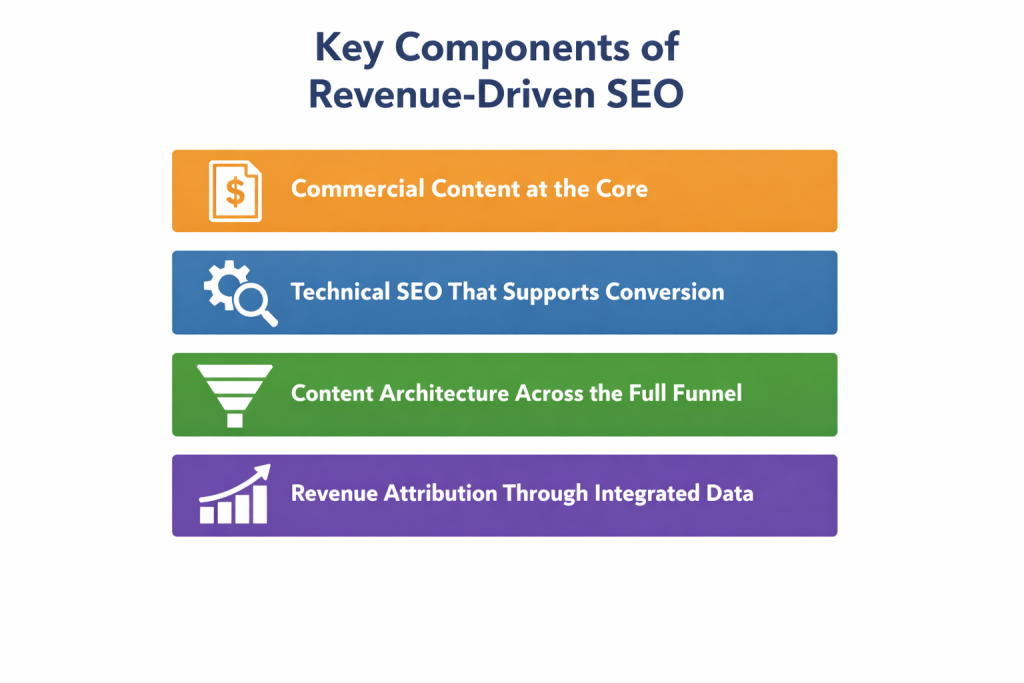
Here are the four pillars that separate a revenue-driven SEO program from a conventional one:
Commercial Content at the Core
Every content asset needs a commercial reason to exist. That does not mean every page should be a sales pitch — far from it. It means every piece of content should be built for someone who is on a path toward a buying decision, whether they are three weeks or three days away from it.
Technical SEO That Supports Conversion:
Site speed, mobile performance, crawlability, and structured data are not just engineering concerns. They determine whether your most valuable pages actually get found and whether buyers stay long enough to trust what they find. A technically sound website gives your commercial content the platform it needs to perform.
Content Architecture Across the Full Funnel
Your SEO program should answer questions at every stage of the buyer journey, from early awareness through active evaluation and final decision. A program that only targets top-of-funnel queries will generate traffic but struggle to convert it. Mapping content intentionally across all three stages is what builds a predictable SEO for lead generation machine.
Revenue Attribution Through Integrated Data
This is the piece most SEO programs skip, and it is the most important. Connecting your analytics platform, your SEO tools, and your CRM allows you to track which organic search visits actually became leads, which leads became opportunities, and which opportunities closed. Tools like Google Analytics 4 provide the event-based measurement infrastructure needed to make this attribution possible at scale.
Mapping SEO to the Sales Funnel
One of the most practical ways to make SEO revenue-focused is to stop thinking about it as a single channel and start thinking about it as a funnel-stage system.
Each stage of the buyer journey demands different content, different keywords, and different conversion goals.
Top of Funnel — Build Awareness
Buyers here are problem-aware but solution-unaware. They are searching for context, education, and category understanding. Blog posts, industry guides, and trend reports live here. This content builds brand familiarity and organic reach, but it rarely converts directly. Think of it as planting seeds.
Middle of Funnel — Drive Evaluation
This is where the real commercial leverage lives. Buyers at this stage are actively comparing options, researching approaches, and trying to understand which solution fits their specific situation. Understanding search intent in SEO at this stage is critical — a buyer searching “best enterprise analytics tools for financial services” has a very specific need, and content that speaks directly to that need will outperform generic alternatives every time.
Bottom of Funnel — Enable Decisions
Pricing pages, product comparison pages, case studies, and ROI calculators belong here. These pages often attract the lowest search volumes, but they draw buyers who are ready to act. Underinvesting in BOFU content is one of the most expensive mistakes SEO teams make, because this is where organic search most directly touches revenue.
A well-balanced revenue-focused SEO strategy deliberately allocates resources across all three stages rather than defaulting to wherever the traffic numbers are largest.
Keyword Strategy for Revenue Growth
Most keyword strategies start with search volume. A revenue-focused keyword strategy starts with buyer intent — and works backward from there.
The core question is not “how many people search this?” It is “who searches this, and what are they trying to do?”
A broad awareness keyword might attract 50,000 monthly searches. A decision-stage keyword might attract 500. But if that smaller pool is made up entirely of buyers who are one conversation away from signing a contract, the 500 is more valuable. That trade-off is at the heart of keyword strategy for revenue growth.
Here are the practices that make this tangible:
Use your paid search data as a keyword intelligence source:
Your PPC campaigns have already told you which keywords convert into leads that sales teams actually want. Those terms are your SEO priority list. The integration between paid and organic search strategy is one of the most underutilised advantages available to integrated marketing teams.
Target specificity, not just volume:
Long-tail keywords that mirror specific buyer questions — “how to reduce customer churn in SaaS” or “procurement software for mid-market manufacturing” — convert at significantly higher rates than broad category terms because they match real intent precisely.
Build topic clusters around commercial themes:
Rather than targeting individual keywords in isolation, group them into thematic clusters that position your brand as the authoritative answer on commercially important subjects. This improves ranking potential while also giving buyers a more complete journey through your site.
Let search intent guide content format:
A buyer searching for a comparison wants a structured breakdown, not a narrative essay. Understanding the intent behind a keyword shapes what kind of content you build, not just what topic you cover.
Measuring SEO ROI
This is the section most SEO reports deliberately avoid, and it is the most important one for marketing leaders to demand.
Measuring SEO ROI is not complicated in theory. It requires connecting what organic search produced — qualified leads, opportunities, closed revenue — to what the program cost in time, tools, and resources. The gap between that theory and most companies’ practice is a reporting infrastructure problem, not an SEO problem.
Start with these SEO performance metrics to build a revenue-connected measurement model:
Organic-sourced leads and MQLs
Set up conversion tracking for every meaningful action — demo requests, contact form fills, content downloads, free trial sign-ups — and filter by organic source. This is the most direct line between SEO activity and commercial output.
Cost per organic lead
Divide your total SEO investment by the number of qualified organic leads generated in a period. Track this over time and compare it against your paid channels. For most mature SEO programs, the cost per lead through organic search is significantly lower than paid equivalents — and that gap widens as the program compounds.
Organic pipeline contribution
Work with your sales team to tag leads by acquisition source in your CRM. Over time, you will be able to measure not just how many leads SEO generated, but what percentage of your total pipeline and closed revenue it touched.
Keyword-to-conversion mapping
Not all ranking keywords drive leads equally. Identifying which keyword clusters actually produce pipeline — not just traffic — allows you to invest future content resources where they generate the highest commercial return.
The goal is to walk into a revenue review with the same confidence your paid media team has. SEO can absolutely support that — but only when the measurement infrastructure is built for it.
Common Mistakes to Avoid
Even well-resourced programs make predictable errors that undermine their revenue impact. These are the ones worth addressing directly.
Optimising for traffic instead of intent
High traffic from people who will never buy is not an asset — it is a distraction. Every significant keyword investment should pass a simple test: Are the people who search this term realistic buyers?
Over-indexing on top-of-funnel content
TOFU content is important, but it is not where revenue is created. Programs that chase traffic volume at the expense of decision-stage content will always struggle to demonstrate direct commercial impact.
Failing to connect SEO data to revenue data
If your SEO reporting and your sales reporting live in separate systems with no shared language, attribution will always be incomplete. This integration is not optional for a revenue-focused program — it is the foundation.
Treating SEO as a short-term project
The compounding nature of organic search means the strongest returns often come in year two and year three, not month two. Programs abandoned before that window closes consistently underperform their potential.
Celebrating rankings without asking what they produced
A first-page ranking for a valuable keyword is a good sign. Whether that ranking actually moved the revenue needle is the only question that matters.
Conclusion
Building a revenue-focused SEO strategy is not about reinventing your organic search program from scratch. It is about reorienting it toward what actually matters.
That means choosing keywords for commercial intent, not just search volume. It means building content across the full buyer journey, not just the top of the funnel. It means connecting your SEO stack to your revenue data so attribution is real, not assumed. And it means measuring success in the language of your CFO, not your analytics platform.
The SEO programs that endure — and that earn internal investment year after year — are the ones that can show their work in pipeline terms. Traffic reports impress. Revenue attribution convinces.
Start building toward the standard that convinces. Connect with us!
What’s the single biggest gap between your current SEO reporting and what your revenue team actually needs to see? Drop your thoughts below — this is a conversation worth having.