

You already know you need SEO help. That part’s not hard. The hard part is figuring out which agency won’t burn six months of your budget and then blame the algorithm when nothing works.
Knowing how to choose an SEO company is genuinely difficult — not because the information isn’t out there, but because most of it is written by agencies trying to win your business. So let’s skip the framing. We have watched companies make this decision well, and badly. The ones who get it wrong usually have one thing in common: they evaluated agencies on presentation quality, not on evidence.
This is the version of that conversation that skips the pitch.
Key Takeaways
- Vet agencies by results, not just by reputation or pitch decks.
- Define your SEO goals before reaching out to any agency.
- Transparency in reporting is non-negotiable — demand it upfront.
- Cheap SEO often signals dangerous shortcuts, not smart budgeting.
- Agency fit matters as much as agency capability.
- Ask for case studies in your specific industry vertical.
- Tie every SEO investment to business outcomes, not just rankings.
Why Choosing the Right SEO Services For Business Matters
Most people frame this as a “how do I find a good one” question. It’s actually a “how do I avoid a bad one” problem. Because a bad agency doesn’t just fail to deliver — it can leave things measurably worse than before you hired them.
Google’s spam policies are explicit about manipulative link schemes and cloaked content. Those tactics still get used. Quietly, by providers who know you won’t notice until a manual action lands in your Search Console. Recovery from that? Months. Sometimes longer. The agency is usually long gone by then.
On the other side — when SEO services for businesses are built on real technical work, content depth, and earned link authority — the compounding is real. A mid-market SaaS company that committed to SEO for 18 months saw its organic channel outperform paid acquisition by month 14. Lower cost per lead. Higher intent signals. Better close rates downstream. That’s not an edge case.
This decision isn’t procurement. It’s a strategy.
Define Your SEO Goals
Before you talk to a single agency, get specific about what you actually want from this. “More traffic” is not a goal — it’s a wish. “Ranking in the top three for our core product category in two specific markets within 12 months” is something you can hold someone accountable to.
Why does the distinction matter? Because it changes everything about the type of agency that fits. A business trying to win local search in three cities has almost nothing in common with a B2B software company trying to capture informational intent at the top of a 6-month purchase cycle. If you want to build a revenue-focused SEO strategy, the agency you hire needs to understand how organic rankings connect to actual pipeline — not just sessions and impressions.
Before making any calls, work through these questions:
- Are we recovering lost rankings, or building from a near-zero baseline?
- Do we need local reach, national scale, or international coverage?
- Is the primary goal awareness, inbound leads, or direct e-commerce revenue?
- What does success look like at 6 months? What about 18?
The answers sharpen your brief fast — and quickly expose agencies whose packages don’t bend to your actual situation.
What SEO Services For Business Does an SEO Agency Offer?
A good agency doesn’t sell you “SEO” as a single service. They diagnose where you are, then build a mix of services that address the actual gaps — and they’re clear about what’s relevant for your situation versus what isn’t.
The core services worth expecting include technical audits covering crawlability, Core Web Vitals, and site architecture; on-page optimization; content strategy and execution; link building through digital PR or editorial outreach; and local SEO, where applicable. More mature agencies also offer competitive gap analysis, schema implementation, and international SEO if your market spans regions.
What separates strong agencies from average ones isn’t the list of services they offer — it’s how they sequence and prioritize them. An agency that leads with link building before fixing critical indexation issues is optimizing for deliverables they can show you, not for your actual growth. That’s a real pattern worth watching for.
Questions to Ask SEO Agencies Before Hiring
When figuring out how to pick an SEO company, the quality of your questions matters more than most people expect.
“Can you share with me a case study from a business in my industry or at a similar scale?” Generic wins mean almost nothing. You want evidence they’ve navigated your competitive landscape, not a different one.
“Who exactly will work on my account day-to-day — and what’s their background?” As a common practise in many agencies, a senior person sells, and a junior person delivers. Know who you’re actually getting before you sign.
“How do you report on results, and how do you connect those metrics to business outcomes?” If the answer is only about the rankings and traffic, you have to push further. Those are inputs. Revenue and pipeline are outputs.
“What’s your approach to content — do you own the writing, or do we?” Agencies for whom content is merely a checkbox, rather than a main asset, are often where campaigns quietly fail.
“Did you ever manage a website through a Google penalty? How did that go?” Their answer reflects on both their technical depth and their risk tolerance.
Ready to have these conversations with an agency that actually engages with them? Connect with our team — no pitch deck, just a straight conversation about what you’re working with.
Red Flags You Should Avoid
A few patterns keep coming up — and they’re worth naming without softening.
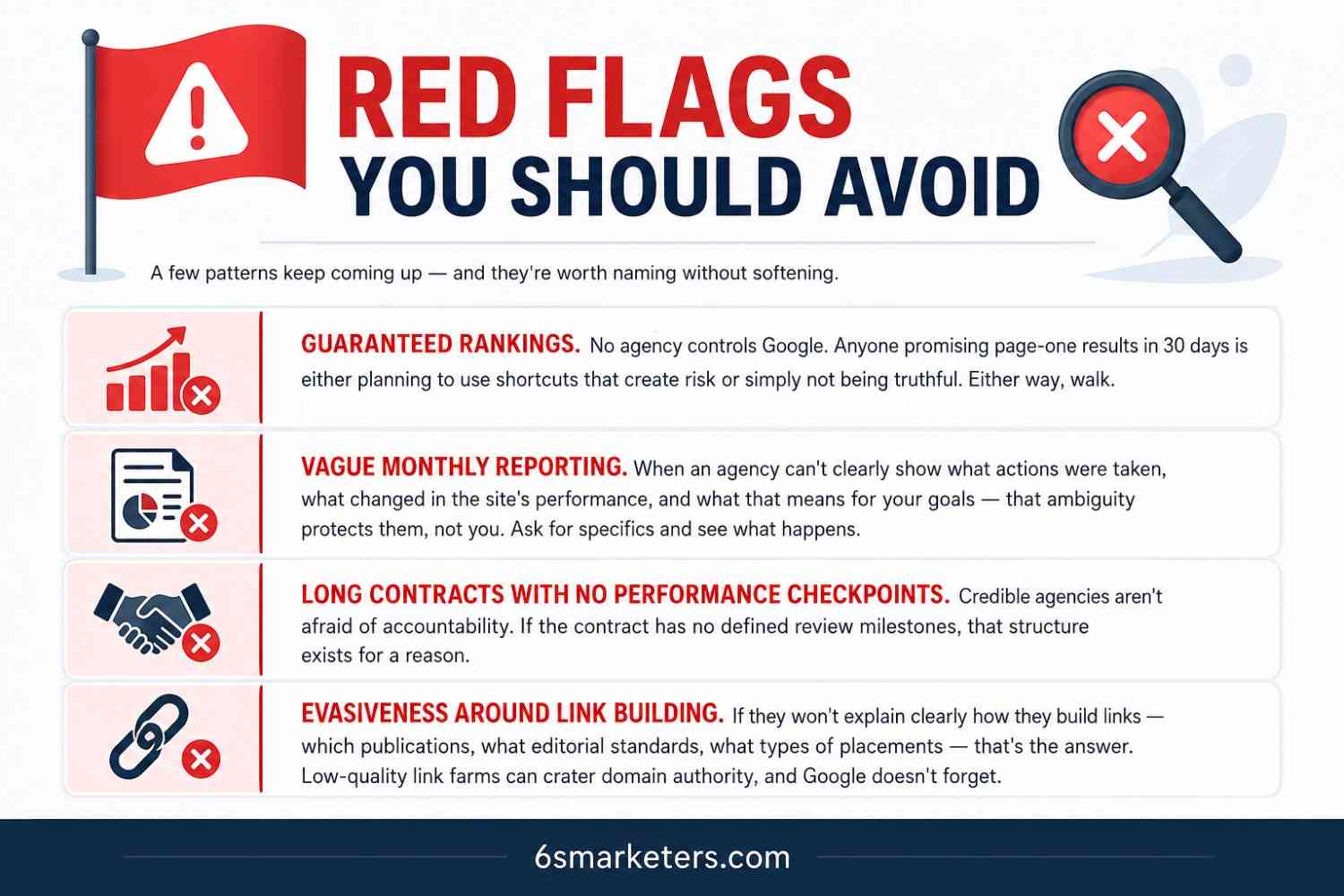
Guaranteed rankings. No agency controls Google. Anyone promising page-one results in 30 days is either planning to use shortcuts that create risk or simply not being truthful. Either way, walk.
Vague monthly reporting. When an agency can’t clearly show what actions were taken, what changed in the site’s performance, and what that means for your goals — that ambiguity protects them, not you. Ask for specifics and see what happens.
Long contracts with no performance checkpoints. Credible agencies aren’t afraid of accountability. If the contract has no defined review milestones, that structure exists for a reason.
Evasiveness around link building. If they won’t explain clearly how they build links — which publications, what editorial standards, what types of placements — that’s the answer. Low-quality link farms can crater domain authority, and Google doesn’t forget.
Freelancer vs SEO Agency
Honest answer: it depends on the scope, and most comparisons gloss over that.
A skilled independent SEO consultant can be exceptional for defined, focused work — a technical audit, a keyword strategy for a specific product line, or a content gap analysis. They’re often more accountable because there’s no team layer between you and the person doing the work.
But for sustained programs requiring technical SEO, content production, and link building to run in parallel and build on each other, agencies usually have the staffing depth to execute without gaps. The risk with freelancers is what happens when one person gets sick, lands a bigger client, or changes direction. The risk with agencies is that your account becomes low-priority once the engagement settles.
The best setup is a lean agency where senior people stay hands-on throughout. That’s rarer than it should be, which is exactly why you ask directly who will be doing the actual work.
How to Evaluate SEO Results
Knowing how to choose the right SEO company includes knowing what to measure once they’re working. Rankings are a useful signal, but they’re a poor headline metric on their own — they don’t tell you whether the traffic converts.
Track organic sessions to high-intent pages: product and service pages, pricing, demo requests. Track conversions that originate from organic specifically. Track your share of voice across your core keyword cluster over time. And monitor backlink quality — a handful of genuinely authoritative, editorially placed links outperforms fifty low-quality ones every time.
Google Search Console is the most unfiltered source of organic performance data available to you. Any agency not reviewing it with you regularly in their reporting is leaving interpretation gaps you should close. See how a revenue-focused SEO approach ties these metrics to pipeline outcomes.
Pricing & ROI Expectations
SEO pricing has a wide range, and the spread confuses a lot of buyers. Understanding what drives cost — and what signals value versus markup — helps a lot. The 6S Marketers SEO Pricing Guide breaks this down in practical detail.
Broadly, small business retainers typically start around $1,000–$2,500/month. Mid-market programs with content creation built in run $3,000–$8,000/month. Enterprise engagements with dedicated multi-person teams go higher than that.
ROI timelines are where expectations most often break down. The first 3–6 months of any serious SEO engagement are diagnostic and foundational — you’re fixing what’s broken, building the content infrastructure, and earning initial links. Meaningful movement in competitive categories generally shows up at the 9–12 month mark. Businesses that treat SEO like a quarterly spend and then cut it before it compounds almost never see a return. The ones that commit — and give it time — almost always do.
Conclusion
Getting this decision right comes down to alignment. Between what you need and what the agency has actually done. Between your timeline expectations and what SEO honestly requires. Between your standards for transparency and how they actually run accounts.
The businesses that get it right don’t just find a service provider. They find a team that treats their organic channel seriously — because they chose someone who knew what that actually meant.
Three actions worth taking this week:
- Write down your specific SEO goals in one sentence before talking to anyone.
- Bring five sharp questions into every agency call — the ones above are a starting point.
- Ask every agency for a case study from your vertical. No case study means no track record there.
Talk to the 6S Marketers team, we’d rather tell you early if we’re not the right fit than take a retainer that doesn’t go anywhere.
External Sources Referenced: