

Why AI Citations Are the New SEO Benchmark
When ChatGPT, Perplexity, or Google AI Mode answers a question in your industry, whose content gets cited? That single question is reshaping content strategy for enterprise marketing teams in Finance, EdTech, and Real Estate. Which content formats win in AI search is no longer a theoretical debate: it is a measurable, strategic priority. This guide breaks down the 7 formats that consistently earn AI citations, why they work, and how to deploy them across your sector. If your content doesn’t appear in AI-generated answers, your organic traffic will keep shrinking, and so will your pipeline. Let’s learn more about which content formats win in AI Search.
Key Takeaways
- AI models prioritise structured, intent-aligned content over keyword-dense pages.
- Listicles and how-to guides dominate citation rates across major LLMs.
- Finance needs data-backed, authoritative formats for Your Money or Your Life (YMYL) compliance.
- EdTech benefits from FAQ and video-plus-transcript content formats the most.
- Real Estate gains from comparison content and localised thought leadership.
- Infographics boost citation potential when paired with descriptive text.
- Content updates, not just creation, directly affect AI citation frequency.
How AI Models Choose What to Cite
There’s a persistent myth that AI engines pull citations randomly from top-ranking pages. They don’t. LLMs like ChatGPT and Perplexity evaluate content based on its ability to answer a specific question, clearly, concisely, and credibly. Query intent, not domain authority, alone determines what earns a citation.
A landmark Wix Studio AI Search Lab study analysed 75,000 AI-generated answers and over one million citations across ChatGPT, Google AI Mode, and Perplexity. The findings confirmed what many enterprise SEO leads had suspected but couldn’t yet prove: which content formats win in AI search is strongly correlated to how well that format matches the user’s intent at the moment of query.
The study found that listicles, articles, and product pages together accounted for 52% of all AI citations. Informational queries skewed toward long-form articles, commercial queries gravitated to listicles, and transactional queries preferred product and category pages. The model you’re targeting matters less than the format-to-intent alignment you’re executing.
Three factors shape whether an AI engine cites your content:
- Structural clarity: Can the model extract a direct answer quickly?
- Source authority: Is the content author or domain recognised as credible in context?
- Format-intent match: Does the content type align with why the question was asked?
This is why a well-structured FAQ page from a mid-sized EdTech company can outperform a 5,000-word pillar post from an established brand — if the FAQ answers a specific question more efficiently. Which content formats win in AI search comes down to precision, not volume.
Ready to build a content strategy that earns AI citations in your sector?
The 7 Content Formats That Win AI Citations
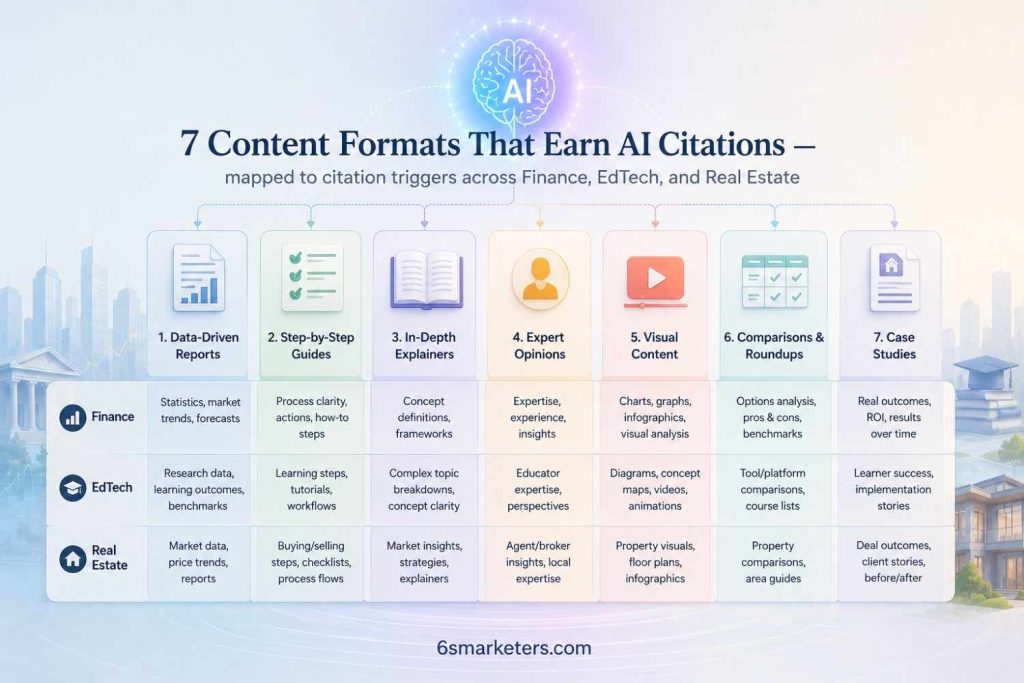
The AI citation formula, 7 content formats your marketing team should prioritise.
1. In-depth How-To Guides
Comprehensive how-to guides are the backbone of informational AI citations. When someone queries “how to invest in REITs as a first-time buyer” or “how to onboard students to an LMS,” they are signalling a process-driven need. AI models love guides that break complex processes into numbered steps with clear headings — because it makes extraction and citation structurally clean.
The key distinction here is depth. A guide that covers a topic in 1,200 words with real-world examples, common pitfalls, and data points will outperform a 3,000-word guide that recycles generic information. If you’re in Finance, a guide titled “How to Structure an SIP for Long-Term Wealth” with actual portfolio scenarios cited from SEBI regulations will earn trust from both readers and LLMs.
Want to understand how AI search is reshaping content discovery for enterprise brands? Read the process on how to appear in ChatGPT results.
2. Data-led Research & Reports
Original research is one of the highest-value formats for AI citations, and one of the least executed. When you publish a proprietary study, a benchmarking report, or even a well-sourced data analysis, you create something that AI engines cannot easily find elsewhere.
The Wix AI Search Lab study worked precisely because it was built on original data: 75,000 queries, one million citations, three major LLMs. That specificity is what makes it citable. Finance brands that conduct annual investor sentiment surveys, EdTech platforms that publish learning outcome data, and Real Estate firms that release city-level property trend reports — these are the organisations that get pulled into AI answers as primary sources.
Specificity beats scale. A well-presented regional salary report in EdTech is more citable than a vague global overview that says nothing new.
3. Structured FAQ Pages
Structured FAQ pages are the single most underutilised format in enterprise content strategies. Most brands treat FAQs as an afterthought, a cluttered page at the bottom of the site. That’s a mistake that’s now costing a real AI citation opportunity.
AI engines, particularly Perplexity and Google AI Mode, frequently pull FAQ-style answers because they match the conversational structure of natural language queries. A question-and-answer pair is already formatted the way an LLM wants to present information. When you mark up FAQs with proper schema, you make that extraction even easier.
In Real Estate, a FAQ page that answers “What are the stamp duty charges for first-time buyers in the US?” that delivers a precise, up-to-date answer clearly will be cited far more reliably than one that buries the same information in a paragraph.. See how to build a stronger presence in AI-driven results with our AI search and SGE optimisation guide.
4. Comparison & Listicle Articles
The data is unambiguous on this one. Listicle-format content led all citation types with 21.9% of all AI citations in the Wix study. For commercial-intent queries, listicles captured 40% of citations, nearly double any other format.
But a counterintuitive finding matters here: third-party editorial listicles earned 80.9% of citations in professional services, compared to 19.1% for brand-owned promotional lists. LLMs actively discount self-promotional ranking content. They prefer neutral, editorial comparisons that evaluate options fairly.
This is a clear signal for Finance and EdTech marketers. If your listicle reads like a sales page, it won’t get cited. If it reads like an informed comparison, “Top 7 Business Current Accounts for Startups in India: Fees, Features, and Limits Compared”, it has genuine citation potential.
5. Expert Thought Leadership
Named expertise matters. When a CMO, compliance director, or learning specialist publishes a bylined opinion piece, not just a ghost-written blog, AI models recognise the authorship signal. Google’s own guidance on E-E-A-T (Experience, Expertise, Authoritativeness, Trustworthiness) has shaped how LLMs evaluate source credibility.
A thought leadership piece on “Why Traditional EMI Calculators Fail Property Investors in Tier-2 Cities”, authored by a named mortgage specialist with a credentialed profile, carries a citation authority that anonymous content simply cannot match. Link your author bios to real credentials, published work, and professional profiles. That chain of verification is what AI engines look for.
6. Video + Transcript Content
Video alone rarely gets cited. But video paired with a full, structured transcript consistently earns AI citations, because the transcript is machine-readable text that contains the spoken expertise of the video. EdTech brands are particularly well-positioned here, since video-based explainers are already core to their content mix.
The transcript page should be treated as a standalone content asset, not an accessibility add-on. Include a summary paragraph, timestamp-linked headings for key topics, and links to related resources. A 15-minute expert video on “Understanding RBI Monetary Policy Impact on Home Loans” with a clean, chapter-formatted transcript is the kind of content AI engines can parse and cite meaningfully.
7. Infographic + Data Visualisation
Which content formats win in AI search is a question that increasingly includes visual formats — as long as they’re backed by descriptive text. Infographics alone are not citable. An infographic embedded in a rich landing page, with surrounding prose that explains what the visual shows, is a very different proposition.
Real Estate and Finance both operate in data-heavy spaces where visual comparison drives decisions. A property price index visualisation with a written methodology section, labelled data points, and alt text optimised for search is far more likely to surface in AI responses than a static image without textual context.
The alt text is not cosmetic. It’s searchable metadata that helps AI systems understand what the image contains. “Infographic comparing home loan interest rates across major Indian banks in Q1 2026” tells an LLM exactly what that image represents.
Want a content audit to identify which formats you’re missing in your sector?
Industry Breakdown: Finance, EdTech & Real Estate
Not every format performs equally across verticals. Here’s how AI citation potential maps to industry type based on the intersection of query behaviour, content authority requirements, and what AI engines have demonstrably cited more often in YMYL categories:
| Content Format | Finance | EdTech | Real Estate | AI Citation Potential |
| In-depth How-To Guides | High | High | High | High |
| Data-led Research & Reports | High | Medium | High | High |
| Structured FAQ Pages | High | High | High | High |
| Comparison & Listicle Articles | Medium | High | High | High |
| Expert Thought Leadership | High | Medium | Medium | Medium |
| Video + Transcript Content | Medium | High | Medium | Medium |
| Infographic + Data Visualisation | High | Medium | High | Medium |
Finance operates under the highest scrutiny. AI models treat finance content as YMYL. Any claim about interest rates, investment returns, or tax implications is held to a higher accuracy standard. This is why data-led research and named expert thought leadership perform so well here. Unverified claims simply don’t get cited. A bank or fintech publishing a quarterly “State of SME Lending in India” report with verifiable data has a fundamentally different citation profile than a blog post making general observations about the credit market.
EdTech benefits enormously from FAQ and video formats because the learner’s query behaviour tends to be specific and process-oriented. “How do I transfer my digital marketing certification credits?” or “Which EdTech platform offers the best placement support for MBA graduates?” are the kinds of queries that produce AI answers pulling from FAQ pages and transcript content. Comparison content also thrives here; learning platform comparison listicles from neutral, editorial sources consistently appear in AI-generated recommendations.
Real Estate sits in an interesting space. Property decisions are among the most research-intensive a person makes, which means the query journey is long and multi-format. How-to guides, comparison articles, and data-rich infographics all perform well, but so do hyper-localised content assets that address specific city, district, or project-level queries. A page that answers “What is the current assessed value of residential properties in Plano, Texas?” with current, sourced figures will typically outperform generic property investment content in AI-generated responses.
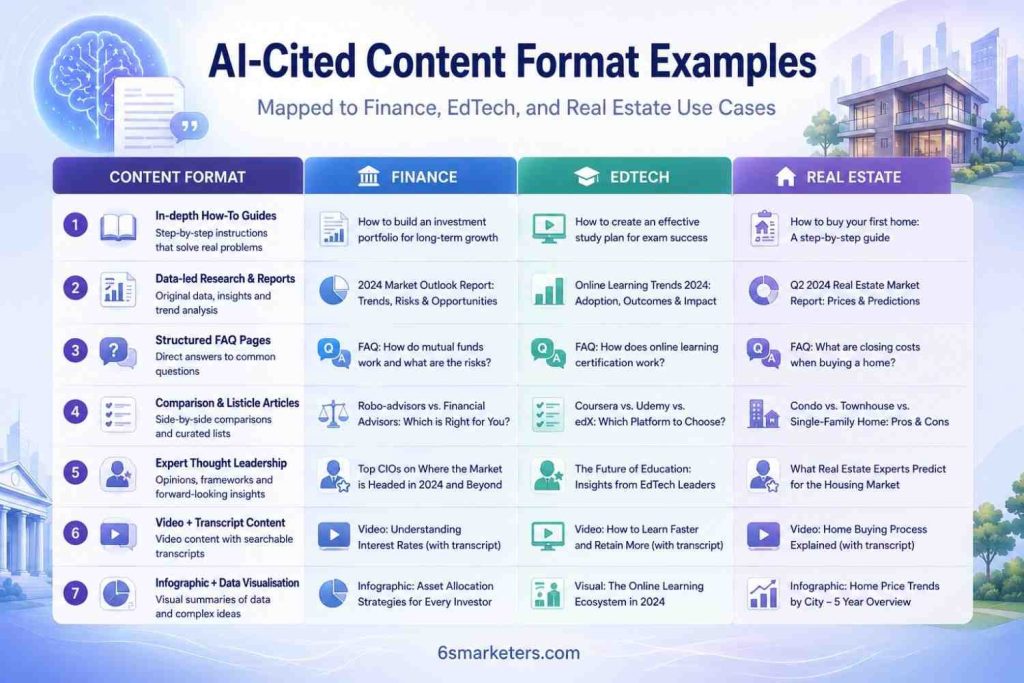
[Image: AI-cited content format examples mapped to Finance, EdTech, and Real Estate use cases]
Content formats with the highest AI citation rates across Finance, EdTech, and Real Estate sectors.
How to Optimise Your Content for AI Citations
Understanding the formats is only half the work. Execution determines whether your content actually gets pulled into AI answers. Here’s what the data and practical experience in enterprise content strategy show works:
Step 1: Map every content piece to a specific query intent.
Before commissioning any content, identify whether the query it’s answering is informational, commercial, or transactional. Format follows function. A blog post answering “what is a SIP?” should look unique from a page answering “best SIP plans for a 5-year investment.”
Step 2: Use structured formatting throughout.
Headers, numbered steps, definition-style paragraphs, and table-formatted comparisons all make content easier for LLMs to parse. Unbroken walls of text, regardless of their quality, are harder to cite. Your H2s and H3s are not just navigation aids; they’re AI-readable labels that signal topic structure.
Step 3: Publish original data wherever possible.
Even modest original research, a survey of 200 clients, an analysis of your platform’s user data, a compilation of publicly available statistics into a new framework, differentiates your content from the sea of regurgitated summaries that AI engines actively deprioritise.
Step 4: Update content on a disciplined schedule.
AI engines flag content currency. A Real Estate guide that references stamp duty rates from 2022 will not be cited when someone asks about current charges. Build a quarterly content review into your editorial calendar specifically for AI citation-sensitive pages. This is one of the most overlooked levers in content formats for AI citation optimisation.
Step 5: Build citation-worthy author profiles.
Link bylines to detailed author pages that include professional credentials, published work, and sector expertise. For Finance in particular, an anonymous “Staff Writer” byline is a citation liability. Named expertise with verifiable credentials is a citation asset.
For a more comprehensive framework on aligning your entire content strategy with AI search requirements, explore our AI SEO strategy framework for enterprise teams.
Conclusion
The shift from traditional search engine optimisation (SEO) to AI citation readiness is not coming; it is already the standard that high-performing marketing teams are being measured against. The seven formats outlined here, in-depth how-to guides, data-led research and reports, structured FAQ pages, comparison and listicle articles, expert thought leadership, video and transcript content, and infographic and data visualisation — all share one quality: they are built to answer questions precisely, credibly, and in a format that AI engines can extract and cite without friction.
For enterprise marketers in Finance, EdTech, and Real Estate, the stakes are especially high. These sectors attract high-value, research-led buyers whose first stop is increasingly an AI answer, not a list of ten blue links. Which content formats win in AI search in your specific vertical should drive every content investment decision you make this year.
At 6s Marketers, we help enterprise teams build citation-ready content ecosystems, not just pages that rank, but content that gets cited where decisions are being made. Let’s talk about what that looks like for your brand.
What’s your biggest challenge in getting your content cited by AI engines in your sector? Drop your thoughts in the comments below.
External Sources Referenced:
Search Engine Land — AI citations favour listicles, articles, product pages: Study