

What is AI SEO?
AI SEO is all about getting your content to show up in AI-powered search engines and things like Google’s AI Overviews, Bing Copilot, ChatGPT, and Perplexity – and that’s a whole lot more than just traditional search. It’s actually about making your content shine for those AI’s so they can single you out as a top answer. Realistically, it’s taking the traditional seo signals and pairing them with content that’s structured and trustworthy in a way that AI models will really latch onto and feature as a top answer.
According to Search Engine Land, this new kind of SEO – AI SEO – is the next big step forward in search, and getting that prized citation from an AI is every bit as good as landing at #1 on Google.
Key Takeaways
- AI SEO strategy is beyond Google. It targets AI-generated answers across multiple platforms.
- Generative engine optimisation (GEO) is the new horizon of SEO for AI search engines.
- The main elements are structured content, E-E-A-T signals, and authority.
- Clean markup, schema, and the fastest site speed are the basics of Technical SEO.
- Measuring AI SEO performance requires new metrics beyond traditional keyword rankings.
- Brands that leverage an AI SEO strategy today will lead the future of SEO.
Introduction to AI SEO: Why Your Old SEO Strategy Isn’t Enough Anymore
Google’s AI Overviews now appear in over 47% of all search queries, according to industry research published in 2024. Users find direct answers without a single link click. ChatGPT handles over 100 million weekly users who ask real questions and expect real answers. Perplexity AI is growing fast as a research tool. The question isn’t whether AI has disrupted search; it is whether your brand shows up when AI does the answering.
This whole evolution to AI is asking us to rethink how we do things. Traditional SEO is all about squaring up to the keyword game, getting those backlinks, and making yourself the #1 result. AI SEO is all about your content being the most credible, structured, and trustworthy source. If you’re a business looking for real, lasting search visibility, this is the framework you need.
AI search engines don’t choose content randomly. They select the source that they trust most. This means your content needs to be credible, well-structured, and backed by subject expertise.
In this post, we’re going to walk you through the actual steps to build an AI SEO strategy that gets you cited, answers, and traffic from both the old search engines and the new AI-facilitated ones. And as we go through it all, we’ll connect the dots between what AI search engines actually want, and what your business needs to actually provide.
In this guide, we connect the dots between what AI search engines want and what your business needs to provide. You will learn a clear, actionable framework that is effective.
What is an AI SEO Strategy?
An AI SEO strategy is a structured approach to making your content noticed by AI-powered search tools. It shapes how your content should get discovered, understood, and cited by tools like Google’s Search Generative Experience (SGE), AI Overviews, and third-party AI platforms such as ChatGPT and Claude that answer the questions your customers are asking every day.
Unlike traditional SEO, which prioritises ranking on a results page, an AI SEO strategy prioritises becoming the source an AI trusts enough to quote directly.
The concept builds on generative engine optimisation (GEO). In 2023, researchers at Princeton, Georgia Tech, and the Allen Institute found that content optimised with citations, quotable statistics, and clear structure earned up to 40% more AI citations.
That’s a massive signal. If you want SEO for AI answers, you must think like a librarian and write like an expert.
See how AI and SEO work together to understand the core dynamics driving this shift in search behaviour and content strategy.
Is Your Business Visible in AI Search Results?
6s Marketers helps brands rank in AI-generated answers and traditional search. Connect with us.
The AI SEO Strategy Framework
The AI SEO Strategy Framework is built on four interconnected layers. And every layer has its importance. If you skip technical SEO, AI crawlers will miss your content entirely. Neglect the content structure, and you lose citations to competitors. Ignore authority signals, and AI engines simply won’t trust you.
The framework works in four interconnected layers:
• Foundation — Technical SEO for AI crawlers and structured data
• Content — Creating AI-readable, answer-worthy content
• Authority — Building brand signals that AI engines trust
• Measurement — Tracking AI search visibility and performance
This isn’t theoretical. Brands that apply all four layers consistently are already seeing results. According to Semrush’s 2024 State of Content Marketing report, brands with strong topical authority and clear content structure are 3 times more likely to appear in AI-generated summaries. The future of SEO runs through this framework.
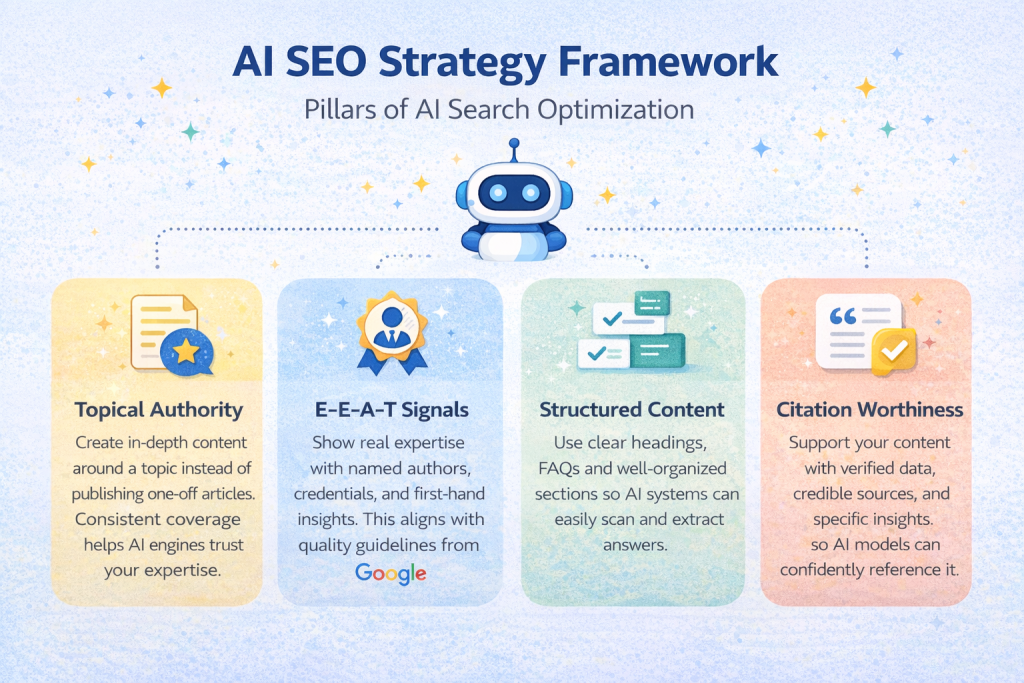
Pillars of AI Search Optimisation
If you want AI search tools to consistently show your content, these 4 pillars have to work together. Leverage them as the best practises that serious brands build over time. Each pillar addresses a specific way that AI engines evaluate and rank content sources.
Here are the four pillars you must build:
- Topical Authority: Never publish on a topic once and just move on. AI engines favour sources that go into detail and stay consistent. The more extensively you write about a subject, the more confidently an AI cites you.
- E-E-A-T Signals: Google’s content guidelines ask a simple question: Is the content written by a real expert? That indicates named authors, verifiable credentials, and first-hand experience, not generic writing that could have come from anywhere.
- Structured Content: AI engines don’t read the way humans do. They scan for signals. Descriptive headings, FAQs, and well-organised information make it easier for AI to extract your content and present it as a straightforward answer.
- Citation Worthiness: Back up what you say. Verified data, named resources, and specific insights give AI models something concrete to reference. Vague claims get skipped.
A study by Ahrefs says that over 70% of pages cited in AI Overviews already rank in the top 10 organic positions. But that percentage is changing fast as AI search engines diversify their sources. Building all four pillars now sets you up for both current and emerging SEO for AI search engines.
Content Strategy for AI Search: Write to Be Cited, Not Just Found
The most powerful shift you can make in your content strategy is this: stop writing for a click and start writing for a citation. AI search engines don’t send users to your page—they summarise your content and send a footnote your way.
A successful content strategy for AI search includes:
- Answer-First Writing: Your content should start with the answer in the opening paragraph. This will help AI cite you when building summaries.
- Question-Based Headings: Your audience doesn’t type keywords. They type questions into an AI search. Therefore, you have to structure your H2s and H3s with the exact questions your customers ask. It signals relevance to AI engines.
- Verified Statistics: A stat without a relevant source is just a claim. AI models are getting advanced. They can now identify well-cited content and give importance to it. Every number you include should be accurate, current, and linked to a credible source.
- Long-Form Depth: Cover a topic in-depth, typically between 1,500 and 3,000 words. This gives AI engines more to work with and signals that your content is genuinely useful, not just surface-level.
- FAQ Sections: These are direct snippet targets. Learn how to get featured in AI summary results with structured FAQ content.
Also, update your content regularly. AI engines prefer fresh information. Freshness is a content signal that directly affects your SEO for AI answers performance.
Technical SEO for AI Crawlers: The Infrastructure Beneath the Surface
Best content adds no value if AI search engines cannot read or cite it. Technical SEO for AI crawlers is all about getting rid of the gaps between your content and the AI systems trying to understand it. This demands more precision than generic SEO because AI reads your site structurally.
Give importance to these technical aspects for AI search optimisation:
- Schema Markup: Label your content clearly. Article, FAQ, HowTo, and Organisation schemas signal AI engines specifically what they’re looking at before they even process the words.
- Core Web Vitals: Slow web pages frustrate users and AI crawlers both. Poor LCP or CLS scores make it difficult for your content to get indexed.
- Clean URL Structures: A logical and descriptive URL makes it easy for AI models to have instant context. It’s a small detail that quietly does a lot of work.
- Mobile Optimisation: Many AI queries come from mobile devices. If your site is not built for mobile-first, you will lose it on both traditional and AI search.
- XML Sitemaps: An outdated sitemap is like showing someone directions to a place that no longer exists. You have to keep yours current, so AI crawlers always find your freshest content.
Google’s John Mueller confirmed in a 2024 Search Central session that structured data meaningfully improves content parsing by automated systems. That includes the AI layers built on top of Google’s index. Clean technical SEO isn’t just a best practice—it’s a direct signal to the systems driving the future of SEO.
Authority and Brand Signals: Why AI Engines Trust Some Sources Over Others
AI engines don’t cite random blogs—they cite sources they trust. And trust, in AI SEO, comes from measurable authority signals. Your brand’s reputation across the web directly influences how often AI tools surface your content as an answer. This is generative engine optimisation at its most strategic level.
Build authority with these signals:
- Author Credentials: Include author bios with real names, photos, and credentials. AI engines factor in E-E-A-T when deciding which content to surface.
- Brand Mentions: Unlinked mentions of your brand across authoritative sites signal relevance and trust to AI crawlers.
- Backlink Quality: High-quality backlinks from trusted domains remain a top AI SEO signal, per Moz’s 2024 ranking factors report.
- Social Proof: Reviews, testimonials, and third-party validation increase perceived authority—especially for local and service businesses.
- Consistent Publishing: AI engines track content freshness and publish frequency. Consistent output builds topical authority over time.
A Semrush study found that pages with verified author profiles and clear institutional cooperation earn 2.5x more AI citations than anonymous content. Your brand is your SEO asset. Invest in making it recognisable, credible, and consistently visible—because that’s what drives sustained AI SEO performance.
Measuring AI SEO Performance: Track What Actually Matters
Keyword rankings, organic clicks, and impressions are traditional SEO metrics that still matter. But they don’t tell the full story in the AI search era. When an AI engine answers a user’s query with your content, the user may never click your link. Yet your brand just earned massive exposure. You need a measurement framework that captures that value.
Track these AI SEO performance indicators:
- AI Mention Rate: How often does your brand appear in AI Overviews or generative answers? Tools like Semrush and Ahrefs now track this.
- Featured Snippet Rate: AI Overviews pull heavily from featured snippet content. Monitor your snippet wins as an AI visibility proxy.
- Branded Search Volume: When AI engines surface you, branded searches often spike. Track branded query trends monthly.
- Share of Voice: Measure how often your domain appears vs. competitors in AI-generated answers for target topics.
- Traffic from AI Referrals: Set up GA4 segments to capture referral traffic from Perplexity, ChatGPT, and similar platforms.
Industry data from 2024 shows that 60% of AI-cited content drives no direct click—yet still generates measurable brand lift and downstream conversions. This means your measurement model must evolve in parallel with your AI SEO strategy. Track visibility, not just clicks. Track citations, not just rankings. That’s how you measure the future of SEO.
Conclusion
The AI SEO revolution isn’t coming. It’s already here. Every day you delay building your AI SEO strategy is a day your competitors inch ahead in AI-generated answers. The businesses that dominate the next decade of search will be the ones that took AI search optimisation seriously before it became obvious. That window of advantage is open right now.
Use this framework as your starting point. Build your technical foundation. Create structured, citable content. Develop real authority signals. And measure the metrics that matter in an AI-first search landscape. The future of SEO rewards action, not observation.
If you’re ready to move from strategy to execution, 6s Marketers is here to help. We specialise in SEO for AI search engines, generative engine optimisation, and full-stack SEO services tailored to businesses that aim at sustainable, AI-era search visibility. Explore our SEO services and let’s build your AI SEO advantage together.