

Search rules have changed, and a lot of fintech pipelines were built assuming they wouldn’t. Old playbooks are coming up short. Demand gen for fintech now runs on visibility, earning a spot in front of buyers before they type your brand name into a search bar. This post breaks down nine tactics for an AI-answer, zero-click world, where a good chunk of real decision-making happens in dark social, out of sight. Each one reflects how enterprise buyers actually research and decide today.”
Key Takeaways
- Of every 1,000 US Google searches, only 360 clicks reach the open web.
- AI Overviews now reduce position-one CTR by 58%
- Featured snippets and AI citations replace traditional clicks
- LinkedIn dark funnel drives undercounted, high-intent demand
- Proprietary data is your most defensible content asset
- Measure branded search, pipeline, and AI mentions, not just traffic
- Video content captures attention. AI-generated text simply cannot
What Zero-Click Search Means for Fintech Demand Generation
Zero-click search is exactly what it sounds like: a user gets the answer they need directly on the search results page, without clicking through to any website. Featured snippets, AI Overviews, People Also Ask boxes, and knowledge panels all deliver this experience. It is not a bug in the system. From Google’s perspective, the product is working perfectly.
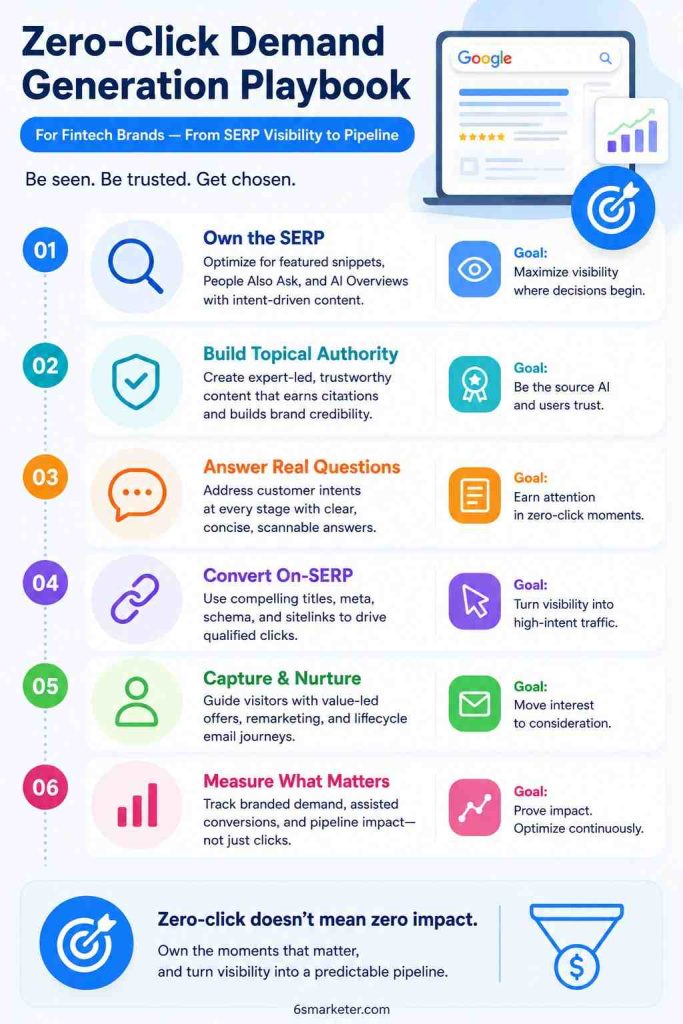
For fintech, the consequences are specific and significant. Demand gen for fintech has historically depended on informational content pulling in CFOs, CTOs, and procurement leads researching payment infrastructure, embedded finance, or regulatory compliance. Those are exactly the query types that trigger AI Overviews at the highest rates.
The numbers make the scale of this shift impossible to ignore. For every 1,000 searches on Google in the United States, only 360 clicks make it to a non-Google-owned, non-ad-paying property, meaning nearly two-thirds of all searches stay entirely inside the Google ecosystem (SparkToro / Datos, 2024). And as AI Overviews have expanded since that study, the pressure has only intensified: AI Overviews now correlate with a 58% lower click-through rate for the top-ranking page in a given SERP.
This is not a traffic fluctuation. It is structural. The fintech companies that adapt their demand generation strategy now will own the buyer’s mental shortlist later.
Why Traditional Demand Gen Tactics Fall Short in Fintech
The standard B2B playbook that suggests writing a long-form guide, ranking for a high-volume keyword, waiting for traffic, and nurturing with email was always a slow process in fintech. Long sales cycles, compliance-sensitive messaging, and risk-averse buyers made it slower still. Zero-click search has broken one of the core assumptions that held this model together: that ranking means traffic.
The data is unambiguous. Ahrefs analyzed 300,000 keywords and found that when an AI Overview appears in results, the top-ranking page loses 34.5% of its clicks compared to similar queries without one. By December 2025, a follow-up study found that the figure had worsened to 58%, meaning that for every 100 clicks that a top-ranking page would historically have earned, Google now keeps 58 of them. For fintech marketers whose content strategy is built on informational queries, such as “how does embedded finance work,” “best payment APIs for enterprise,” this is a direct hit.
Here is the harder truth: those informational queries are precisely where AI Overviews appear most. Ahrefs research found that 99.2% of keywords triggering AI Overviews are informational in intent. The content that fintech teams have invested in most heavily, the explainers, the guides, the comparison pages, is now the content Google resolves on SERP before any click occurs.
Traditional demand gen tactics still optimize for the click that may never come. A modern fintech demand generation strategy starts earlier, stays more visible, and measures influence rather than traffic alone.
9 Tactics That Drive Fintech Demand Gen in a Zero-Click World
Zero-click search relocated demand rather than killing it. Buyers are still out there, and they’ve just shifted where they spend their attention. The old mandate, ‘get more organic clicks at any cost,’ has given way to something broader: capturing intent across search, AI surfaces, and brand touchpoints that shape the final decision. These nine tactics are built for that shift, each one designed to build visibility, authority, or pipeline influence wherever B2B fintech buyers actually show up now.
1. Own the Featured Snippet for High-Intent Fintech Queries
Featured snippets are the last valuable piece of above-the-fold real estate that still drives clicks, and they remain winnable with the right content structure. For fintech specifically, high-intent queries around payment processing fees, open banking compliance, API security standards, and embedded lending regulations are still triggering snippet boxes rather than AI-generated prose.
To own a snippet, lead every section with a direct, 40–60-word answer to the exact question your buyer is asking. Use the question as your subheading. Follow the answer with structured data, comparison tables, or numbered steps. Avoid preamble. Fintech content often buries the answer in qualifications; strip that habit from anything you want Google to pull into a snippet. If you need a framework for building this type of content architecture, our AI SEO strategy framework walks through the structural approach in detail.
Owning even three to five high-intent snippets in your niche builds brand familiarity at the exact moment a buyer is forming their mental shortlist.
2. Build Brand Search Through Thought Leadership
When someone searches your company name specifically, that is a vote of prior influence. Brand search growth is one of the cleanest signals that your demand gen is working, and it is almost entirely invisible in traditional traffic reports.
Thought leadership in fintech is overcrowded with press releases dressed up as insight. What actually builds brand search is a specific, non-obvious perspective: a piece on why cross-border payment reconciliation will break as FX volatility increases, or a data-backed argument for why embedded finance is maturing faster in Southeast Asia than in Europe. Specificity earns attention in a way that generic “top trends” content does not.
There is also a direct connection to AI visibility. Ahrefs research found that branded web mentions show the strongest correlation with AI Overview presence — stronger than backlinks, domain rating, or any other on-site factor. Brands sitting in the bottom 50% of web mentions are essentially invisible to AI systems. Thought leadership that earns mentions in industry publications, newsletters, and partner content is not just building brand — it is directly feeding AI citation authority.
3. Create AI-Citation-Ready Content
Brands cited inside AI Overviews earn 35% more organic clicks and 91% more paid clicks than non-cited brands appearing on the same query (Seer Interactive, November 2025). Being cited is not the same as ranking first — and the requirements are different.
AI systems favour content with four qualities: original data, clear source attribution, structured formatting, and authoritative framing. For demand gen for fintech, this means structuring every major piece with a clear declarative answer early, citing external sources explicitly, using schema markup, and incorporating proprietary statistics wherever possible. Write in complete, parseable sentences. Avoid the hedged, multi-clause constructions that read well to humans but confuse language models.
A practical checkpoint: before publishing any content, ask whether an AI assistant could excerpt a clean, accurate answer from it in under two sentences. If the answer is no, the structure needs work.
4. Leverage LinkedIn for Dark Funnel Demand
LinkedIn is where a significant portion of B2B fintech demand gets shaped — and almost none of it is tracked. A CTO who saved your post about ISO 20022 migration six weeks ago, or a CFO who watched your 90-second video on DORA compliance three times, does not show up in your attribution model. But they may well be the person who adds your brand to their vendor list when the formal procurement process begins.
This is the dark funnel, and it is where B2B fintech content marketing now operates most powerfully. The tactics that work on LinkedIn are different from what works on Google: personal voice over brand voice, specific takes over general advice, and formats that invite engagement, such as polls, short-form video, and thread-style posts that unfold an argument across multiple sections.
Do not only post from your brand page. Activate leadership voices. A Head of Payments or Chief Compliance Officer with 3,000 relevant followers has more dark funnel influence than a company page with 30,000. Here is more on building a full-stack marketing strategy for fintech that includes channel-level thinking like this.
5. Publish Proprietary Data and Benchmarks
Original data is the most defensible content asset in fintech. It cannot be replicated, cannot be synthesized away by AI, and gives other publishers a reason to cite you, which is exactly what builds AI citation authority and domain credibility simultaneously.
Proprietary research does not need to be large-scale. A survey of 200 treasury managers on their payment stack decision criteria, or an analysis of your own platform’s transaction data showing seasonality patterns in cross-border B2B payments, creates something no competitor has. Benchmark reports, state-of-the-industry indexes, and annual data studies all serve this function.
The distribution logic matters too. Release the headline findings as a LinkedIn post for immediate reach. Gate the full report to capture demand signals. Pitch the most interesting data points to industry publications for third-party citation. One proprietary dataset, distributed well, does the work of ten generic blog posts.
6. Build Topical Authority Through Content Clusters
A single article ranking for a keyword is a fragile thing. A content cluster is a hub page supported by a constellation of related pieces, all internally linked. It signals topical depth to both search engines and AI systems, helping them decide which sources to trust.
For zero-click SEO for fintech, the cluster model matters because AI systems are reading your entire site when deciding whether to cite you, not just the individual page. If your hub page covers embedded finance and your supporting content covers embedded lending, embedded insurance, regulatory requirements by region, and implementation case studies, you become the authoritative source on the topic. A site with one article on embedded finance becomes a footnote.
Map your clusters to the buyer’s research journey: awareness-stage content at the top (what is this, why does it matter), evaluation content in the middle (how it works, what to look for in a vendor), and decision-enabling content at the bottom (case studies, ROI calculations, integration guides).
7. Use Video to Capture Attention AI Can’t Replicate
There is one type of content AI cannot generate, and it is the kind that features a real person with a specific perspective, recorded in a specific moment. A five-minute video of your Head of Product walking through a real compliance challenge your customers faced last quarter is irreplaceable. No language model can fabricate the specificity, the cadence of thought, or the credibility of someone who was actually in the room.
52% of B2B marketers expect to increase investment in thought leadership content (Content Marketing Institute, 2025), and short-form video sits at the top of that planned investment list. LinkedIn video, YouTube Shorts used as awareness drivers, and embedded video on key landing pages all serve different roles in a mature fintech lead generation strategy.
Keep the format tight. A 90-second clip answering one specific question your buyer is actively asking, “How do we handle PSD3 compliance across multiple jurisdictions?” — will outperform a polished ten-minute interview designed to cover everything. Specificity over production value, every time.
8. Optimize for People Also Ask and PAA Boxes
People Also Ask boxes appear across a wide range of B2B fintech queries and remain one of the more click-generating features on a modern SERP. Unlike AI Overviews, which can satisfy a query entirely, PAA boxes expand to reveal more questions — and each expansion is an opportunity for clicks and brand exposure.
Using question-based headings, FAQ schema, and concise 40–60-word answers remains one of the most effective zero-click search strategy for B2B fintech tactics available today. For fintech, target the specific questions your buyers are already asking: implementation timelines, compliance requirements, integration complexity, pricing structures, and vendor comparison criteria.
Structure your content with these questions as H3 subheadings and answer each directly below before expanding with supporting detail. Run your target queries through Google regularly and map the PAA boxes that appear — these are your buyer’s actual vocabulary, and matching it precisely is what earns PAA placement.
9. Turn Zero-Click Visibility Into Branded Re-engagement
Being cited in an AI Overview or appearing in a featured snippet with no clicks is not wasted visibility if you build infrastructure to capture it downstream. The buyer who saw your name in an AI answer, recognized it from a LinkedIn post, and then searched your brand name directly is a real demand signal. Most fintech marketers are not set up to track or act on it.
The zero-click search strategy for B2B fintech that converts passive exposure into an active pipeline uses retargeting, branded paid search, and email nurture sequences triggered by account-level signals. Brand search volume growth in Google Search Console, increases in direct traffic, and lift in branded keyword conversions are all leading indicators that zero-click visibility is creating downstream demand. Reach out to see how we build these systems for fintech teams.
Zero-Click Demand Gen for Fintech: Tactic × Outcome
| Tactic | Primary Outcome | Demand Signal to Track |
| Own Featured Snippets | SERP visibility without clicks | Impressions, snippet capture rate |
| Thought Leadership | Branded search growth | Brand search volume in GSC |
| AI-Citation-Ready Content | AI Overview placement | AI mention monitoring tools |
| LinkedIn Dark Funnel | Pre-intent influence | Post engagement, follower ICP match |
| Proprietary Data & Benchmarks | Third-party citations | Backlinks, press mentions |
| Topical Authority Clusters | Domain trust, AI citation depth | Topical coverage score |
| Video Content | Engagement, trust signals | View rate, profile visits |
| PAA Optimisation | Click-through from question boxes | PAA ranking position |
| Branded Re-engagement | Pipeline from prior exposure | Branded search lift, direct traffic |
Measuring Demand Gen Beyond Traffic: What to Track
Traffic is no longer a reliable proxy for demand. A fintech brand can lose 30% of organic traffic in a year while generating more qualified pipeline than ever — because the visitors who still click through are higher-intent. AI-referred visitors convert at 4.4x the rate of traditional organic visitors, and AI referral traffic has grown 527% year-over-year. Both figures point to the same structural shift: fewer visitors, far higher intent.
The measurement model needs to shift accordingly. Here is what to track in place of, or in addition to, raw traffic:
- Branded search volume: growth in people searching your specific brand name signals that awareness-stage tactics are working
- AI mention frequency: tools like Semrush, Ahrefs, and brand monitoring platforms now track how often AI systems cite your brand in generated responses
- Share of voice in your category: how often do you appear in AI answers, PAA boxes, and featured snippets for your core topic cluster?
- Pipeline source quality: Are inbound leads better qualified now? Average deal size and sales cycle length are downstream of demand gen quality
- Dark funnel signals: account-level intent data from platforms like 6sense or Bombora that show which companies are researching your category even before they engage
The hardest adjustment for most fintech marketing teams is reporting a decrease in traffic alongside an improvement in pipeline quality. Both things can be true simultaneously. Shifting from click-centric attribution to influence and outcome attribution does not require a full reorganization; it requires agreement on what success looks like before the quarter begins.
Conclusion
Demand gen for fintech has not become harder. It has become more honest. The marketers who were gaming traffic with thin content are losing the most. The ones who were building genuine authority, publishing real data, and creating content that earns trust were always doing the right thing. The zero-click environment has just made the gap between those two approaches impossible to ignore.
The nine tactics in this post share a common thread: they prioritize visibility and influence over volume and clicks. They treat the buyer’s trust as a scarce resource, not the algorithm’s attention. Demand gen for fintech that works in 2026 and beyond is built on being genuinely worth citing by AI systems, by industry publications, and by buyers who forward your content to colleagues.
Start with one tactic. Build your first proprietary benchmark. Structure one content cluster. Show up consistently on LinkedIn with a specific perspective. The compound effect of doing a few things well, repeatedly, is what creates the brand that ends up on every shortlist.
Want to build a fintech demand gen system that works in a zero-click world? Let’s talk.