

AI search tools have moved from novelty to necessity within real estate discovery. The real estate buyer journey has fundamentally shifted; buyers no longer open Zillow as their first move. They open ChatGPT, Perplexity, or Google’s AI Overviews. They type a conversation, not a keyword. And by the time they visit a property portal, they have already formed shortlists, budget expectations, and neighbourhood preferences. For real estate marketing teams, this change is not gradual. It is already happening at scale. Understanding where that shift started and exactly how it has accelerated is the only way to build content and visibility strategies that stay relevant in 2026 and beyond.
The real estate buyer journey now begins in an AI conversation window. According to FlyDragon’s Q1 2026 buyer survey of 4,180 home buyers across 38 U.S. metros, 67% reported using an AI search tool, ChatGPT, Perplexity, Gemini, or Google’s AI Overviews as their primary research method before contacting a real estate professional. That figure was just 17% eighteen months ago.
Meanwhile, across 8.2 million tracked real estate queries, 61.3% of all buyer-side searches now begin inside an AI interface rather than a traditional search engine. The displacement is visible in portal traffic data too: Zillow’s share of agent-discovery traffic recorded its first-ever year-over-year decline, with nearly all of that displaced share moving to AI tools.
For real estate marketing leaders, the message is clear: the channel that drives first impressions has changed. The brands that recognise this now and restructure their real estate content strategy accordingly will build a compounding visibility advantage that late movers simply cannot buy their way out of later.
Key Takeaways
- 67% of buyers now start with AI search tools.
- Traditional portals are losing first-touch discovery share.
- 91% of real estate brands are invisible to AI.
- AI-sourced leads close at 4× the rate of portal leads.
- Conversational queries replace keyword fragmentation.
- Content authority — not rankings — drives AI citation
- GEO and SEO are complementary, not competing
How the Real Estate Buyer Journey Has Evolved in the AI Era
The traditional real estate buyer journey followed a fairly predictable pattern. A buyer would type a short keyword phrase like “3 bedroom homes Austin under $500k” into Google, scan a page of portal results, click on Zillow or Realtor.com, browse listings, and eventually contact an agent. That journey was fragmented, non-linear, and heavily portal-dependent. The portal owned the relationship until a phone number was dialled.
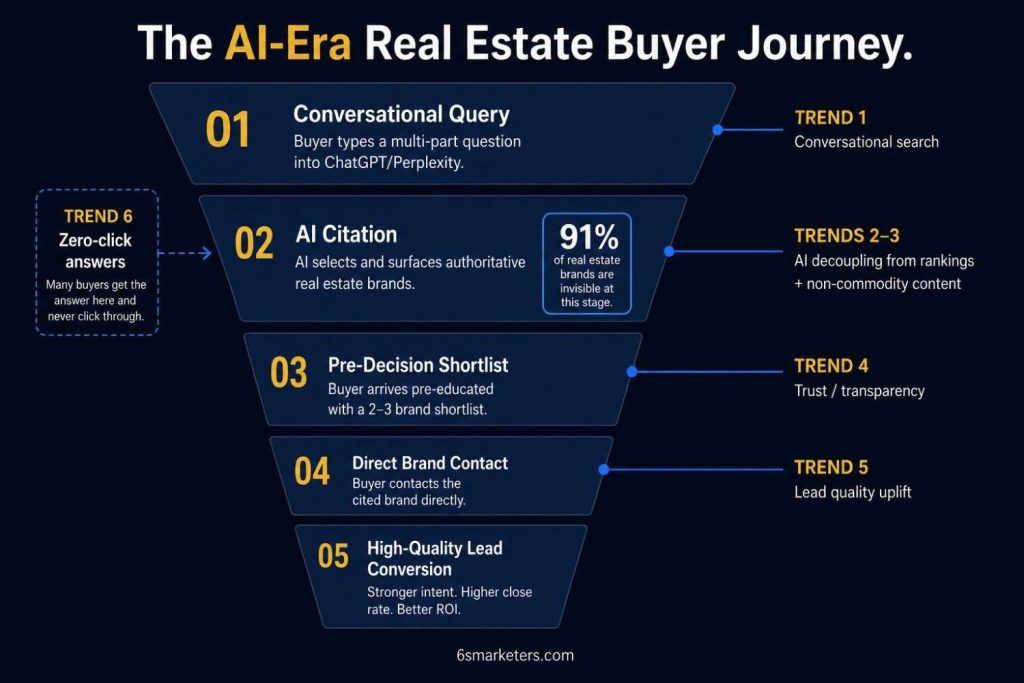
The AI-era journey looks structurally different. FlyDragon’s session-replay analysis of 12,000 buyer journeys reveals that the modern buyer does not type fragmented keywords. They ask full, contextual questions. One query might combine five distinct concerns — neighbourhood safety, school ratings, commute time, price trajectory, and flood risk — into a single conversational prompt. The AI synthesises an answer, offers a shortlist, and in many cases, names specific professionals or services it considers authoritative.
Before AI: Search → Portal → Browse listings → Compare agents → Contact
After AI: Conversational query → AI-generated shortlist → Targeted contact with pre-selected professional
The most significant shift is timing. Buyers are now forming preferences, budget expectations, and neighbourhood shortlists before they ever land on a listing site. The battle for the buyer relationship is being won or lost at the AI discovery stage, not at the portal stage. And 91% of real estate brands currently have zero visibility at that stage.
This is not a slow transition. It is already the dominant behaviour among buyers under 44. For any brand investing in real estate digital marketing trends, understanding this before/after framework is the foundation of every smart decision from here forward.
6 Trends Reshaping How Property Buyers Search and Decide
These six trends are not abstract predictions. They are drawn from live buyer behaviour data, AI platform mechanics, and the measurable performance gaps opening up between brands that have adapted and those that have not. For real estate marketing teams, these trends directly affect where content investment should go, how it should be structured, and which visibility signals matter most right now.
1. Conversational Search Is the New First Touch in Property Discovery
Buyers no longer search in fragments. The average buyer in 2026 asks 8.7 questions before identifying a two-to-three agent shortlist — and 71% of those queries are conversational in structure. This is not a minor preference shift. It is a fundamental change in how discovery intent is expressed. A buyer asking “Which neighbourhoods in Texas have the best infrastructure growth for first-time buyers in a ₹1.2 crore budget?” gives you more information about their intent in one prompt than many traditional keyword searches. Real estate content strategy must now be built around answering these multi-layered conversational queries — not just ranking for individual keywords. Brands that structure content around real buyer questions will appear in AI-generated answers. Brands that optimise only for keyword density will not.
2. AI Overviews Are Decoupling Visibility From Traditional SEO Rankings
This one surprises most digital marketers — and it should. Starmorph’s 2026 GEO research found that in July 2025, 76% of AI-cited URLs ranked in the organic top 10. By February 2026, that figure had dropped to 38%. The remaining 62% of AI citations were from the pages ranking over position 10. AI is no longer simply amplifying whoever ranks first. It is surfacing authoritative content from across the entire web. For real estate brands, this means a well-structured neighbourhood guide or a detailed market analysis on page three of Google can outperform a first-position listing page in AI Overviews — if it is written with genuine depth and clear E-E-A-T signals. Chasing rankings alone is an incomplete strategy in the AI search real estate buyer journey era.
3. Non-Commodity Content Is the Only Content AI Chooses to Cite
Google’s own AI search optimisation documentation makes a distinction that every real estate content team should bookmark. It compares generic content — “7 Tips for First-Time Homebuyers” — with experience-driven content — “Why We Skipped the Inspection and What the Sewer Report Revealed.” The difference lies in originality: one repeats widely available advice, while the other shares firsthand insights that readers and AI systems cannot find everywhere else. AI systems are not citing generic guides, checklist posts, and keyword-stuffed property roundups. First-hand market analysis, specific transaction insights, hyperlocal data commentary, and scenario-based content are. This is the clearest possible signal: real estate brands must move from content production to content expertise. Volume without depth is invisible to AI.
4. Buyers Expect AI Transparency, and Trust Is Declining Where It Is Absent
Cotality’s 2026 AI in Housing Report, covering buyers across the U.S., Canada, the UK, and Australia, found that 75% of buyers expect AI to be embedded somewhere in the transaction. Yet trust in AI to help find a home fell to 16% in 2026, a 14-point drop from 2025. The gap between expectation and trust is a content opportunity. Buyers want AI assistance, but 68% say clear AI labelling for property listings and mortgage recommendations is important. Real estate brands that openly disclose how AI is used in their content creation and recommendations — while maintaining visible human editorial oversight will build the trust signals that AI systems reward. Transparency is not just a policy requirement. It is an E-E-A-T asset.
5. Lead Quality From AI Search Is Structurally Higher Than Portal Leads
Across 42,180 tracked leads, AI-sourced leads closed at 9.6% within 90 days. That compares to 2.4% for portal leads and 1.8% for paid search. Average revenue per AI-sourced lead was approximately $1,180 versus $240 from portals. The reason is not mysterious. A buyer who has spent 30 or more minutes in conversation with an AI about a specific market arrives pre-educated. They have already filtered their options. When they contact a brand that the AI has recommended, the relationship dynamic is closer to a referral than a cold inquiry. For real estate digital marketing trends, this changes the ROI conversation. AI visibility is not just a branding play. It is a measurable lead quality upgrade.
6. Zero-Click AI Answers Are Capturing Queries Before Portal Traffic Starts
Zero-click searches, where a user gets their answer directly from an AI-generated summary without clicking through to any website, jumped from 56% to 69% of all searches between May 2024 and May 2025. For informational real estate queries, neighbourhood comparisons, pricing trends, buyer process explanations, the trigger rate climbs even higher. This does not mean content investment is futile. It means the goal has changed. The brand that provides the answer in the AI summary builds the trust that drives the direct contact. Being the cited source in a zero-click answer is more valuable than ranking second for a query that does generate clicks. The real estate buyer journey increasingly passes through an AI answer layer that never sends the buyer to a website unless the brand has earned the citation first.
Is your real estate brand visible in AI search results? Let’s find out — and fix it.
What Real Estate Brands Must Do to Stay Visible in AI Search
The six trends above point to a consistent pattern: the brands that get cited by AI systems are not necessarily the biggest, the oldest, or the highest-ranked. They are the most genuinely helpful and the most structurally clear. Acting on that insight requires specific choices, not generic best practices.
Build a conversational content architecture. Map your content to the actual multi-part questions buyers are asking AI systems — not just standalone keywords. Create dedicated content that answers layered buyer queries around neighbourhoods, pricing trends, process steps, and market timing. Structure every page with clear headings, direct paragraph-level answers, and FAQ modules that AI can extract and cite. This is the single most important shift in real estate content strategy for 2026.
Invest in non-commodity depth over publishing volume. One well-researched market analysis with first-hand data, specific transaction examples, or original pricing commentary will outperform ten generic guides in AI citation frequency. The brands winning AI visibility are not producing more content — they are producing content that only they could produce. Hyperlocal specificity is a competitive moat.
Treat your AI SEO strategy framework as an extension of your existing SEO — not a separate system. Google’s own documentation confirms this clearly: GEO and AEO are still SEO. Structured data, E-E-A-T signals, internal linking, and technical crawlability all feed directly into what AI Overviews and generative systems choose to surface. Brands that treat AI visibility as a parallel discipline to traditional search will duplicate effort and dilute both.
Make transparency a content signal, not just a disclosure policy. Clearly state editorial oversight practices, author credentials, and AI usage in content production. Buyers are actively evaluating trust signals — and 68% say clear AI labelling is important or essential in 2026. Brands that disclose thoughtfully will earn the trust scores that AI systems reward through their E-E-A-T evaluation frameworks.
Measure AI citation share, not just organic rankings. Traditional rank tracking does not tell you whether your brand appears when a buyer asks ChatGPT for a recommendation. Build a testing cadence: identify 15–20 high-intent queries relevant to your market, run them across ChatGPT, Perplexity, and Google AI Overviews, and track whether your brand is cited, recommended, or absent. That data should sit alongside your standard digital marketing performance metrics.
The Real Estate Marketing Playbook Has a New First Chapter
Six trends are reshaping how property buyers search, shortlist, and decide: conversational search replacing keyword fragmentation; AI Overviews decoupling visibility from traditional rankings; non-commodity content becoming the only citable content; trust gaps creating brand differentiation opportunities; AI-sourced leads delivering structurally superior conversion rates; and zero-click AI answers capturing buyer intent before portal traffic even begins.
What connects all six is the same insight. The real estate buyer journey no longer starts on a portal or a search results page. It starts in a conversation with an AI system. And the brands that appear in that conversation cited, trusted, and recommended do not get there through volume or paid placement. They get there through genuine content depth, clear authority signals, and a willingness to answer the questions buyers are actually asking.
The gap between brands that have adapted and those that have not is widening rapidly. Research across 187 real estate brands found that those who began building AI search visibility in early 2025 now hold 5.7x the citation share of those who started twelve months later, despite the latter group spending more on average. The compounding advantage of early action is real and measurable.
This is the moment to act. If your real estate brand’s content strategy was designed for the Google search of 2022, it is not designed for the buyer journey of 2026. The good news: the gap is still closeable for now.
Ready to build a real estate content strategy built for the AI search era? Start a conversation with the 6s Marketers team today and find out exactly where your brand stands in AI-generated discovery.
What’s your experience with AI search changing how buyers first discover your brand? Share your perspective in the comments. The real estate marketing community is navigating this shift in real time.
External Sources Referenced
- FlyDragon: The 2026 State of AI Search in Real Estate. Largest publicly published benchmark study of AI search behaviour in U.S. residential real estate (12,400 AI-generated responses; 8.2M queries tracked).
- Cotality: AI in Housing 2026 Report. Buyer trust and AI adoption survey covering U.S., Canada, UK, and Australia homebuyers.