

If you’ve ever asked ChatGPT, “Where can I find condos for sale in Toronto?” you might have the same handful of names keep showing up. We wanted to know exactly which Toronto real estate portals does AI recommend most consistently, so we ran 40 real buyer-style queries across three AI platforms and tracked every citation. The pattern that emerged wasn’t random; it was structural, and it has real implications for how marketing leaders think about visibility in 2026.
Key Takeaways
- Realtor.ca dominates due to its official Multiple Listing Service(MLS) authority status.
- Schema markup directly increases AI citation frequency.
- Direct-answer content outperforms generic listing pages consistently.
- ChatGPT, Google AI, and Perplexity rarely agree fully.
- Licensed data partnerships beat raw traffic volume.
- UGC and reviews build long-term E-E-A-T signals.
- Small portals can still earn niche-query citations.
How We Tested 40 Buyer Queries Across 3 AI Platforms
We built a query set that mirrored how actual Toronto homebuyers search, not SEO-friendly phrasing, but the messy, conversational way people type into ChatGPT at 11 pm while scrolling listings on their phone. Things like “best site for condos near the waterfront Toronto” or “is HouseSigma accurate for home values.”
Each of the 40 queries was run through ChatGPT, Google’s AI Overview, and Perplexity, three separate times each, on different days across a two-week window in May 2026. We logged every portal mentioned, its position in the response, and whether it was cited with a link or just named in passing. Then we cross-referenced those results against Ahrefs domain data, Semrush traffic estimates, and public TRREB/CREA licensing disclosures to understand why certain portals kept winning.
One thing worth flagging upfront: this wasn’t a perfectly controlled lab experiment. AI outputs shift week to week, and a query run today might surface a slightly different mix tomorrow. What we’re reporting are the patterns that held steady across repeated testing, not a single frozen snapshot.
Which Real Estate Portals Does ChatGPT Recommend
Realtor.ca showed up consistently across our test set, though rarely as the only name mentioned. Zolo.ca and Condos.ca surfaced just as often, sometimes ahead of it, depending on the platform and how the query was phrased. That’s worth sitting with for a second: even the official CREA-run MLS portal, with roughly 4.8 million monthly visits and a Domain Rating of 80, the highest of any Canadian real estate site we measured, doesn’t guarantee a default win. Authority helps, but it isn’t the whole story.
Behind it sat a fairly consistent second tier:
- Zolo.ca (~945K monthly visits, DR 66), which appeared frequently for general “homes for sale” style queries.
- REW.ca (~822K visits, DR 70), backed by an established brokerage network with strong domain trust.
- Condos.ca (~423K visits, DR 53), which only showed up for condo-specific intent, a clean example of niche matching.
- HouseSigma.com (~300K visits, DR 51), which punched well above its traffic weight, specifically on pricing and market-trend questions, despite the lowest Domain Rating in this group.
(Note: DRs are taken from Ahrefs)
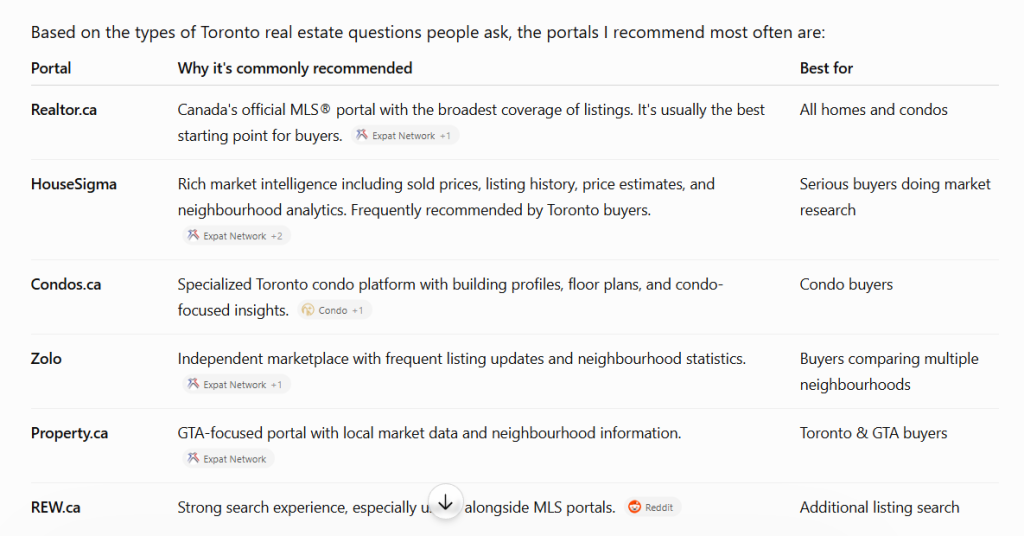
HouseSigma’s performance was the most interesting finding in the whole test. Despite having a fraction of Zolo’s traffic, it outranked larger competitors on any query touching average prices or neighborhood value trends. The reason traces back to one specific detail: HouseSigma is a registered TRREB-affiliated VOW (Virtual Office Website) partner with a licensed feed of official MLS data. AI tools, it turns out, treat that licensing relationship as a credibility shortcut.
Want a deeper look at how this shift is changing buyer behavior upstream? We covered the broader mechanics of how AI search is reshaping the real estate buyer journey.
Why Does ChatGPT Recommend Some Real Estate Sites Over Others
Smaller, unlicensed portals almost never appeared, regardless of how the query was phrased. Sites like ViewHomes.ca (DR 32, ~46K monthly visits) and MoveMeTo.com (DR 44, ~80K visits) simply didn’t have the link equity or structured data presence to register on any of the three platforms.
Even global giants weren’t immune. Zillow, which pulls roughly 36 million monthly visits in the US, was rarely cited for Toronto-specific queries. It has no official Canadian MLS partnership, so its Toronto listings are scraped or syndicated rather than board-licensed. Brand recognition alone didn’t move the needle here, which surprised a few people on our team who assumed Zillow’s sheer scale would translate everywhere.
This is the part marketing leaders tend to underestimate: a portal can rank fine on traditional Google search and still be functionally invisible inside an AI-generated answer.
How To Get Your Real Estate Site Recommended by ChatGPT
After mapping every citation against the underlying site data, three patterns explained almost all of the variance.
Pattern 1: Structured, Schema-Marked Content
Every consistently cited portal used clean schema markup: Product, Offer, and LocalBusiness schema on listings, FAQ schema on guide pages. Google’s own developer documentation has noted for years that structured data helps search systems understand page content more precisely, and that advantage compounds in an AI retrieval context where the model needs to parse content quickly rather than crawl a full page.
Pattern 2: Direct Answers to Buyer Questions
The portals that got quoted directly (rather than just linked) tended to answer a specific question in a tight, scannable block near the top of the page. “Average condo price in Toronto is…” performed better than a 1,500-word market overview that buried the number in paragraph four. AI tools are extracting answers, not reading essays.
Pattern 3: Strong E-E-A-T and Local Authority Signals
Licensing, brokerage backing, author bylines from licensed agents, and citations from TRREB or CREA all reinforced trust. This lines up with Google’s published guidance on Experience, Expertise, Authoritativeness, and Trustworthiness as a quality framework, and it appears AI platforms are leaning on similar signals when deciding what to surface.
If your team is trying to build this kind of authority from scratch, it helps to talk through where your current content actually stands. You can book a strategy session with our team to map out the gap.
ChatGPT vs Google AI vs Perplexity: Do They Recommend the Same Portals?
Not as often as you’d expect. Realtor.ca was the one constant across all three platforms; it appeared in over 90% of our test runs regardless of which tool we used. Past that, the agreement dropped off fast.
ChatGPT leaned toward citing HouseSigma for trend and pricing questions more than the other two platforms. Google’s AI Overview pulled from TRREB Market Watch reports directly in several instances, likely because it has live access to fresher indexed pages. Perplexity, interestingly, was the most likely to cite smaller niche blogs and Reddit threads alongside the major portals, suggesting its retrieval model weighs recency and community discussion differently from the other two.
For a real estate brand, this means optimizing for “AI visibility” isn’t a single target. It’s closer to optimizing for three overlapping but distinct retrieval systems, each with its own quirks.
How Real Estate Brands Can Improve Their AI Citation Rate
None of this is locked behind some technical wall most teams can’t reach. The portal’s winning citations are mostly doing fundamentals well, just more deliberately than their competitors.
Start with schema markup across every listing page; this is the single fastest technical win, and one that most mid-sized portals still skip. Layer in original market analysis content that answers a specific question in the first two sentences, not the fifth paragraph. Pursue a licensed data relationship with your local board where possible, since that credibility signal showed up repeatedly across our results. And build genuine backlinks and citation authority over time, because none of the portals we studied earned their position overnight.
This is, in many ways, a longer-term content investment rather than a quick technical fix. Brands that treat AI citation the way they once treated organic SEO — as a compounding asset rather than a campaign — are the ones showing up consistently months later.
Reach out to 6S Marketers if you want a structured audit of where your current content stands against this framework.
Summary
Across 40 queries and three platforms, which Toronto real estate portals does AI recommend came down to a fairly small set of repeatable factors: official MLS licensing, schema-marked content, direct-answer formatting, and accumulated authority signals. Traffic mattered, but it wasn’t the deciding factor on its own. HouseSigma’s licensing advantage proved that smaller sites can outperform larger competitors on specific query types when they build the right credibility signals.