

There’s a pattern that shows up repeatedly in competitive SEO analysis. One brand invests heavily in a polished, well-structured content programme. Another brand — sometimes smaller, sometimes less sophisticated — runs a product page loaded with unfiltered customer language, half-answered questions, and a review section that’s clearly never been cleaned up. The second brand ranks higher. Consistently.
That outcome stops feeling random once you understand what search engines are actually rewarding today. User generated content carries a specific kind of evidential weight that marketing copy structurally cannot — because it comes from people who have no incentive to say something good unless they actually mean it.
This post is a practical examination of that mechanism. Not a philosophical case for authenticity, but a clear look at why UGC moves rankings, where it creates risk, and how to build a user generated content strategy that generates compounding SEO value rather than compounding problems.
Key Takeaways
- UGC introduces search queries your team will never think to target and does so continuously, without a brief.
- Customer-written content carries E-E-A-T weight that no amount of editorial polish can substitute for.
- Freshness signals accumulate automatically on pages where users keep contributing, no republishing required.
- Unmoderated UGC degrades SEO performance faster than most teams realise — thin content and spam are silent rank killers.
- Structured UGC with schema, moderation, and indexed URLs outperforms passive collection at every stage.
- AI search systems are increasingly pulling from experience-backed content, giving managed UGC a new visibility channel.
What Counts as User-Generated Content for SEO Purposes?
The definition matters more than most guides acknowledge. Not all content originating from a user contributes to your search performance, and treating it as though it does leads to misallocated effort and missed opportunity.
For user generated content to carry SEO value, it needs to live on — or be indexed in direct connection with — a URL you own and control. A detailed five-star review published on a third-party platform builds brand credibility. That same review, embedded on your own product page with properly implemented Review Schema, builds your rankings. The content is identical. The SEO outcome is completely different.
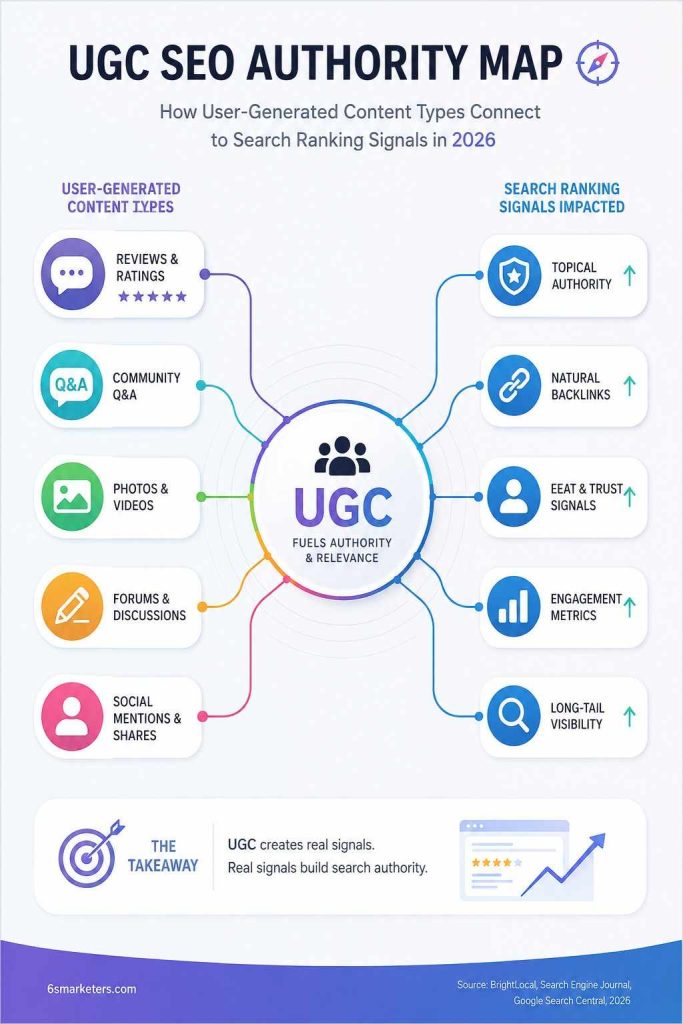
Here’s what qualifies as UGC for search purposes, and what role each type plays:
- Product reviews and star ratings sitting on pages you control, marked up with structured data so Google can surface them as rich snippets
- Q&A sections where prospects document the exact doubts that sit between interest and purchase — and get answers your brand or community provides
- Community forums and discussion threads hosted on your domain, generating indexed pages around topics your editorial team never planned for
- Comment sections on articles and resource pages that extend the semantic depth of the original piece
- Video testimonials embedded with keyword-rich transcripts that give crawlers something to index beyond the visual content
- Customer-submitted images attached to product listings, with descriptive alt text that opens up image search visibility
One distinction worth making explicitly: social mentions and shares build brand signal, but unless that content lands on an indexed page with surrounding context, it does nothing for on-page authority. This is why brands with enormous social followings sometimes rank below companies with a fraction of their audience reach but a richer on-site content ecosystem.
Explore how content formats that win in AI search connect to your broader UGC approach; the overlap is significant.
How User-Generated Content Builds SEO Authority: 6 Mechanisms
1. UGC Supplies the “Information Gain” Google Actively Prioritises
Every page Google evaluates gets measured against a deceptively simple question: Does this add something the web doesn’t already have? When a content team reads the top five ranking articles on a topic and produces a sixth structured around the same ideas, the information gain is close to zero. Same arguments, slightly different phrasing, different brand name in the byline.
User generated content breaks that cycle not because of any technical mechanism, but because real customers describing real outcomes produce content that genuinely does not exist anywhere else. A buyer who explains that your logistics software cut their warehouse dispatch errors during peak season is not restating a category claim. They’re documenting a specific, verifiable outcome in language that came from their own operational experience. That’s what Google’s quality systems are now trained to find and reward.
2. Customers Write Search Queries. Your Keyword Research Will Never Surface
Keyword research tools work backwards. They measure what people have already searched for at sufficient volume to register as a data point. By definition, they miss emerging phrasing, niche terminology, and the highly specific questions that buyers type in at the exact moment of decision.
A software company’s content team targets a “workflow automation platform.” A customer review on that same site mentions “stops our approvals getting stuck when the project lead is travelling.” That phrase or something close to it is exactly what a frustrated operations manager searches for at 11 pm. No keyword planner surfaces it. But it lands on the page, gets indexed, and starts pulling in qualified traffic that the editorial strategy never accounted for.
Multiply that across hundreds or thousands of reviews, threads, and comments, and the keyword coverage compounds in a way no publishing calendar can replicate.
3. It Builds E-E-A-T Credibility That Brand Copy Cannot Manufacture
Google’s E-E-A-T framework (Experience, Expertise, Authoritativeness, and Trustworthiness) has moved well beyond an abstract principle. In 2026, Google’s systems can evaluate whether the person behind content has genuinely experienced what they’re describing or whether they’ve researched it from a distance. Those are different things, and the algorithm treats them differently.
This creates a structural problem for brand content. A marketing team can describe product benefits compellingly and accurately. What they cannot do is describe the experience of using it under real conditions with real consequences. That account only exists in what actual customers say, which is precisely why verified reviews and detailed testimonials strengthen E-E-A-T in a way that editorial investment alone cannot.
When a confirmed buyer documents how a product held up over eighteen months of daily use in a specific operating environment, that account carries experiential authority that no ghostwritten case study can match.
4. Pages Stay Algorithmically Fresh Without Constant Editorial Spend
Publishing cadence has a ceiling. Briefing, writing, editing, and publishing quality content at scale is expensive, and the moment you stop, your pages start ageing. Search engines register that.
A product page with an active review section operates on a different timeline. Each new submission, whether it arrives weekly or daily, represents fresh activity on that URL. The page keeps drawing in new perspectives, new language, new use cases. From a crawling and indexing standpoint, that signals ongoing relevance in a way that a static page published eight months ago simply cannot sustain.
This matters especially in categories where customer sentiment, product iterations, or competitive dynamics shift regularly. UGC-driven pages evolve with the market rather than against it.
5. Dwell Time and Engagement Lift When Authentic Voices Do the Talking
A business decision-maker who lands on a page and immediately finds other practitioners describing specific outcomes in honest, unpolished language slows down. They read more carefully. They follow through to related content. They compare experiences described in different reviews. That behaviour — longer session duration, lower bounce rate, deeper site engagement — correlates with the user satisfaction signals that sustain rankings over time.
The dynamic is not complicated. Decision-makers are more persuaded by accounts from people in similar roles than by claims from the brand trying to sell them something. When your pages carry both — authoritative brand content and authentic customer voice — the two reinforce each other in a way that neither achieves alone.
6. AI Search Systems Are Increasingly Citing Experience-Backed Content
As of April 2026, Google AI Overviews appear on nearly half of all search queries. Pages cited inside those Overviews pull in substantially more organic clicks than pages that rank in traditional results but don’t appear in the AI-generated answer.
What those systems select for is not keyword density or domain authority in the conventional sense. They look for content that demonstrates specific, verifiable, experience-driven knowledge, the kind that well-managed user generated content provides naturally. A forum thread where a practitioner walks through a specific technical decision, or a review section where buyers compare outcomes across use cases, reads as citable to an AI system in a way that generic brand copy does not.
For businesses building long-term organic visibility, this is not a future consideration. It’s already affecting where clicks go.
Building a content strategy that earns both traditional rankings and AI citations? Talk to the 6s Marketers team — we help businesses build organic authority that holds.
UGC SEO: Benefit vs. Risk at a Glance
| UGC Type | SEO Benefit | SEO Risk | How to Mitigate |
| Product Reviews | Long-tail keyword diversity; rich snippet eligibility; E-E-A-T trust signals | Fake or incentivised reviews can trigger spam penalties | Enable verified-purchase flags; moderate flagged submissions; use Review Schema correctly |
| Q&A Threads | Featured snippet eligibility; natural question-based keyword coverage | Duplicate answers to the same question create thin content | Consolidate duplicate Q&As; canonicalise or redirect low-value threads |
| Forum Posts | Indexed freshness; deep semantic keyword expansion; community authority | Spambots, off-topic posts, and low-quality content dilute page quality | Require registration; use automated spam filters + human moderation; close inactive threads |
| Social Mentions | Indirect brand authority: trust signals from third-party references | Social content on external platforms doesn’t directly benefit on-page SEO | Embed select social content on indexed pages with contextual copy |
| Video Testimonials | Dwell time improvement; visual search visibility; authentic E-E-A-T proof | Large, unoptimised video files can slow page speed | Compress files; add keyword-rich transcripts; use structured data for video content |
| Comment Sections | Semantic depth, page freshness, and long-tail keyword expansion | Spam comments, toxic content, or off-brand discussions can harm credibility | Moderate all first-time commenters; use no-follow on external links; reply to add value |
The UGC SEO Risks Brands Must Actively Manage
The case for user generated content in SEO is strong. The case for assuming it manages itself is not.
Thin content compounds quietly
A Q&A section where forty people ask functionally the same question — each with slight wording variations and three-sentence answers — is not rich content. It’s a thin content problem scaled across dozens of pages. Google’s quality systems don’t distinguish between carelessness from your editorial team and carelessness from your community. The result is the same: suppressed page authority. The answer is consolidation — merge duplicate threads, develop the best answer into something substantive, and ensure each indexed Q&A page earns its place.
Spam gets crawled before you catch it
Standard automated filters handle volume, not sophistication. Spam submissions designed to read as genuine reviews pass through regularly. When a crawler indexes a comment section full of manipulative content before your moderation team has reviewed it, that’s the version of the page that enters Google’s index. Human review — even at a lightweight cadence — is not optional overhead. It’s what protects the SEO value of everything legitimate users have contributed.
Review patterns trigger quality flags
Clusters of submissions sharing structural language, accounts created within the same window, reviews originating from the same IP range — these patterns are now detectable. Brands that prioritise review volume over review authenticity are building something that can be reclassified as a spam signal at algorithm update time.
Duplicate submissions divide authority, not multiply it
When the same question generates ten separate thread pages across your forum, those pages don’t accumulate authority collectively. They split it. Each one individually carries less ranking potential than a single, well-developed page addressing the question comprehensively. Periodic architecture audits of UGC sections — especially forums — are part of the ongoing cost of running a content strategy that depends on community contribution.
How to Build a User Generated Content Strategy That Actually Moves SEO
Allowing reviews to accumulate and hoping the SEO follows is not a user generated content strategy. It’s a passive collection with aspirational framing. A strategy starts with decisions made before a single piece of content arrives.
Make your UGC crawlable by design
Reviews rendered in JavaScript that crawlers cannot parse, forum threads sitting behind a login wall, Q&A content blocked in robots.txt, none of it contributes to search performance, regardless of quality. Before soliciting a single review or opening a community forum, confirm that the content will live on indexable URLs that crawlers can reach and read without obstruction.
Implement the schema before you need it
Review Schema, Q&A Schema, and FAQ Schema are not retroactive improvements. They need to be embedded in the architecture from the start. Getting this right from day one means the difference between a review section that earns rich snippet display in results and one that sits on the page at half its potential.
Engineer the submission prompt, not just the permission to submit
Most brands use a generic “tell us what you think” prompt and then wonder why the content is too thin to rank. The question determines the answer. “Describe the specific situation that led you to choose this, and what changed after you started using it” generates substantive, keyword-rich, experience-driven content. The framing is everything and most brands leave it to chance.
Scale moderation to your volume (but start it immediately)
A product with fifty reviews needs a different workflow than a forum with fifty thousand posts. The process must exist from day one, regardless of scale, not after the first spam wave arrives and starts affecting crawl quality.
Treat your best UGC as editorial raw material
The most insightful review in your database deserves more than a single product page. It might anchor a case study, underpin a comparison piece, or form the centrepiece of a content hub article that directly addresses a common objection. The strongest user generated content strategy treats what customers create as source material — not just proof of satisfaction.
Your search engine optimisation performance compounds when the content ecosystem sustains itself. Managed UGC is one of the few content inputs that genuinely does grow in value without proportional growth in cost.
Conclusion
User generated content does not produce overnight rankings. What it builds is a content ecosystem that keeps growing in value without requiring proportional investment because the people who use your product keep adding to it.
The brands that hold strong organic positions through the rest of this decade will not necessarily be the ones with the largest content teams or the most aggressive publishing schedules. They’ll be the ones who made it structurally easy for real customers to document real outcomes on indexed, crawlable pages. Every review that describes a specific problem solved, every forum thread that goes three layers deep into a genuine question, every video testimonial with a transcript attached — each one adds credibility that a brand-written paragraph cannot replicate.
Google is getting better, not worse, at identifying where genuine human experience lives on the web. User generated content, properly built and actively managed, is how you make sure it lives on yours. The infrastructure decisions made now determine whether UGC becomes your most scalable SEO asset or your most overlooked one.
Ready to build a UGC strategy that earns lasting search authority? Connect with the 6S Marketers team, and let’s build it properly.
External Sources Referenced
- Search Engine Land: Why User-Generated Content Works Well for SEO
- Google Search Central: Creating Helpful, Reliable, People-First Content