

Google officially announced the Google May 2026 Core Update on May 21, 2026, around 8:43 AM Pacific Time.
This is the second major core update of 2026, after the March 2026 Core Update that wrapped up on April 8 after a 12-day rollout. The May 2026 core update is notable in the context of its launch – weeks of pre-existing ranking volatility, a compressed update cadence, and a search ecosystem being reshaped by AI-driven ranking systems
For marketing leaders and content strategists who’ve been investing in organic growth — this is the update that demands your attention, not your panic.
Key Takeaways
- May 21, 2026, launch; rollout up to two weeks.
- Second Google core update of 2026 confirmed.
- Don’t react to mid-rollout ranking fluctuations.
- Thin, over-optimized content continues losing ground.
- Original, expertise-led content is rewarded consistently.
- Wait until post-June 4 before drawing data conclusions.
- AI Overviews visibility can also shift during rollouts.
Google Launches the May 2026 Core Update
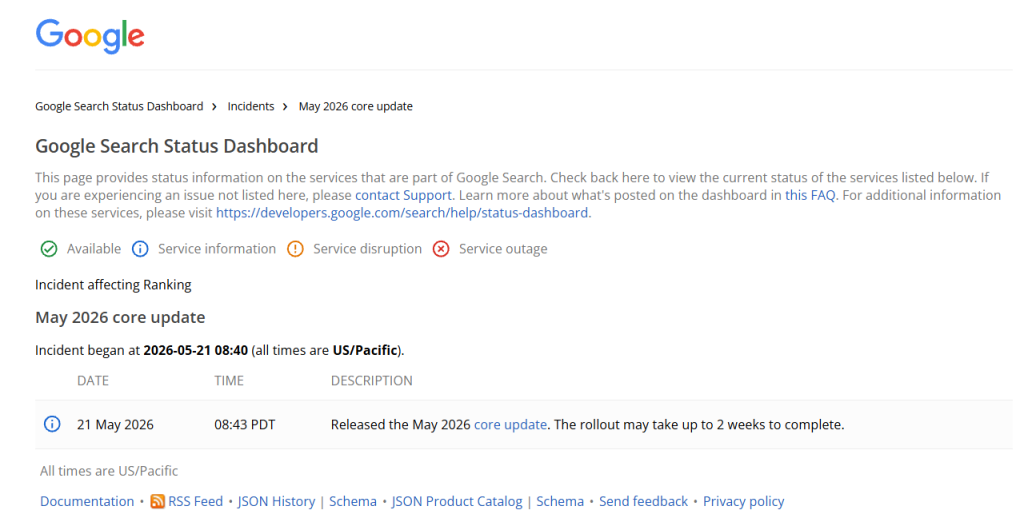
Google confirmed the rollout of the Google May 2026 Core Update via its Search Status Dashboard and announced it simultaneously on the Search Central account on X. The entry on the dashboard was direct:
Released the May 2026 core update. The rollout may take up to two weeks to complete.
Core updates are broad recalibrations of how Google’s systems evaluate content quality across the entire index. Every category, every industry, every content format — all of it gets reassessed simultaneously.
What’s different about May 2026 is the underlying infrastructure driving it. Based on signals from the past two updates, Google has been layering Gemini-based quality models into its core ranking systems. This is no longer purely rule-based ranking. It’s a system that can evaluate content with far greater nuance, recognizing genuine expertise versus surface-level topic coverage.
Timeline of the May 2026 Core Update
Understanding the rollout timeline helps you avoid the most common mistake: reacting to data that’s still in motion.
Google algorithm changes 2026 timeline:
- December 2025 Core Update: December 11 – December 29 (18 days)
- March 2026 Spam Update: March 24 – March 25 (under 20 hours)
- March 2026 Core Update: March 27 – April 8 (12 days)
- May 2026 Core Update: Started May 21 — rollout ongoing, expected to conclude around June 4
Six weeks separated the completion of the March update from the start of this one. That’s a deliberately paced cadence. And yet, many sites were already experiencing ranking movement before May 21 — fallout from the March update still working through the system, combined with ongoing algorithmic adjustments.
This is why the Google Search Status Dashboard update is your first stop, not SEO forums or rank-tracking tools. Dashboard data is authoritative. Forum data is anecdotal.
Expected SEO Impact of the Google Core Update May 2026
Broad core updates don’t just shuffle positions by a spot or two. They can produce meaningful shifts in visibility — and the Google core update SEO impact varies significantly depending on your content strategy.
Here’s what the May 2026 update continues to reinforce:
Content that tends to gain: Pages built around original reporting, first-hand expertise, specific use cases, and clear user intent satisfaction. Sites that have been publishing consistently helpful content — not optimized for Google, but genuinely useful to readers — tend to hold or improve.
Content that tends to lose: Thin topic clusters, over-optimized product pages with minimal substantive content, AI-generated content that hasn’t been meaningfully reviewed by a subject matter expert, and pages that satisfy keyword density but not actual user needs.
An interesting pattern from recent updates: aggregators and third-party publishers citing authoritative sources have been getting demoted, while the original authoritative sources themselves gain ground. If your fintech blog is summarizing RBI guidelines without adding genuine analysis, that’s the kind of page that’s at risk.
For brands in e-commerce, edtech, or real estate — verticals where content is often generated at scale — this is a significant signal. Volume without depth is no longer a viable SEO strategy.
Want to test your current content strategy against these new ranking signals? Talk to our team — we work with growth-focused digital businesses across fintech, travel, and e-commerce to build organic visibility that holds through updates like this.
Why Rankings Fluctuate During Google Core Updates
Here’s something most businesses get wrong: they treat ranking fluctuations during a rollout as final verdicts.
They’re not.
During an active core update rollout, Google is essentially running a live experiment across its infrastructure. Different data centers receive updated signals at different times. Rankings bounce. Pages that dropped on day two might recover by day eight. Pages that jumped initially sometimes settle lower once the rollout stabilizes.
Google ranking fluctuations during a two-week rollout are normal, expected, and not diagnostic. Pulling Search Console data on day five of a rollout and making content decisions based on it is like reading a book’s last chapter first — the context is missing.
The May 2026 update compounds this because it follows weeks of pre-rollout volatility. Many sites were already seeing movement before May 21. Attributing those changes to the May update is easy but potentially incorrect.
The practical takeaway: your baseline should be performance data from the weeks before May 21, compared against a clean window after the rollout completes — roughly June 4 onward.
What Google Suggests After Core Updates
Google’s advice on core updates has stayed pretty much the same for years: there’s no quick fix to bounce back.
At first, that sounds like a vague answer. But it actually tells you a lot about how rankings work.
What Google is telling is this: core updates are not penalties. They’re recalibrations. A drop in rankings doesn’t mean something is wrong with your pages — it means Google’s updated systems now value other content more highly for those queries.
Google recommends that site owners:
- Wait until the rollout is complete before evaluating Search Console data
- Focus on whether the content genuinely satisfies the needs of the person searching
- Assess pages holistically — not just individual pieces of content
- Refer to Google’s core update guidance page and the self-assessment questions it provides for content creators
The self-assessment framework that Google offers is genuinely useful. You will find questions like: Does the content provide original information? Would you trust this content if a friend sent it to you? Is the content written for people, or primarily for search engines? These questions reflect what the ranking systems are increasingly capable of evaluating.
To stay updated on Google algorithm updates and how they affect your organic strategy, tracking the Search Status Dashboard and Search Central blog should be part of your regular workflow.
How SEOs Must React to the May 2026 Google Algorithm Update
SEO after core update best practices aren’t about quick fixes. They’re about monitoring what the data is actually communicating to you once the dust settles.
Here’s a practical response framework:
Step 1 — Wait
Don’t touch rankings or content strategy until the rollout completes. Mid-rollout changes often address temporary fluctuations, not the actual update impact.
Step 2 — Diagnose with clean data
After June 4, compare your Search Console performance against your May 1–20 baseline. Look for patterns: which pages dropped, which queries lost impressions, which content types held stable.
Step 3 — Evaluate content against intent
For pages that dropped, ask honestly: Does this page fully answer what the searcher needed? Or did it rank previously because of links or historical authority rather than content quality?
Step 4 — Prioritize depth over breadth.
If you’re running a content calendar that prioritizes publishing velocity, this update is a clear signal to recalibrate. Fewer, deeper, more authoritative pieces consistently outperform content clusters built for keyword coverage.
Step 5 — Build E-E-A-T signals deliberately
Experience, Expertise, Authoritativeness, and Trustworthiness aren’t abstract concepts anymore — they’re measurable through author credentials, original data, citations, and on-page content depth.
If you’re running paid campaigns alongside organic and want to understand how search visibility shifts affect your full funnel, let’s have that conversation.
Common Mistakes to Avoid During and After the Google Core Update SEO Impact Period
Some of the most damaging moves happen in the first week after a core update announcement. Here’s what to avoid:
- Reacting to day-one data. Traffic dropped 15% on May 22. That tells you almost nothing. The rollout is still in progress. Wait it out.
- Making mass content changes mid-rollout. Blanket updates to dozens of pages while the algorithm is still recalibrating create noise that makes proper diagnosis nearly impossible afterward.
- Chasing competitor movements. If a competitor gained visibility, it doesn’t mean copying their approach will work for you. Their gains may be temporary or may reflect fundamentally different content quality signals.
- Deleting underperforming pages. Before removing content, evaluate whether it serves any useful purpose — even pages with declining traffic may support internal linking, conversion flows, or topical authority.
- Ignoring technical health. Core updates expose technical weaknesses that prevent good content from ranking. Core Web Vitals, crawlability, and mobile performance all influence how Google evaluates your pages.
How to Recover from the Google May 2026 Core Update
The Google May 2026 Core Update is a continuation, not a disruption. It extends a clear multi-year direction: Google is getting better at recognizing content that exists to help people versus content that exists to rank.
For businesses that have been building content with genuine expertise, consistent depth, and real user value — this update is likely to reward you, or at worst hold you steady. For those relying on scaled content production without strong editorial standards, the pressure will continue to build.
How to recover from a Google core update isn’t a one-time checklist. It’s an ongoing commitment to content quality, technical health, and authentic expertise signals. The businesses that treat SEO as a long-term asset — rather than a traffic tap to optimize — are the ones that emerge stronger from every update cycle.
The search environment in 2026 is dynamic. Updates are more frequent. AI is reshaping how results are displayed. And the gap between content that ranks and content that gets ignored is massively decided by genuine quality signals.
Build for the reader first. The algorithm will follow.