

Google Spam update June 2026 is rolling out, its second spam update of the year. If your rankings or organic traffic changed around June 24, this update could be the reason. Here’s everything you need to know.
What Is the Google Spam Update June 2026?
On June 24, 2026, at 9:03 a.m. PDT, Google confirmed the release of the June 2026 spam update via the Google Search Status Dashboard. The update applies globally and covers all languages.
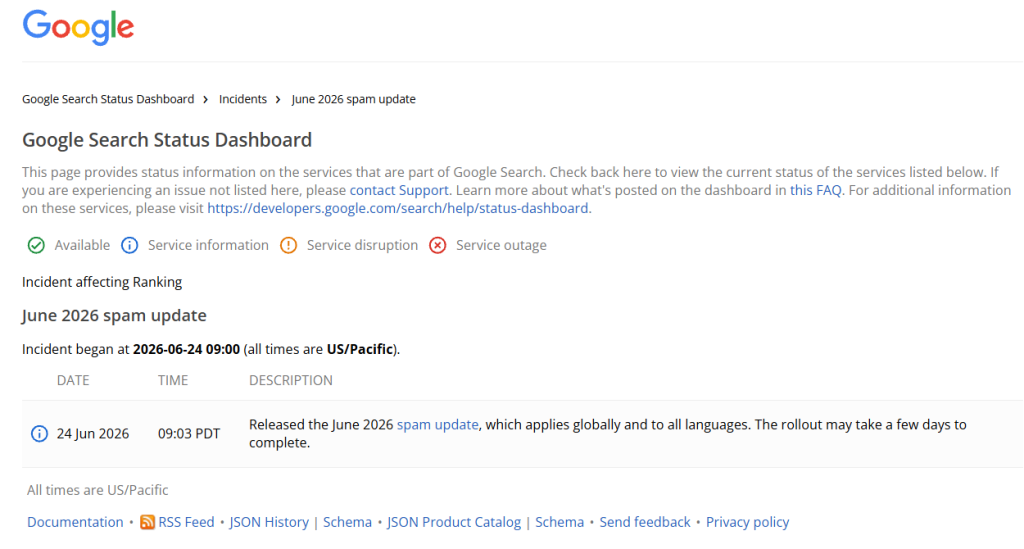
According to Google’s release note, the rollout may take a few days to complete.
This is the second Google spam update released in 2026. The first March 2026 spam update was completed in under a day, making it the fastest spam rollout on record. The June update appears to be a broader deployment, and Google has not attached any new Google spam policy update announcement to it, meaning the existing spam policies still form the framework for evaluating impact.
What Does the June 2026 Spam Update Target?
Google hasn’t published a companion blog post naming specific targets for this update. However, based on the scope of Google’s existing spam policies, the update is likely to address one or more of the following areas:
| Spam Category | What It Covers |
| Scaled content abuse | Large volumes of low-quality pages generated primarily to capture search traffic, including AI-generated content lacking original value |
| Site reputation abuse | Third-party content is published on reputable domains without editorial oversight, solely to exploit domain authority |
| Expired domain abuse | Purchasing expired domains and repurposing them with unrelated content to inherit ranking signals |
| Cloaking | Showing different content to Google’s crawlers than to actual users |
| Unnatural link schemes | Manipulative backlink practices designed to artificially inflate authority |
| Thin or auto-generated content | Pages with little to no substantive value, often scraped or template-duplicated at scale |
Keep an eye on community discussions and SEO forums over the coming days — patterns in who’s affected will quickly reveal which categories this update emphasised most heavily. You can also stay informed by checking our Google updates history.
How to Check if Your Site Was Affected
The most direct way to determine whether the June 2026 spam update impacted your site is to look at your data with June 24 as your reference point.
Step 1: Open Google Search Console.
Navigate to the Performance report and set a date comparison that spans the week before and after June 24. A sudden drop in impressions, clicks, or average position starting on or after that date is a strong signal.
Step 2: Check for a manual action.
In Search Console, go to Security & Manual Actions → Manual Actions. If Google’s spam team flagged your site directly, you’ll see a notification here. This is separate from an algorithmic impact — both require action, but manual actions have a formal reconsideration pathway.
Step 3: Review your server logs.
A drop in Googlebot crawl activity following June 24 can indicate reduced priority in Google’s crawl queue, often a side effect of demotion.
Step 4: Compare against industry benchmarks.
Tools like Google Search Console Insights, Semrush, or Ahrefs allow you to overlay your traffic data against broader industry fluctuations. If your drop mirrors the wider market, a different cause may be at play.
Not sure whether your site was hit? Our team can run a full SEO audit and pinpoint exactly what changed. Talk to an SEO Expert.
What to Do if Your Site Was Hit: A Recovery Checklist
Recovering from a spam update takes a methodical approach. Here’s a step-by-step process to work through.
Step 1: Audit for Spam Policy Violations
Start by reading through Google’s current spam policies documentation and honestly comparing your site’s practices against each policy. Common violations are doorway pages, hidden text, and keyword stuffing. Resolve any violations before expecting recovery — algorithmic improvements won’t apply to a site still engaging in the same behaviour.
Need a full technical audit process? Our technical SEO checklist covers every layer you should review.
Step 2: Review AI-Generated and Thin Content
Google’s scaled content abuse policy is clear: content created primarily to rank and does not add genuine value is a policy violation, regardless of whether it was written by a human or an AI tool. Audit pages that were produced at high volume. Ask whether each page gives a reader something they couldn’t find anywhere else.
Step 3: Check Your Backlink Profile
Use Google Search Console’s Links report alongside a third-party tool to identify any suspicious inbound links. Look for link farms, paid link networks, or sudden spikes in links from unrelated or low-quality domains. Use Google’s Disavow tool only for links you genuinely cannot have removed manually, and use it carefully. Over-disavowing legitimate links can cause additional ranking drops.
Step 4: Send a Reconsideration Request (if Manual Action)
If Search Console shows a manual action rather than an algorithmic impact, you’ll need to resolve the underlying issue and then submit a reconsideration request through Search Console. Be specific about what you found and what you fixed. Vague or incomplete requests are typically rejected. Google’s reviewers are looking for evidence that the site has genuinely addressed the concern, not just an acknowledgement that a problem existed.
Need a hands-on partner to guide your recovery? We specialise in post-update SEO remediation. Get in Touch.
How Long Does the Spam Update Rollout Take?
Google announced that the June 2026 spam update rollout may take a few days to complete. This is consistent with most spam updates, though the timeline can vary. For context, the March 2026 spam update finished in under a day, while the August 2025 spam update ran for nearly four weeks.
Conclusion
The Google spam update June 2026 is now live and actively indexing the web with fresh enforcement of Google’s spam policies. If your site saw traffic or ranking changes around June 24, it’s time to act methodically, audit your content, check your backlinks, verify your Search Console status, and build a documented recovery plan. Spam updates reward sites that are genuinely built for users. Stay tuned to this blog for updates as the rollout completes and the SEO community reports on which site patterns were most affected. And if you need strategic support, our team is here to help.