

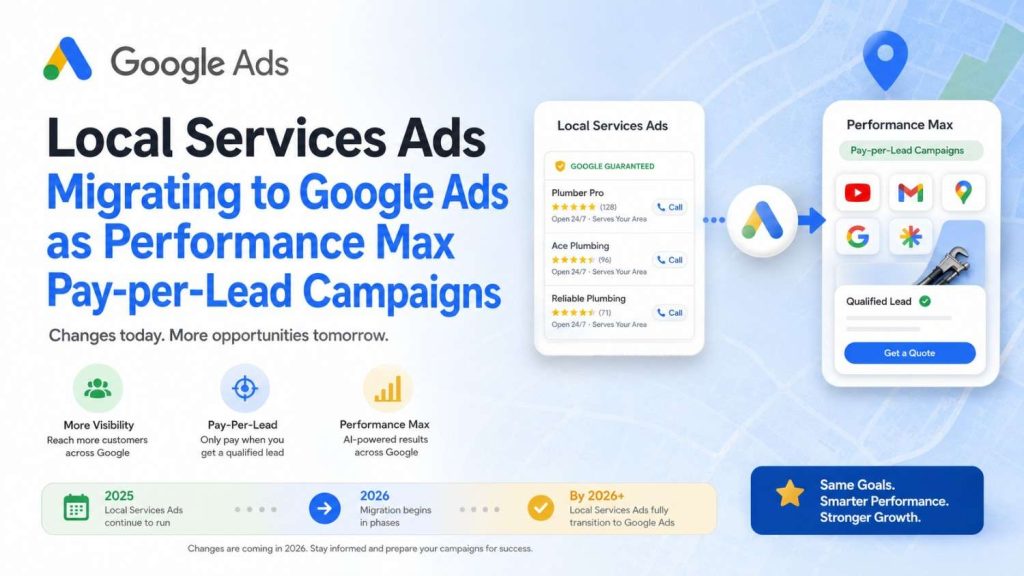
Google confirmed on 20 July 2026 that Local Services Ads will run inside the main ad platform as a Performance Max campaign type built for pay-per-lead goals. The standalone dashboard retires. Google Local Services Ads keep their pay-per-lead billing, Search and Maps placement, and keywordless targeting. Three mechanics shift underneath: manual bidding disappears, vertical-level Target CPA collapses into one campaign-level target, and weekly budgets convert to daily averages. The rollout runs in phases from August 2026 through 2027, with 14 days of notice. One detail carries real cost: historical performance reports stop at the door.
Google published the migration documentation on 20 July 2026, and the phrase most people fixated on was the campaign name. Performance Max. That label carries baggage — sprawling reach, opaque placements, YouTube and Gmail inventory nobody asked for. Understandable reaction. It misreads what Google shipped.
The campaign type borrows Performance Max infrastructure and almost nothing else. Read it as Performance Max for Local Services: serving locked to Search and Maps, with headlines, videos, and sitelinks unsupported. Google Local Services Ads keep the lead-based billing they have always used.
So the interesting question shifts. The customer-facing product holds steady. The account plumbing underneath changes in ways that rewrite how spend gets allocated, how bids work, and how much of your past you can still see.
Key Takeaways
- Pay-per-lead billing and Search/Maps placement continue.
- The standalone Local Services Ads dashboard retires permanently.
- Historical performance reports vanish; export them first.
- Manual bidding and vertical Target CPA both end.
- Weekly budgets convert to daily average spend.
- Migration starts August 2026, runs through 2027.
- Google emails your admin 14 days beforehand.
- BBB callouts go; add six replacement callouts.
What Is Happening: The Google Local Services Ads Shift
Google is folding Local Services Ads into Google Ads as a specialised Performance Max campaign type optimised for pay-per-lead goals. Existing campaigns migrate automatically, and your old dashboard login redirects into Google Ads from transition day.
This sits among the more consequential Google Ads updates of 2026. Google merged Business Profile and Local Services booking systems in 2024, then moved review management into Business Profiles in July 2025. This absorbs the last standalone piece — the ad-management layer.
What Is NOT Changing In Your Local Services Ads Migration
Google’s documentation is unusually specific about what holds.
Billing model: You pay for valid leads calls, messages, bookings. Clicks stay unbilled.
Placement: Ads serve exclusively on Google Search and Google Maps, in the same positions as before. Standard Performance Max campaigns reach across YouTube, Gmail and Display. This one stays local.
Keywordless targeting: No keyword lists, no match types, no negative keyword housekeeping. Targeting runs off service categories and areas.
Verification: Your verified status and Google Verified badge transfer automatically. Insurance and licence reverification no longer apply.
Lead history survives too contact details, message threads and older call recordings all move into the new Lead Manager.
What IS Changing: Every Confirmed Google Ads Difference
The full confirmed list, from Google’s migration documentation.
| Area | Local Services Ads dashboard | Google Ads after migration | Action worth taking |
| Performance reports | Full campaign history available | History stops at migration day | Export everything before notice arrives |
| Bidding | Manual max cost-per-lead supported | Automated bidding only | Record current targets for reference |
| Target CPA | Separate target per vertical | One blended campaign-level target | Split verticals into separate campaigns |
| Budget | Weekly amount | Daily average (weekly ÷ 7) | Recheck pacing on limited schedules |
| Trust callouts | BBB callout supported | BBB callout removed | Select at least six structured callouts |
| Business details | Edited inside the dashboard | One-way sync from Business Profile | Freeze profile edits near migration day |
Reporting: Your Performance History Stops At Migration
Campaign-level metrics do not travel. Impressions, clicks, weekly spend, ad-level performance all of it stays behind in a dashboard you lose on transition day.
The cost lands later than people expect. Migrate in August 2026 and your in-platform history restarts at zero. Come August 2027, no prior-year comparison sits inside the interface. Anyone reporting seasonality and local service demand is aggressively seasonal — loses their baseline exactly when they need it.
Export monthly aggregates and lead-level detail into a structure you can rejoin to Google Ads data later. Screenshots feel faster. They fail when somebody asks for a trend line.
Bidding: One Blended Target CPA Replaces Verticals
Google Ads has no concept of vertical-level Target CPA. If your campaign runs separate targets across categories, the system calculates one unified target and applies it everywhere.
Run the arithmetic on a worked example. Say a campaign carries plumbing at a $70 target cost per lead and HVAC replacement at $190, because the jobs differ sharply on close rate and ticket value. Migration produces one blended number between them. Plumbing now looks expensive to the bidding system, and HVAC looks cheap. Delivery skews toward whichever vertical the blended target flatters, and lead mix drifts within weeks.
Google’s own fix is separate campaigns per vertical. A sequencing trap sits buried in that advice.
You cannot create new pay-per-lead campaigns inside Google Ads yet. Google’s documentation states that campaign creation arrives later, and that new campaigns still run through g.co/localservices. The remedy therefore depends on a route outside the platform you were just moved into. Sort that structure out ahead of transition day, while the old controls exist.
Budgets: Weekly Amounts Become Daily Average Spend
Google divides your historical average weekly budget by seven to set a daily average. Monthly spend caps at that daily figure multiplied by 30.4.
A $1,400 weekly budget becomes $200 a day, capping the month around $6,080. The monthly ceiling barely moves. Day-level behaviour does. Daily averages flex upward on busy days and pull back on quiet ones, which suits a seven-day schedule and breaks pacing on a limited one. Accounts on weekday-only schedules should watch the first fortnight closely.
Assets And Trust Signals: BBB Callouts Now Disappear
Google has retired Better Business Bureau callouts. The compensating move sits in the Assets tab, where you select at least six structured callouts business hours, specialties, accepted payment methods, and similar. You can also upload up to 100 business photos.
Accounts that leaned on the BBB badge in a crowded local pack lose a real trust signal. Replacing it takes ten minutes of thought about which six callouts separate you from the competitors beside you.
Sorting bidding structure and assets ahead of a forced migration benefits from a second set of eyes. Talk to our paid search team for a structural review before your notice window opens.
The Migration Timeline: When Will Your Account Move?
Google moves accounts in three waves.
August 2026. Phase one covers selected home and storefront service advertisers in the United States: plumbing, HVAC, electrical, appliance repair, house cleaning, lawn care, roofing, pest control, and moving.
Late 2026. The rollout widens to service-area businesses without physical storefronts, plus accounts running custom bidding or booking configurations.
2027. Non-US accounts and every remaining business category transition.
One wrinkle deserves flagging. Google’s documentation lists home and storefront verticals for phase one, while Search Engine Land’s coverage names pet care, home services, wellness and education. Treat vertical lists as directional. Plan around the notification.
The notification runs on a fixed cadence: an advance email to your account administrator 14 days out, a dashboard banner, a reminder seven days later, and a confirmation once migration completes. Two weeks covers exporting data and checking settings. It runs thin for restructuring.
Check who actually receives that email. On accounts managed across several parties, the listed administrator is often somebody who left two years ago.
What To Do Before And After Your Local Service Ads Migration Date
Before Migration: The Export Nobody Wants To Redo Later
Five tasks, roughly in priority order.
- Export every performance report you might want. Monthly spend, leads and cost per lead, split by vertical and service area. Store it where your reporting stack can read it.
- Document your current bid targets. Write down each vertical-level Target CPA before the system blends them.
- Decide your campaign structure. Split mismatched verticals while the old controls remain available.
- Confirm Google Ads access. Everyone who touches the account needs permissions in the destination platform.
- Audit your Google Business Profile. Name, address, Phone number, hours, and primary category sync one-way into your campaign, so inconsistencies surface immediately.
That last point connects directly to local SEO services work. Your Business Profile stopped being a purely organic asset it now feeds paid campaign configuration daily.
After Migration: The First Two Weeks Of Google Ads
Google asks for up to two weeks before performance settles. Respect that window. Changing bids on day three, reading noise as signal, then reversing on day nine stretches an unstable fortnight into a bad quarter. Do this instead:
- Verify settings on day one. Service areas, ad schedule, business categories, budget, lead routing number.
- Freeze Business Profile edits. Changes to name, address or primary category trigger a 24-to-48-hour verification review that can pause your campaign. Editing during migration week compounds two disruptions.
- Rebuild your reporting view. Conversions equals leads charged. Cost equals spend. Cost/conv. equals average cost per lead.
- Set your callouts. Six minimum, chosen deliberately.
- Watch lead mix alongside lead volume. Blended Target CPA distorts composition before totals.
The upside sits in your wider paid search marketing programme. Google Ads for Local Services now sits beside Search and Shopping in one account, which makes cross-channel budget decisions far easier to argue with real numbers.
Conclusion: Treating Migration As An Operations Task
The consumer-facing product survives intact. Same placements, same billing, same keywordless targeting, same verified badge. Google Local Services Ads will look identical to the person searching for an emergency plumber at 11 pm.
The work sits on your side of the glass. Export history before it evaporates. Fix blended-target exposure while the old controls exist. Replace the BBB signal with six deliberate callouts. Leave bids alone for a fortnight.
Accounts treating Google Local Services Ads migration as a calendar event lose a year of comparative data and spend a quarter untangling a blended bid. Treating it as a scheduled operations project produces cleaner structure and unified reporting.
Your notice email gives you 14 days. Useful preparation takes longer. Speak to our team about a pre-migration audit if your account carries multiple verticals or a limited-schedule budget.
Sources
- Google Ads Help — Local Services Ads transition to Performance Max campaigns with pay-per-lead goals.
- Search Engine Land — Local Services Ads come to Google Ads via Performance Max