

Every real estate developer we talk to has a version of the same story: a campaign that spent well into six figures and produced a folder of leads nobody could actually reach. Before we spend a single dirham of a client’s budget, every campaign has to clear a 7-point filter first: a compliance, demand, and readiness check built from running real estate ad campaigns in Dubai across off-plan launches, ready-unit inventory, and commercial developments. This is the Ads strategy for Dubai Real Estate Developers, in full, so your team can run it yourself or use it to pressure-test any agency proposal in front of you.
Key Takeaways
- Compliance comes first.
- Verify demand per project, not per category.
- Test the funnel before the ad, not after.
- Investors and end-users need separate messaging.
- Platform choice follows the funnel stage.
- Benchmark cost per lead against the real project, not a generic industry figure.
- Tracking has to work before launch.
Why Most Real Estate Ad Campaigns in Dubai Waste Budget
Most wasted ad spend does not come from bad creative. It comes from skipping a check that only takes an hour. A permit that was never filed. A landing page nobody has load-tested on mobile. A Cost-Per-Lead(CPL) target pulled from a generic blog post instead of the project’s own numbers. Real estate marketing Dubai campaigns are unusually unforgiving of these shortcuts, because the market moves fast and the regulatory bar is high.
The market itself explains the pressure. Dubai’s real estate sector closed 2025 with transaction value reported at roughly AED 917–919 billion (about USD 250 billion) across an estimated 270,000+ transactions, a record year, with growth reported at around 20% year-on-year, according to figures released by Dubai’s Public Debt Management Office and reported separately by Dubai Land Department data. More developers are chasing that demand with paid media than ever before, which means a sloppy campaign now competes directly against a disciplined one for the same buyer’s attention.
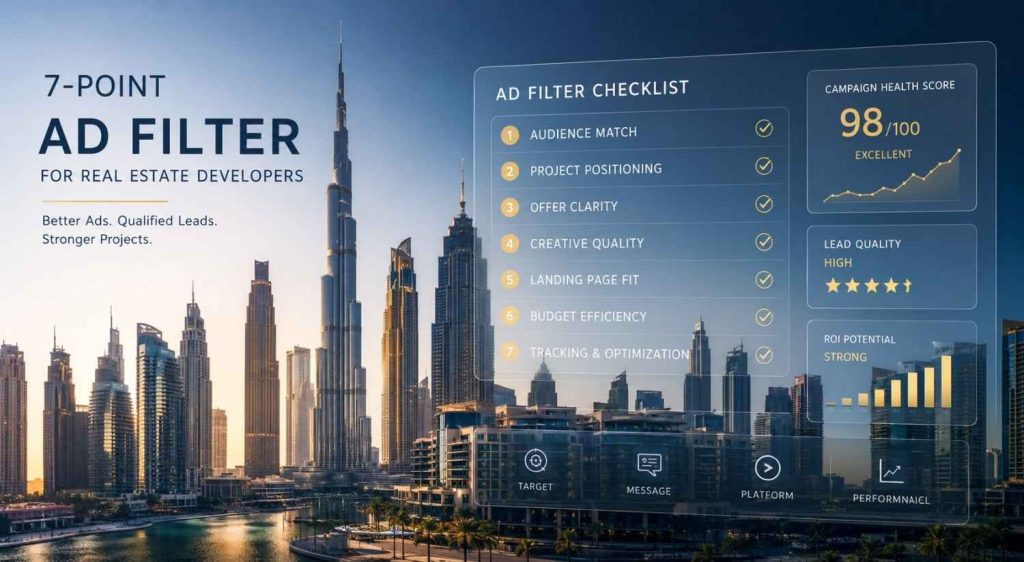
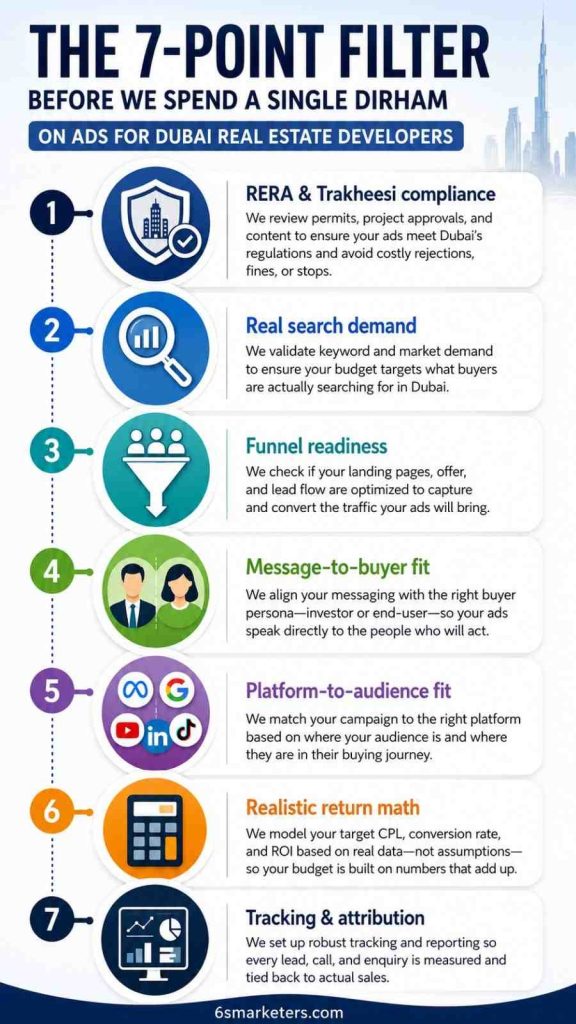
Our Ads Strategy for Dubai Real Estate Developers: The 7 Point Checklist
| # | Filter Point | What It Catches |
| 1 | RERA & Trakheesi compliance | Ads that get rejected, fined, or pulled mid-flight |
| 2 | Real search demand | Budget spent chasing a keyword nobody searches |
| 3 | Funnel readiness | Clicks that arrive at a page that can’t convert them |
| 4 | Message-to-buyer fit | Investor messaging shown to end-users, or the reverse |
| 5 | Platform-to-audience fit | Budget on the wrong platform for the funnel stage |
| 6 | Realistic return math | A target CPL, nobody checked against real numbers |
| 7 | Tracking & attribution | Nobody can tie back to an actual sale |
Step 1: Does the Campaign Clear RERA and Trakheesi Rules?
Any developer, broker, or agency running ads for Dubai real estate developers needs a valid Trakheesi permit before a single ad goes live — and this applies to social media and digital campaigns, not just billboards and print. Trakheesi is the Dubai Land Department’s (DLD) electronic permit system, supervised by the Real Estate Regulatory Agency (RERA); every approved ad carries a unique permit number that must appear on the advertisement itself.
Off-plan campaigns carry extra requirements: the ad must state the developer’s name, the project’s escrow account number, and the expected completion date. Skipping this step is not a minor risk; non-compliant advertising can draw fines that are commonly cited in the tens of thousands of dirhams, and repeat violations can affect a brokerage’s licence. (Permit fees and fine amounts change; confirm the current schedule on the DLD site before quoting a figure in client-facing material.)
What we check before launch: a live, unexpired Trakheesi permit number, correct off-plan disclosures on every ad variant, and that the landing page content matches what the permit was approved for, because DLD and portal reviewers check the destination page, not just the ad copy.
Step 2: Is There Real Search Demand Behind the Project?
A campaign built on the assumption that “everyone wants a beachfront unit” burns budget fast. Before any Google Ads for real estate in Dubai campaign gets a brief, we pull actual keyword and search-volume data for the specific project type, price band, and community, not the category as a whole. A one-bedroom in a secondary community and a branded-residence penthouse do not share a demand curve, even if they share a postcode.
What we check before launch: search volume and seasonality for the specific unit type and community, competitor share of voice on the same terms, and whether the “obvious” primary keyword is actually the one buyers use, or a marketing team assumption.
Today’s buyers often begin their journey with AI-powered search tools before they engage with ads. Learn how AI is changing the real estate buying journey.
Step 3: Is the Funnel Actually Ready to Convert a Click?
A strong ad sending traffic to a slow, English-only, desktop-only page is a bigger budget leak than a mediocre ad on a great page. Before spend goes live, we test the full path a lead takes: ad → landing page → enquiry form or WhatsApp → CRM entry → first human response. If any link in that chain is broken or slow, fixing it is worth more than any bid adjustment.
What we check before launch: mobile page speed, Arabic/English parity where relevant, a working WhatsApp or call-to-action that reaches an actual person, and confirmation that leads land in a CRM someone is monitoring, not an inbox nobody checks on weekends.
Even the best ad campaign can fall short if your landing page doesn’t encourage action. Explore these proven CTA optimization tactics to turn more clicks into qualified enquiries.
Step 4: Does the Ad Message Match the Real Buyer Type?
Off-plan investors and end-user buyers respond to different arguments, and Dubai’s market has both in large numbers. Some market reports have put off-plan sales at roughly seven in ten residential transactions through 2025, though the exact split varies by source and should be checked against current DLD reporting rather than repeated as a fixed number. An investor wants yield, payment-plan structure, and exit timing.
An end-user wants layout, school proximity, and move-in readiness. Running one generic message to both groups is one of the most common reasons Meta Ads for Dubai real estate underperform on cost per qualified lead, even when the click-through rate looks healthy.
What we check before launch: separate ad sets and separate messaging for investor and end-user segments, and creative that reflects which one the specific project actually suits.
Don’t let generic campaigns drain your ad budget. Connect with us to create high-performing real estate campaigns that deliver measurable results.
Step 5: Is the Ad Platform Right for This Audience?
Google and Meta Ads for Dubai real estate do different jobs in this funnel, and mixing them up is expensive. Search captures people already looking; Meta builds awareness and warms up an audience that isn’t searching yet. There’s a compliance layer here, too, that catches many international campaigns off guard: Google’s restricted-targeting rules for housing ads, and Meta’s Special Ad Category for housing, are enforced against ads targeting the United States and Canada — and Meta’s version extends to parts of Europe as well. A Dubai project itself sits outside that scope, but a campaign remarketing to overseas Indian, UK, Canadian, or European diaspora buyers can trigger those exact restrictions, because the restriction follows the audience location, not the property’s address. Teams running real estate ad campaigns in Dubai aimed at diaspora investors should plan targeting with that in mind rather than discovering it mid-campaign.
What we check before launch: funnel-stage mapping (search vs. awareness), and a targeting review for any campaign reaching audiences physically located in the US, Canada, or Europe.
Step 6: Are the Return Numbers Realistic, Not Hopeful?
Generic “average CPL for Dubai real estate” figures circulate widely online, and we don’t trust them, because cost per lead swings enormously by community, price point, and season — a figure quoted for a mass-market apartment launch tells you almost nothing about a branded villa campaign. Rather than anchor a budget to a number pulled from a blog post, we set the first two weeks of spend as a live benchmarking test against the project’s own numbers, then build the real target from that data.
What we check before launch: a defined test budget and timeframe, a clear break-even CPL based on the project’s actual sales value and close rate, and agreement on what “success” means before the campaign, not after.
Step 7: Can the Team Actually Track What Happens Next?
An ad campaign that can’t be traced to a booked unit is a cost centre, not a marketing engine. Before launch, every campaign needs working conversion tracking, consistent UTM tagging, and a CRM field that records which ad and which keyword produced each lead — so that six months later, when a lead converts to a sale, that value can be traced back to the campaign that started it.
What we check before launch: conversion tracking installed and tested (not just “added”), UTM conventions applied consistently across every platform, and a CRM handoff that survives beyond the marketing team into sales.
Conclusion
Running this filter first doesn’t slow a launch down; it prevents the far more expensive delay of pausing a live campaign to fix a permit issue or a broken form. For real estate marketing Dubai teams managing multiple project launches a year, the filter also becomes a shared checklist between marketing, sales, and compliance, so nobody discovers a gap after the budget is already spent.
Great PPC campaigns start with the right strategy, not just bigger budgets. Learn how our PPC advertising services help developers maximize every advertising dirham.
External Sources Referenced
- Dubai Land Department — Real Estate Advertisement Permit (Trakheesi)
- Google Ads Policy Help — Housing in Personalized Advertising
- Meta Transparency Center — Advertising Standards
- UAE Public Debt Management Office — Dubai Real Estate Market 2025 Milestone