

Let’s start with a confession most SEOs won’t make publicly: for years, submitting a Google spam report felt like shouting into a void. You’d flag a competitor’s sketchy link scheme, hit submit, and never hear anything back. The common understanding — backed by Google’s own documentation — was that those reports fed into algorithmic training, not direct enforcement. Google now uses Spam Reports for manual actions; this changed on April 14, 2026.
Google updated its Search Central documentation to confirm that spam report submissions may now be used to take manual action against websites that violate its spam policies — and the text submitted in those reports may be passed verbatim to the site owner being reported.
If you’re in marketing leadership, run a content-heavy site, or have any stake in organic visibility, that’s a sentence worth reading twice.
Key Takeaways
- Google officially connects spam reports to manual actions now.
- Report text gets forwarded verbatim to site owners.
- Manual actions hit rankings, traffic, and credibility hard.
- Scaled, low-value content faces the sharpest new risk.
- Search Console monitoring is now a non-negotiable habit.
- Spam compliance must move beyond editorial into operations.
- Recovery from manual actions takes weeks, sometimes months.
What Changed in Google Spam Reports — and Why It’s a Bigger Deal Than It Looks
Here’s the specific language Google removed from its reporting documentation. The older disclaimer read: “While Google does not use these reports to take direct action against violations, these reports still play a significant role in helping us understand how to improve our spam detection systems.”
It is now gone, replaced with something much more pointed.
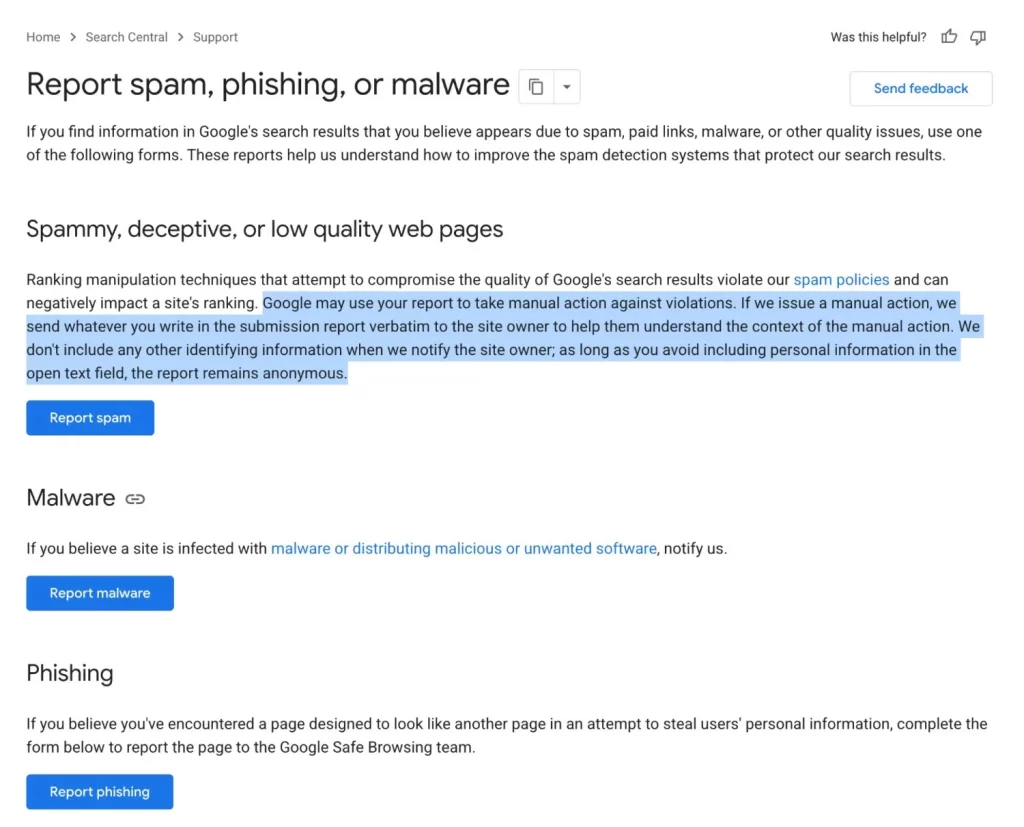
Google’s report spam page now clearly states that the company may use submitted reports to issue a manual action against a violating website. That’s not subtle language. It’s a direct reversal of what the industry understood to be true.
There’s a second piece that’s getting less coverage but deserves equal attention. If Google issues a manual action, it may send whatever was written in the submission report verbatim to the site owner, and Google says it will not share any other identifying details about the reporter when notifying the site owner.
So whoever reports your site stays anonymous. But the words they used? Those land directly in your Google Search Console inbox.
That’s a meaningful transparency shift. It tells you more about why you’re being penalized — but it also means a competitor, a disgruntled partner, or even a random user now has a more actionable way to trigger enforcement against you. The Google spam report update 2026 isn’t just a policy note. It’s a structural change to how enforcement actually reaches websites.
How Manual Actions Work — The Enforcement Path You Should Understand
Before diving into risk, it’s worth being precise about what a manual action actually is, because people conflate it with algorithmic penalties all the time.
The process runs like this: a person flags a page for suspected spam; a human reviewer at Google then confirms whether a policy violation exists; if confirmed, a penalty is applied, and a Search Console notice is sent to the site owner.
The critical distinction: the report itself is not the penalty, but it can now be part of the path that leads to one.
Google’s automated systems still catch the vast majority of spam on their own. Manual actions have always been reserved for cases where human judgment was needed — sophisticated manipulation that algorithms hadn’t yet caught, or situations where the violation was contextually complex. What’s new is that public spam reports can now put a site into that human review queue.
Search practitioners and website owners are advised to monitor Google Search Console for any manual action notifications, which represent a separate enforcement channel from algorithmic spam detections.
If you’re not already checking Search Console weekly, start today. This isn’t optional anymore.
Staying on top of Google algorithm updates helps, but manual actions operate on a different track — and the Google Search Console manual actions report is where you’ll see them first.
Why This Update Matters for Your SEO Strategy in 2026
Be honest with yourself for a moment. How much of your content was produced primarily to capture search volume rather than genuinely help the people reading it?
In 2026, many sites are publishing more content, faster, using some mix of AI, templates, outsourcing, and editorial workflows. The risk isn’t AI use by itself — the risk is low-value scaled production aimed mainly at search capture.
That’s exactly the environment this update was designed to address.
The spam reports SEO impact here cuts two ways, and it’s worth being clear about both.
If you’ve built your organic presence on solid editorial standards, original research, and genuine subject matter expertise, this update mostly affects the sites you’ve been competing against. SEOs and site owners who have been frustrated by spam-heavy results now have a slightly more direct line to flag those problems. That’s a competitive advantage if your content is legitimately better.
But if parts of your site have accumulated thin pages, templated location content, or aggressive link acquisition over the years, the risk profile just changed. What was previously a low-probability enforcement scenario now has an additional trigger mechanism outside of Google’s automated systems.
The Google spam policy changes in 2026 form a pattern worth noting. The March 2026 spam update rolled out globally in under 24 hours. A new back-button hijacking policy is set for enforcement in June. And now, spam reports connect directly to manual reviews. Google isn’t moving slowly here.
Spam Report Consequences — Real Risks for Website Owners
Understanding the Google manual penalty risk requires looking at what Google actually targets. Here’s where exposure is highest right now:
Scaled content without original value. Auto-generated comparison pages, templated service descriptions, AI-spun articles with no editorial review — these have always been policy violations. They’re now more likely to be reported and reviewed by humans.
Link manipulation schemes. Purchased links, private blog networks, and reciprocal link exchanges are still the most scrutinized areas. Competitors who know your link profile can now report what they find.
Doorway and near-duplicate location pages. Dozens of city pages with 90% identical copy, tweaked only for location names. Businesses using doorway pages saw major drops in the March 2026 update, including dozens of city pages with nearly identical copy.
Expired domain misuse. Acquiring domains with existing authority and repurposing them for unrelated content to pass link equity.
Not every spam hit triggers a manual action — many happen automatically with no warning at all. But manual actions are harder to recover from and more visible in their impact. A site-wide manual action can effectively remove your organic traffic overnight.
Worried about where your site stands? Talk to our team at 6S Marketers — we’ll help you identify exposure before a report does it for you.
How to Stay Safe from Google Spam Penalties in 2026
There’s no single fix here. Staying safe from spam report consequences is about building the kind of site that holds up under human scrutiny — not just algorithmic review.
Start with a content quality audit. Pull your lowest-traffic pages and ask the honest question: Does this page provide original value, clear purpose, and trustworthy execution? Pages that can’t answer yes are liabilities. Either improve them substantially or consolidate and redirect.
Make Search Console a standing agenda item. Specifically check the Manual Actions report under Security & Manual Actions. If Google found a specific violation, you’ll see it there.
Strengthen your editorial production process. Stronger briefs, real editorial review, subject-matter validation, transparent authorship, careful template design, and clear value-add expectations for every page type — these aren’t just best practices. They’re now your operational compliance framework.
Clean up your link profile proactively. Run a backlink audit. If you see patterns that would look suspicious to a human reviewer — clusters of exact-match anchor text, links from unrelated foreign-language sites, or spikes from obvious link farms — address them. Disavow where necessary and document everything.
Treat spam compliance like a business operations issue. Site owners should treat spam compliance as an operational issue, not just an editorial one. That means ownership, accountability, and regular review cycles — not just a checklist you run when something breaks.
For a comprehensive approach to SEO that’s built to last through policy changes like this one, 6S Marketers works with businesses to build search strategies grounded in content quality and sustainable practices.
Conclusion
Here’s the bottom line: Google just made spam enforcement more human — and more public — than it’s ever been. For a long time, SEOs and site owners who spotted spam in Google Search had one option: submit a report and hope the algorithm caught up eventually. Such reports were not directly connected to any enforcement and certainly couldn’t trigger a Google spam manual action. That’s no longer the case.
The businesses that will navigate this well are the ones that have already been building with users in mind rather than search engines. If your content genuinely helps people, if your links were earned honestly, and if your site structure reflects real value, you’re in a far stronger position than your competitors who took shortcuts.
For everyone else, the window to course-correct is still open. But the margin for error is getting smaller with every update Google rolls out in 2026.
What’s changed most for your team this year — content quality standards, link acquisition strategy, or something else entirely? Drop your take in the comments. Always curious how forward-thinking businesses are adapting.
External Sources:
- Search Engine Land — “Google Spam Reports Can Now Be Used for Manual Actions“
- Google Search Central — Spam Policies and Manual Actions Documentation.