

Search visibility today isn’t just about ranking—it’s about how you show up. Two pages can rank side by side, yet one earns significantly more clicks. The difference often comes down to schema markup.
Schema doesn’t magically push you to position one. But it does something just as powerful: it makes your listing impossible to ignore. And in competitive B2B spaces, that edge compounds.
If your pages are still showing as basic blue links while your competitors have ratings, FAQs, or product details, you’re already losing.
Key Takeaways
- Schema helps search engines understand your content
- Rich snippets increase click-through rates significantly
- JSON-LD is Google’s preferred schema format
- Schema doesn’t guarantee rankings, but improves visibility
- Validation tools prevent costly implementation errors
- Different schema types serve different business goals
What is Schema Markup & Why Does it Matter
Schema markup is a form of structured data that helps search engines interpret your content more clearly.
It’s like putting labels on your site. Search engines are told exactly what a page contains instead of guessing.:
- This is a product
- This is a review
- This is an FAQ
- This is an organization
Such clarity allows search engines to generate rich snippets, improved search results that include ratings, pricing, breadcrumbs, or FAQs.
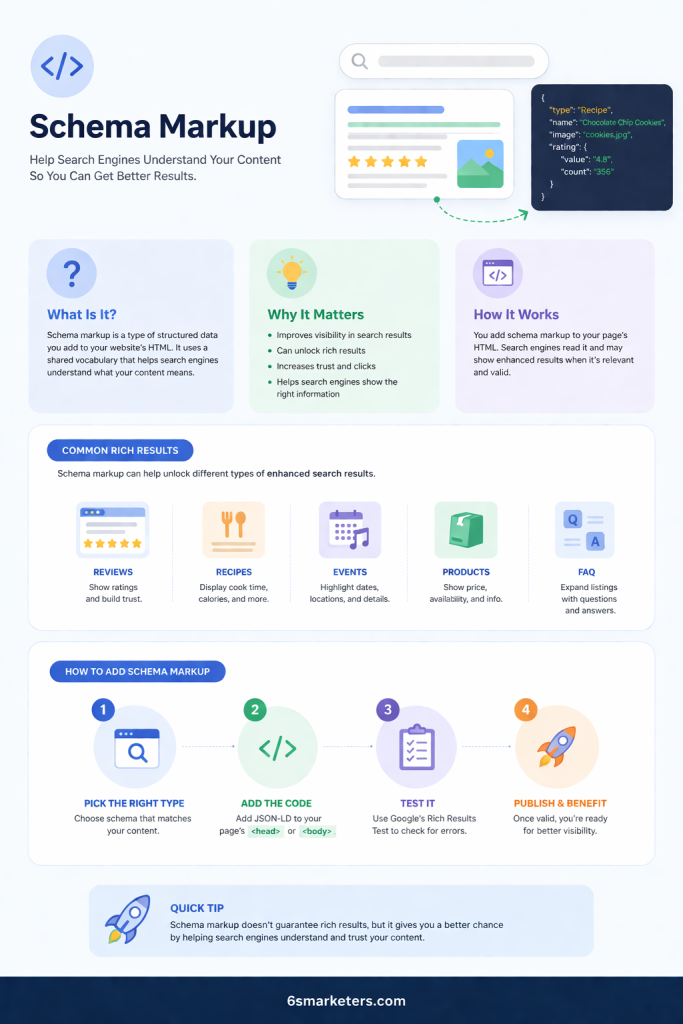
Why does this matter? Visibility is not only about ranking anymore but about attention economics. A listing with structured enhancement is visually distinctive, builds trust faster, and gets more clicks without necessarily ranking first.
A structured data intersection is where SEO stands. It is not just technical.
If schema is currently missing from your SEO setup, you’re missing a layer. You can review broader technical gaps here: Technical SEO Checklist.
Types of Schema Markup
Some schemas are better than others. The type you implement must be consistent with your business model and content strategy.
Table: Types of Schema Markup
| Schema Type | Best For | Impact on Search Appearance |
| Organization | Company websites | Brand knowledge panel |
| Product | E-commerce pages | Price, availability, reviews |
| FAQ | Service & informational pages | Expandable Q&A in search results |
| Review | Testimonials & case studies | Star ratings |
| Article | Blogs & editorial content | Enhanced visibility in news/search |
| Local Business | Multi-location businesses | Map listings, contact info |
| Breadcrumb | Structured navigation | Cleaner search result hierarchy |
A practical example: a SaaS product page using SEO schema markup can display pricing and ratings directly in search. Meanwhile, a services page using FAQ schema can answer objections before the click even happens.
The key is alignment. Randomly adding schema won’t move the needle—but strategic implementation will.
How Schema Improves CTR
Let’s be clear: schema doesn’t directly improve rankings. But it does improve click-through rate (CTR), and that’s where the real impact lies.
Here’s how:
1. Visual Differentiation
Rich results take up more space. More space equals more attention. It’s that simple.
2. Pre-Click Trust Building
Star ratings, reviews, and FAQs reduce uncertainty. Users feel informed before clicking.
3. Intent Matching
Schema ensures your content is presented by search engines in accordance with user intent. Bounce rates decline as engagement increases.
4. Competitive Advantage
Many industries still have inconsistent adoption of schema. The gap mentioned is an opportunity.
For instance, businesses expanding into new locations frequently struggle with visibility. Insights from industry trends indicate that structured data, particularly local business schema, enables search engines to better match a page with a query indicating a geographical location.
If your competitors are not using this, you don’t need better rankings. You need a better presentation.
And if they are? You need to catch up fast.
If you’re assessing how schema fits into your overall SEO strategy: SEO services.
How Do You Implement Schema Markup
Many teams get stuck at this step. It may sound technical, but it’s closer than you think.
Step 1: Choose the Right Format
Google recommends JSON-LD. It’s clean, flexible, and doesn’t interfere with your HTML.
Step 2: Create the Markup
Here’s a simple json ld schema example for an organization:
{
“@context”: “https://schema.org”,
“@type”: “Organization”,
“name”: “Your Company Name”,
“url”: “https://yourwebsite.com”,
“logo”: “https://yourwebsite.com/logo.png”,
“sameAs”: [
“https://www.linkedin.com/company/yourcompany”
]
}
Step 3: Add It to Your Website
You can place this script in the <head> section or via a tag manager.
Step 4: Validate Before Publishing
Never skip this. Even small errors can invalidate your markup.
If you’re unsure where to start or want to implement schema correctly from day one, connect with us.
Common Mistakes to Avoid
Schema is powerful—but only when done right. Here’s where things often go wrong:
1. Using Irrelevant Schema Types
Adding product schema to a service page doesn’t help. It confuses search engines.
2. Overloading Pages with Schema
More isn’t better. Focus on relevance and accuracy.
3. Not Matching Visible Content
If your schema says “5-star rating” but your page doesn’t show it, Google may ignore or penalize it.
4. Skipping Validation
An unvalidated schema is as good as no schema.
5. Expecting Instant Results
Schema improves visibility—but it’s not an overnight growth hack.
The biggest mistake? Treating schema as a checkbox instead of a strategy.
How To Do Schema Validation & Rich Result Testing
You don’t need to guess whether your implementation works. These tools give clarity:
1. Google Rich Results Test
Checks if your page is eligible for rich snippets.
2. Schema Markup Validator
Validates structured data syntax.
3. Google Search Console
Shows schema-related errors and enhancements over time.
4. SEO Plugins (for CMS users)
Implementing things can be done easily using tools like Rank Math or Yoast.
Adopt these tools as part of your routine and not only when onboarding.
Conclusion
Schema markup sits at the intersection of technical SEO and user psychology.
It doesn’t just help search engines understand your content—it helps users choose your content.
And in competitive markets, that distinction matters more than ever.
If your strategy stops at rankings, you’re leaving clicks—and revenue—on the table.
The smarter approach is layered:
- Rank well
- Show up better
- Convert faster
Schema helps you do all three.
The question is: are your search results working as hard as they should?