

When a platform as critical as Google Search Console shows you numbers, you trust them. That trust drives reporting, strategy, and often budget decisions.
So when the Google Search Console impression bug surfaced, it wasn’t just a technical hiccup. It exposed a deeper issue: how dependent modern SEO has become on platform-reported metrics without enough validation layers.
If you’ve seen unusual spikes in impressions without corresponding growth in clicks or rankings, you weren’t imagining things. The GSC impression data error was real—and it likely affected your reporting.
Let’s break this down properly.
Key Takeaways
- Impressions inflated due to a logging issue.
- Clicks and rankings remained largely accurate.
- Data discrepancy started mid-May 2025.
- SEO reports may need retrospective validation.
- Overreliance on a single data source risky.
- Cross-validation should be standard practice.
Overview of the GSC Impression Bug
The Google Search Console impression bug refers to a confirmed reporting issue where impressions were inaccurately logged and displayed starting May 13, 2025.
Impressions, as you know, are counted when a URL appears in search results—even if it’s not clicked. They’re often used as a proxy for visibility.
The problem? The system started overcounting impressions, leading to what many initially celebrated as growth.
In reality, the Google Search Console reporting error created a false narrative:
- Visibility appeared to increase
- CTR (Click-Through Rate) appeared to drop
- Performance looked skewed across dashboards
This wasn’t a minor fluctuation—it was a systemic issue.
What Caused the Issue
Google clarified that the issue stemmed from a logging error, not an algorithm update or ranking shift.
That distinction matters.
This wasn’t about:
- Ranking changes
- Indexing shifts
- SERP feature volatility
It was about how data was recorded and processed internally.
A logging error typically means:
- Events (in this case, impressions) were counted incorrectly
- Duplicate or invalid impressions may have been recorded
- Data pipelines processed flawed inputs
From a technical standpoint, this suggests a breakdown not in search performance, but in measurement accuracy.
And that’s where things get uncomfortable for decision-makers. If your measurement is flawed, your conclusions are flawed as well.
What’s Changing
Google is correcting the Google Search Console impression bug. This means impression counts that were earlier inflated due to a logging issue are now being recalibrated to reflect actual visibility.
As this fix rolls out, many properties will see a noticeable drop in reported impressions. And, this is not because performance declined, but because the data is becoming accurate.
This adjustment also affects derived metrics like CTR, which may appear to improve as inflated impressions are removed. The key change is not in how users interact with your site, but in how that visibility is measured and reported inside Google Search Console.
Timeline of the Bug
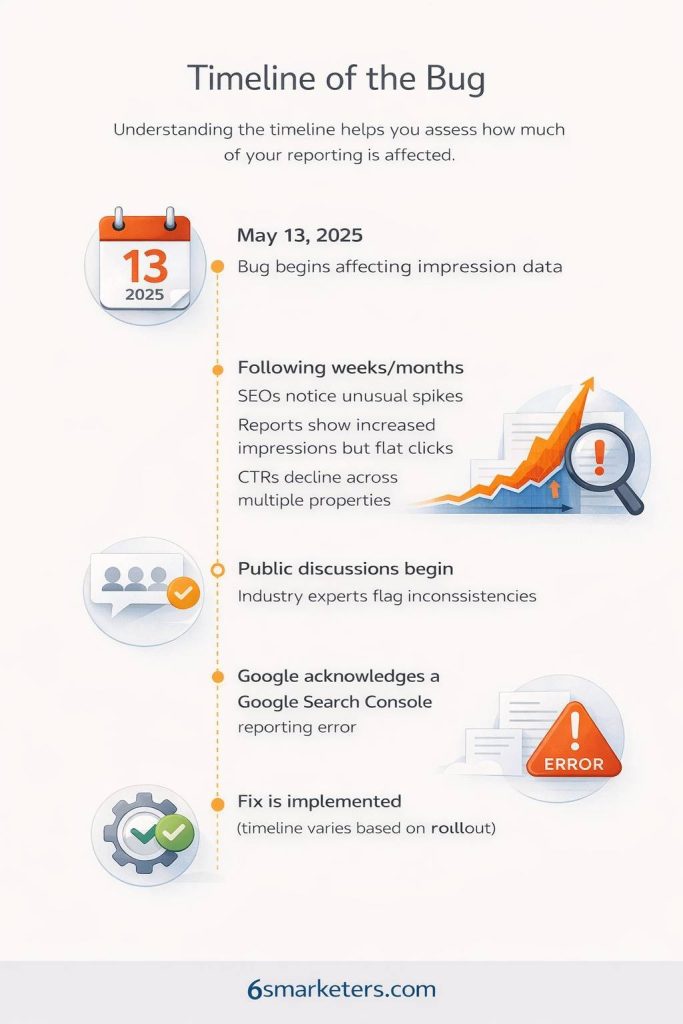
Understanding the timeline helps you assess how much of your reporting is affected.
- May 13, 2025 – Bug begins affecting impression data
- Following weeks/months – SEOs notice unusual spikes
- Reports show increased impressions but flat clicks
- CTRs decline across multiple properties
- Public discussions begin – Industry experts flag inconsistencies
- Google acknowledges a Google Search Console reporting error
- Fix is getting deployed (timeline varies based on rollout)
What’s important here is the lag.
The issue wasn’t immediately obvious because impressions are a top-of-funnel metric. They fluctuate naturally. That made the bug harder to detect early.
Impact on SEO Metrics
This is where the real consequences show up.
1. Inflated Visibility Metrics
Many dashboards showed strong impression growth. Teams interpreted this as:
- Better keyword coverage
- Improved rankings
- Stronger content visibility
But in reality, Google Search Console impressions are inflated artificially.
2. Misleading CTR Decline
CTR = Clicks ÷ Impressions
When impressions spike falsely:
- CTR drops—even if clicks remain stable
- Performance appears weaker than it is
This led to unnecessary optimizations in some cases:
- Rewriting meta titles/descriptions
- Questioning content quality
- Adjusting keyword targeting
3. Reporting Confusion Across Teams
Marketing leaders saw conflicting signals:
- “Visibility is up, but engagement is down?”
- “Are we attracting the wrong audience?”
This created friction between:
- SEO teams
- Content teams
- Performance marketing teams
4. Misaligned Strategic Decisions
In some cases, budgets and priorities shifted based on inaccurate insights.
That’s the real cost—not the bug itself, but the decisions made because of it.
What Data is Affected (and What Isn’t)
Let’s get specific.
Affected:
- Impressions (primary impact)
- CTR (indirectly affected)
- Visibility trends
- Keyword-level impression data
Not significantly affected:
- Clicks
- Rankings
- Conversions (if tracked externally)
- Google Analytics traffic
This distinction is critical.
If you relied heavily on impressions to measure growth, your reports need scrutiny.
If you prioritized clicks and conversions, you’re in a safer position.
What You Should Do Now
Ignoring this issue is not an option. But overreacting isn’t helpful either.
Here’s a grounded approach:
1. Re-evaluate Historical Reports
Look at data from May 13, 2025, onward:
- Identify abnormal spikes
- Compare with previous trends
- Flag inconsistencies
Don’t rewrite history, but annotate it.
2. Align Metrics Across Platforms
Cross-check:
- Google Analytics
- Paid search data
- CRM or pipeline data
If impressions say growth, but traffic doesn’t—trust traffic.
3. Reset Internal Expectations
If stakeholders saw inflated numbers:
- Communicate the issue clearly
- Explain what changed
- Reframe performance baselines
Transparency builds credibility.
If you need a structured audit of your reporting gaps, start here.
4. Avoid Reactive Optimization
Don’t:
- Over-optimize titles based on false CTR drops
- Pivot strategy solely on impression trends
Let stable metrics guide decisions.
SEO Reporting Best Practices After the Bug
This incident exposed a bigger problem: overdependence on a single tool.
Here’s how to fix that going forward.
1. Build Multi-Source Validation
Never rely solely on GSC.
Use:
- Analytics platforms
- Rank tracking tools
- First-party data
Consistency across sources = reliability.
2. Prioritize Business Metrics Over Vanity Metrics
Impressions are useful—but they’re not outcomes.
Focus on:
- Qualified traffic
- Conversions
- Revenue attribution
Visibility without impact is noise.
3. Document Anomalies Proactively
Create a habit of:
- Logging unusual data spikes
- Tracking platform updates
- Annotating dashboards
This saves time when issues surface later.
4. Educate Stakeholders on Data Limitations
Not all metrics are equal.
Help leadership understand:
- What impressions really represent
- Where data can fail
- Why cross-validation matters
This prevents panic during anomalies.
5. Revisit Underused GSC Reports
Many businesses already underutilize Search Console.
If you’re only looking at performance reports, you’re missing deeper insights.
Explore this breakdown: Google Search Console Reports Most Businesses Ignore.
Conclusion
The Google Search Console impression bug is a reminder of something most teams overlook:
Data is only as reliable as the system collecting it.
The issue itself will pass. Google will fix bugs. Platforms will evolve.
But the real question is—what changes on your side?
Do you:
- Continue trusting surface-level metrics?
- Or build a more resilient, validated reporting system?
Because in a landscape where decisions move fast, misinterpreted data is more dangerous than missing data.
External Reference
Search Engine Land – Google Fixing A Search Console Bughttps://searchengineland.com/google-search-console-bug-inflated-impression-counts-473530