

If your content is getting attention, but very little earns engagement. There is a gap. And, you will understand this gap only when you look at how people actually interact with digital experiences today. Skimming has replaced reading. Comparisons are happening faster than you think. Decisions are made with less patience and higher expectations. This is where you can leverage an interactive content strategy.
You have to stop asking users to interpret information on their own. Use Interactive content to guide. This will help them—step by step—based on their inputs, preferences, and intent. It creates a better experience where the content adapts, rather than stays static.
For businesses, this is a performance advantage. When users get actively involved, they tend to stay on the site longer, they pick up the info faster, and make their next move with more conviction.
If your current content has lots of information for the user and is not helping them to make decisions, it is of no use. You have to begin with interactive content, which becomes the missing link that plugs that gap. Let’s take a closer look at how Interactive Content can help.
Key Takeaways
- Interactive content really boosts time spent on a page.
- Engagement improves through active user participation.
- Personalized experiences drive higher conversion rates.
- Data collection becomes more contextual and useful.
- Supports stronger intent-based content strategies.
- Enhances content recall and decision confidence.
What is Interactive Content
Interactive content is basically anything that doesn’t just require a user to read and move. It is something the user actually interacts with by clicking on things, checking out options, making some decisions, maybe even getting back some results that are useful to them. That can look like quizzes, calculators, tests, polls, fancy info-graphics you can play with, or any of a million other things interactive. What makes interactive content so cool isn’t even so much the format itself as much as the deal you’re offering the user – in exchange for some of their time, you give them something of value.
What makes interactive content so powerful isn’t the format itself, but the deal you’re making with the user – you’re giving them something in exchange for their time and attention. The user gives input. The content responds with relevance.
That exchange creates a two-way experience—something traditional blogs or videos rarely achieve.
If your current content strategy focuses only on delivering information, you’re missing the layer where decisions actually happen.
If you want to align your content with real user intent? Start here:
Search Intent in SEO.
Types of Interactive Content
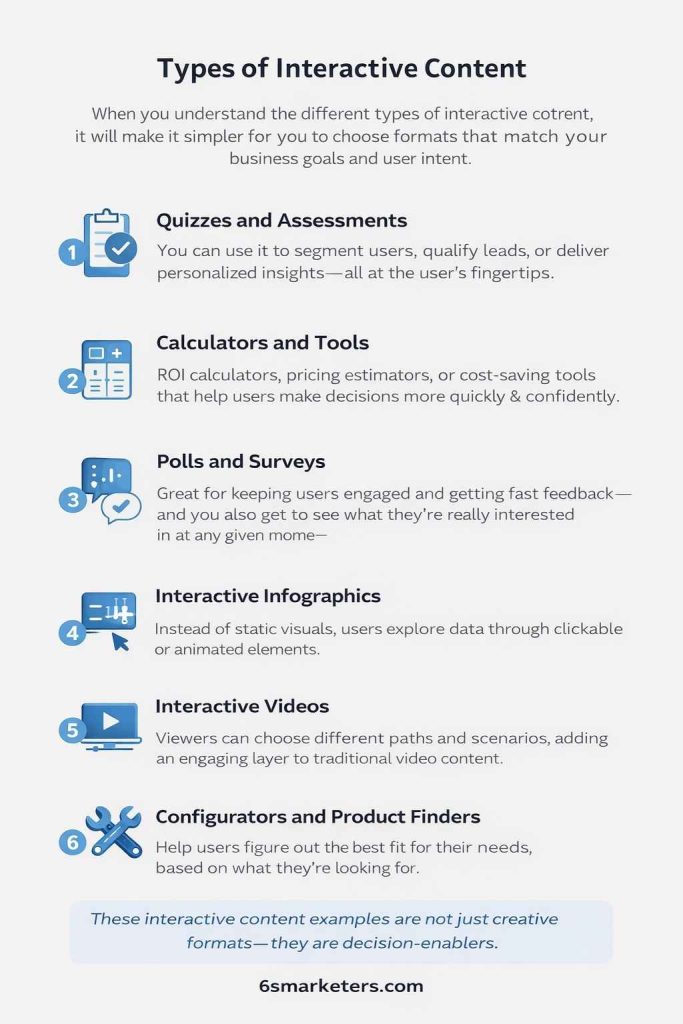
When you understand the different types of interactive content, it will make it simpler for you to choose formats that match your business goals and user intent.
1. Quizzes and Assessments
You can use it to segment users, qualify leads, or deliver personalized insights – all at the user’s fingertips.
2. Calculators and Tools
ROI calculators, pricing estimators, or cost-saving tools that help users make decisions more quickly and confidently.
3. Polls and Surveys
Great for keeping users engaged and getting fast feedback – and you also get to see what they’re really interested in at any given moment.
4. Interactive Infographics
Instead of static visuals, users explore data through clickable or animated elements.
5. Interactive Videos
Instead of looking at static visuals, users get to explore data through interactive elements that they can click on or animations that jump out at them.
6. Configurators and Product Finders
Help users figure out the best fit for their needs, based on what they’re looking for.
These interactive content examples are not just creative formats—they are decision-enablers.
Benefits of Interactive Content
The shift toward interactive content marketing is not just a trend. It’s a response to how people now evaluate information.
1. Higher Engagement
Interactive formats naturally increase time spent on content. When users engage, they stay longer, explore more, and build stronger familiarity with your offering.
2. Better Conversion Rates
Interactive content reduces friction. Instead of forcing users to interpret information, it guides them toward decisions.
For example, a calculator showing potential ROI removes guesswork. That clarity shortens the buying cycle.
3. Improved Data Collection
Forms often fail because they ask for information without giving value first.
Interactive content flips that. It collects insights during the experience—making data more accurate and context-rich.
4. Stronger Personalization
Modern engagement strategies depend on relevance. Interactive formats allow real-time personalization based on user inputs.
That makes the experience feel tailored but not generic.
5. SEO and Discoverability Impact
Search engines increasingly reward content that satisfies intent and keeps users engaged.
Interactive content contributes to:
- Lower bounce rates
- Higher dwell time
- Better engagement signals
These factors influence rankings indirectly but meaningfully.
Looking to extend content value across formats? Explore this:
Content Repurposing Strategy.
How to Include Interactive Content in Your Own Content Strategy
Adding interactive content without a strategy will not work. It needs to align with intent, funnel stage, and business goals.
Start with Intent Mapping
Every interactive asset should answer a specific question or solve a problem.
For example:
- Early-stage: Quizzes to educate
- Mid-stage: Assessments to evaluate
- Late-stage: Calculators to justify decisions
Identify High-Impact Pages
Focus on pages that already attract traffic but underperform in conversions.
These are ideal places to introduce interactive elements.
Replace, Don’t Just Add
Instead of layering interactive elements on top of existing content, consider replacing static sections.
For example:
- Replace long explanations with a tool
- Replace generic CTAs with personalized outputs
Integrate with Sales and CRM
Interactive content should not exist in isolation. Connect it with your CRM to capture and act on user insights.
Measure What Matters
Track:
- Completion rates
- Engagement depth
- Conversion uplift
Without measurement, interactive content becomes a creative exercise—not a revenue driver.
Want to turn engagement into actual leads? Start here.
Tools and Resources for Interactive Content Marketing
Creating interactive content is easier than it used to be. The difficulty lies not in access, but in execution.
Here are commonly used tools:
- Outgrow – For quizzes, calculators, and assessments
- Typeform – For conversational forms and surveys
- Ceros – For interactive design and storytelling
- Ion Interactive – For advanced enterprise-level experiences
- Canva (Interactive Features) – For simple interactive visuals
The right tool depends on complexity and scale. Start simple, but stay intentional.
Tips for Creating Interactive Content That Works
Interactive content fails when it prioritizes novelty over usefulness. These principles keep it effective:
1. Start with a Clear Outcome
Every piece should answer: What does the user gain at the end?
If the answer is unclear, the experience will feel pointless.
2. Keep It Frictionless
Too many steps reduce completion rates. Keep interactions simple and intuitive.
3. Make Results Actionable
The output should guide the next step—not just present information.
For example:
- “Your score is 65” → Weak
- “Here’s how to improve your score” → Strong
4. Align with Business Goals
Interactive content should drive:
- Lead generation
- Product understanding
- Decision acceleration
If it does not connect to revenue, it becomes a distraction.
5. Test and Iterate
Small changes in flow, questions, or outputs can significantly impact performance.
Treat interactive content as a product—not a one-time asset.
Ready to build interactive experiences that convert?
Connect with us.
Conclusion
Interactive content is not about making content “fun.” It’s about making it useful in motion.
As buying journeys get more complicated and grabbing someone’s attention gets tougher, you can’t just rely on the same old static content anymore. People making decisions expect – and need – clarity, personalisation, and to be able to get what they need, fast. Interactive content delivers all three of those things.
What it really does is bridge the gap between just telling people about something and actually getting them to take some kind of action. In doing that, it flips content from being just some dull thing people passively look at into a living experience.
And it’s here, in that switch, that engagement actually starts to turn into actual sales.
External Reference
Search Engine Land – Interactive Content AI Optimized Search Success