

Your potential buyer opens ChatGPT, types in a question your product answers perfectly — and your brand doesn’t appear anywhere in the response. No mention. No citation. Someone else’s content fills that space instead.
That’s already happening. And most marketing teams are clueless.
Buyers are quietly shifting how they research. They’re skipping the scroll and going straight to AI. By the time they land on your website — if they land on it at all — they’ve often already formed an opinion, based on what ChatGPT told them. Knowing how to appear in ChatGPT is no longer a fringe SEO experiment; it’s quickly becoming the difference between being in the room and being invisible.
This guide cuts through the noise. We’ll show you what actually drives ChatGPT citations, which content signals matter most, and where to start — without overhauling everything you’ve already built.
Key Takeaways
- ChatGPT favors clear, self-contained answer blocks consistently.
- Original data and owned insights dramatically boost citation rates.
- Authority signals and topical depth outperform keyword stuffing.
- Link-free answer capsules are cited far more often.
- Generative AI SEO is now a board-level growth priority.
- Structured formatting helps LLMs extract and attribute content.
- AI SEO strategy requires consistent trust-building over time.
What Does It Mean to Appear in ChatGPT
When a user asks ChatGPT a question, the model synthesizes an answer by drawing on its training data and, increasingly, real-time web browsing. To “appear in ChatGPT” means your content becomes a source that the model references, paraphrases, or directly cites in its response.
This is different from ranking on Google. There’s no blue link, no position one. Instead, your brand’s insights get woven into an AI-generated answer — with or without attribution, depending on how the query is handled. The brands that show up in ChatGPT are seen as category authorities, almost by default.
Generative AI SEO isn’t about gaming an algorithm. It’s about becoming the most credible, quotable source on a topic — so that LLMs naturally reach for your content when forming an answer.
How ChatGPT Finds and Uses Content
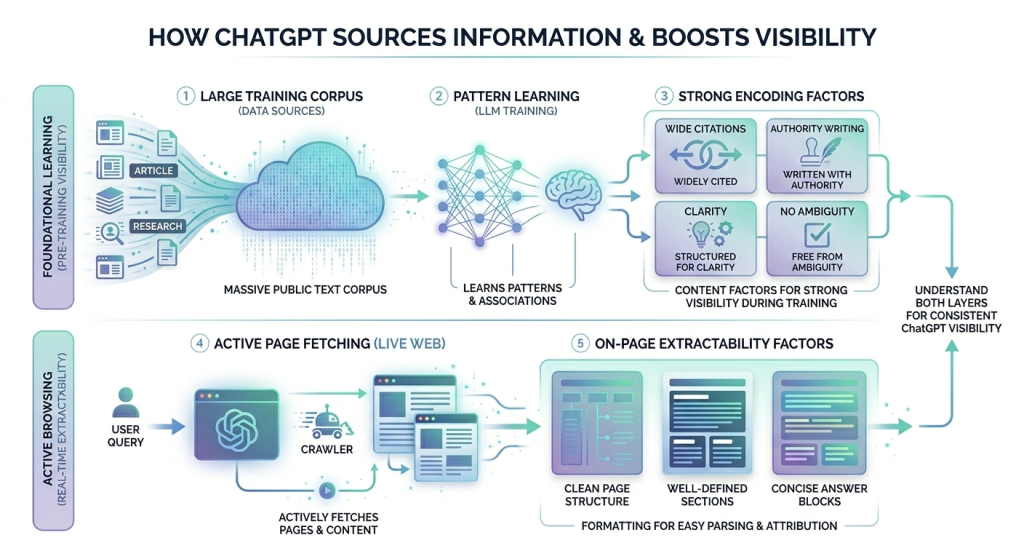
[Alt-text: Infographic explaining foundational learning and active browsing strategies for How to Appear in ChatGPT results.]
ChatGPT doesn’t crawl the web in real time the way Google does (though the browsing-enabled version does pull live results). Its foundational knowledge comes from large-scale training data, a massive corpus of publicly available text, including websites, articles, research, and documentation. The model learns patterns, facts, and associations from this data.
When ChatGPT generates a response, it’s essentially predicting the most accurate and useful answer based on patterns in that training. Content that is widely cited across the web, written with authority, structured for clarity, and free from ambiguity tends to be encoded more strongly during training.
For browsing-enabled responses, ChatGPT actively fetches pages and extracts content. Here, formatting matters enormously. A page with clean structure, well-defined sections, and concise answer blocks is significantly easier for the model to parse, extract, and attribute. To learn how to show up in ChatGPT consistently, you need to understand both layers — training visibility and on-page extractability.
Explore our full breakdown of AI search and SGE optimization to understand the technical side of this in depth.
Why AI SEO Matters in 2026
Here’s the uncomfortable truth: organic search traffic is fragmenting. A growing share of queries never reach a traditional search engine at all. ChatGPT crossed 400 million weekly active users in early 2025, and that number has only climbed. Perplexity, Gemini, and Microsoft Copilot are adding hundreds of millions more.
For B2B brands especially, this matters. Decision-makers and research-heavy buyers are using AI interfaces to shortlist vendors, compare solutions, and form opinions — often before they visit a single website. If your content doesn’t appear in ChatGPT during that research phase, your competitors’ content will.
“The funnel didn’t disappear. It moved — to a place where content authority determines first impressions, not ad spend.”
The future of SEO AI isn’t a replacement for traditional SEO — it’s an evolution of it. Brands that invest in AI search optimization today will hold a compounding advantage as LLM usage continues to scale. Ready to build an AI SEO strategy that gets your content cited by ChatGPT?Talk to Our Strategists.
Key Factors to Appear in ChatGPT
An audit of nearly two million sessions across 15 domains — spanning ecommerce, healthcare, cybersecurity, and more — surfaced a consistent pattern: certain structural and editorial traits dramatically increase the likelihood of ChatGPT citation. Here’s what actually moves the needle on how to rank in ChatGPT:
Answer capsules
A concise, self-contained explanation of roughly 20–25 words placed directly after a headline or H2 question. This format gives LLMs a clean, quotable unit of information they can extract and attribute. In the audit, 72% of cited blog posts included an identifiable answer capsule.
Original or proprietary data
Content built around first-party research, survey results, or branded benchmarks gives LLMs a concrete, citable claim. Generic advice blends into the noise. Owned data cuts through it.
Topical depth and completeness
ChatGPT tends to favor sources that comprehensively cover a topic. Thin content that only skims the surface rarely earns a citation. Depth signals expertise — and LLMs reward expertise.
Crawlability and indexation
You cannot get cited by ChatGPT if the browsing-enabled model can’t access your page. Clean technical SEO, fast load times, and open access are foundational.
Content Optimization for AI Search
Content optimization for LLMs requires a deliberate reframe of how you write. Traditional SEO optimizes for a crawler that counts words and links. AI search optimization targets a model that reads for meaning, extracts clarity, and attribution potential.
Write answer-first
Lead each major section with a direct, self-contained answer to the implied question. Follow it with context, examples, and supporting detail. This mirrors how LLMs prefer to extract and cite information.
Keep your answer capsules link-free
This is counterintuitive but well-supported by data. Capsules containing hyperlinks appear to signal to LLMs that the authoritative answer lies elsewhere. Keep the capsule clean; place links in supporting paragraphs below.
Use clear, hierarchical headings
H2s and H3s that mirror real user questions help LLMs understand the structure and context of your content. Vague headings are invisible to AI parsing.
Avoid over-abstraction
LLMs struggle with vague, hedged language—concrete, definitive statements — even when nuanced — are far more quotable than content padded with disclaimers.
For a complete framework, see our guide to planning an AI SEO strategy, which covers everything from content strategy to technical prerequisites.
Data Point: Over 90% of answer capsules that earned ChatGPT citations contained zero internal or external links — underscoring why clean, self-contained formatting is central to AI search optimization.
Role of Authority & Trust Signals
ChatGPT doesn’t select sources randomly. LLMs are trained on content that the broader web has deemed authoritative — and that means your domain’s trust signals matter, even in a generative search context.
Editorial backlinks from respected publications, mentions across forums and aggregators, and consistent brand presence across the web all contribute to how prominently your content is encoded in model training. This is why how to get cited by ChatGPT overlaps significantly with traditional digital PR.
Author credibility plays a role, too. Content explicitly attributed to named experts with verifiable credentials — bios, LinkedIn profiles, published research — carries more weight than anonymous or generic brand content.
E-E-A-T (Experience, Expertise, Authoritativeness, Trustworthiness) isn’t just a Google framework anymore. It’s increasingly the implicit scoring rubric for LLM source selection. Understanding search intent in SEO helps you align content with the exact signals that both Google and AI models reward.
Common Mistakes to Avoid
Most content teams make one critical error when they start thinking about AI search optimization: they treat it like traditional keyword SEO, just with different target phrases. That approach won’t work. Here are the mistakes that actively suppress your chances of appearing in ChatGPT:
Writing for density, not clarity
Cramming keywords into content without ensuring the surrounding text delivers a complete, clear answer defeats the purpose. LLMs optimize for meaning, not keyword frequency.
Hiding your best insights behind generic intros
Long preambles before the actual answer reduce your content’s quotability. Get to the point — LLMs don’t have patience for buildup, and neither do the buyers using them.
Neglecting technical accessibility
Paywalled content, JavaScript-heavy pages that block crawling, and slow-loading sites all reduce the chances that a browsing-enabled LLM can read and cite your material.
Ignoring content freshness
While LLMs carry older training data, browsing-enabled models prioritize recently updated, timestamped content for current-state queries. Publishing once and forgetting is not a viable AI SEO strategy. Not sure where your content stands in AI search? Let’s run an audit together. Get Your AI SEO Audit.
Future of AI Search Optimization
The signals that drive ChatGPT citations today will become table stakes within 12 months. The future of SEO AI points toward a landscape where generative AI SEO becomes as foundational as on-page SEO was in 2015 — non-negotiable for any brand serious about digital presence.
What’s coming: LLMs will get better at detecting content authenticity, brand consistency, and real-world validation. First-party data, original research, and expert-attributed content will hold an even larger premium. Brands that create proprietary insights now — industry benchmarks, original surveys, and owned frameworks that will build citation moats that are genuinely hard to replicate.
Multimodal AI is another frontier. As ChatGPT and its peers begin processing video, audio, and structured data more fluidly, content optimization for AI search will expand well beyond the written word. The brands building diversified, authoritative content ecosystems today are positioning themselves for that reality.
Conclusion
Knowing how to appear in ChatGPT isn’t a technical trick. It is a strategic commitment to becoming the clearest, most credible voice in your category. The content traits that LLMs consistently cite are the same traits that great writing has always valued: clarity, authority, originality, and directness.
Start with your top-performing pages. Add concise, link-free answer capsules after your primary headings. Inject proprietary data and branded insights wherever you can. Build the kind of content that both humans and models recognize as worth quoting.
The brands that figure this out now will occupy the most valuable real estate in AI-generated answers, right at the moment a decision-maker is forming their opinion. That’s a competitive advantage worth every effort.