

Introduction to Human Creativity vs AI Tools
By 2026, the average marketing team is going to have access to a mind-boggling 50+ AI tools, but at the same time, we’re seeing an all-time high in complaints about the quality of the content being churned out. When you take a quick glance at the numbers, it shows that conversion rates are decreasing & the unique voices of brands are starting to lose.
AI tools are making it harder to stand out from the crowd. The eternal debate between human creativity vs AI tools just goes on & on – but the truth is, the rush to get on the AI bandwagon has outpaced good old-fashioned strategic thinking.
Companies are churning out more content than ever before, but their return on that investment is dwindling to almost nothing. The problem is misplacement: using AI where human judgment is needed, and using expensive human hours where AI could do the job in minutes.
The debate around human creativity vs AI is not about technology preference. It’s basically a resource allocation problem with real-world cash costs. Get this right & you can create a content machine that scales without sacrificing any quality whatsoever.
This post is going to break down where exactly the line sits – and show you how to use both sides of it to get ahead.
Key Takeaways
- AI tools scale content production without replacing strategic thinking.
- Human creativity drives brand differentiation and audience trust.
- AI content vs human content differs in depth, empathy, and originality.
- Smart businesses blend both to maximize ROI and output quality.
- Knowing when to use each is the real competitive advantage.
- Avoid over-relying on AI — it shows, and it costs you credibility.
What Is The Role of AI Tools in Digital Marketing
Let’s be realistic here: AI tools for digital marketing have moved from being the ‘fun new thing’ to being a must-have – an essential tool in the content creation pipeline. You can find platforms like ChatGPT, Jasper, Copy.ai, Surfer SEO, and a whole bunch of others being used by both in-house teams and agencies to help shape their content.
What do they actually do well?
- Generating first drafts at speed and scale
- Repurposing long-form content into short-form assets
- Keyword clustering, topic ideation, and SERP analysis
- A/B testing copy variations quickly
- Automating metadata, alt text, and structured content
The benefits of AI tools are real. They compress timelines. They reduce the heavy load of repetitive work. They allow lean teams to punch above their weight in content volume.
But volume never equals value.
AI in marketing strategy is most powerful when it handles the operational layer — freeing human thinkers to focus on insight, positioning, and narrative. The moment AI becomes the strategy itself, results tend to flatten. Want to build a smarter AI + human content strategy? Let’s talk.
Strengths of Human Strategy
Here is what no AI tool has cracked yet: genuine business intuition.
Human strategists bring a context to the table that data on its own just can’t provide. They get that when a brand decides to change its positioning in Q3, that’s not just about updating the messaging – it’s sending a message to competitors, a nudge to the sales team, and a reflection of how the company’s priorities are shifting. And that level of understanding – that layer of human insight – ends up shaping content in ways that no algorithm can match.
Human creativity also drives:
- Original research, proprietary perspectives, and category-defining ideas
- Emotional relatability, learning when to be bold versus when to pull back
- Cultural sensitivity and timing that AI consistently misjudges
- Stakeholder alignment, which depends on relationship intelligence
- Brand voice consistency is maintained across years and campaigns
In a world where AI content vs human content is increasingly hard to distinguish on the surface, authenticity becomes the differentiator. And authenticity — real, grounded, specific — still comes from people who have lived the problem they are writing about.
Understanding search intent, for instance, goes beyond keyword matching. It requires reading the room of your market — something covered well in this breakdown of search intent in SEO — and human strategists are still the best at translating that intent into content that converts.
Key Differences in AI vs Human with Pros & Cons
| Category | Pros | Cons |
| AI Tools | Delivers content at scale in minutes, not days | Lacks genuine originality — remixes existing content |
| Consistent output with minimal fatigue | Cannot verify business context or industry nuance | |
| Cost-effective for high-volume, low-complexity content | Prone to factual errors without human review | |
| Strong at pattern recognition and data synthesis | Produces generic output without expert prompting | |
| Human Creativity | Produces ideas that are truly novel and brand-specific | Slower — ideation and production take real time |
| Understands emotional, cultural, and relational dynamics | Resource-intensive and harder to scale | |
| Adapts to ambiguity with judgment, not just logic | Inconsistent when teams are under pressure or undertrained | |
| Builds trust through authentic voice and experience | Expensive for high-volume, repetitive content needs |
Takeaway: It’s not about which is better — both have a job. Confusing those jobs creates mediocre output and wasted budget.
When to Use AI Tools
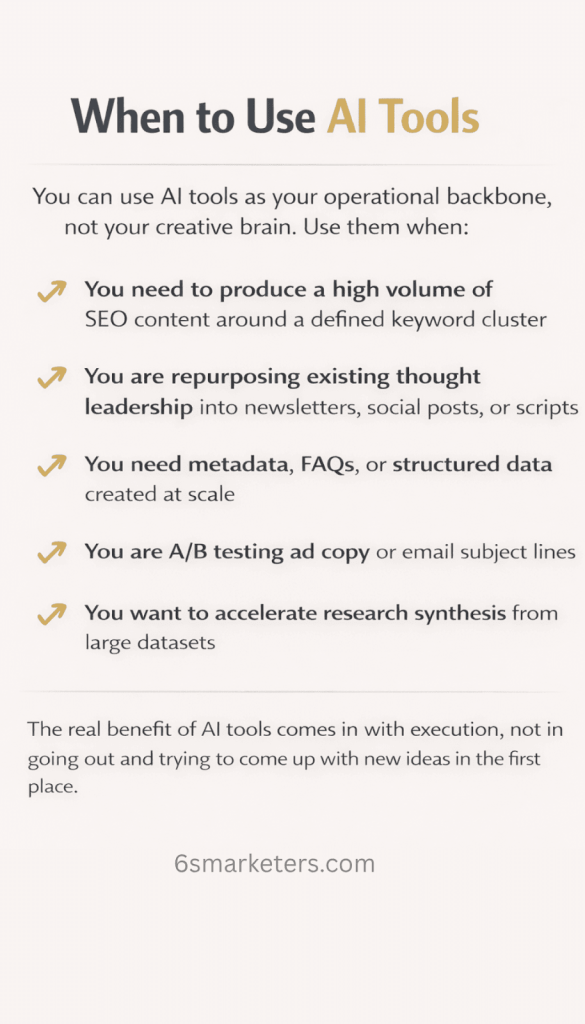
You can use AI tools as your operational backbone, not your creative brain. Use them when:
- You need to produce a high volume of SEO content around a defined keyword cluster
- You are repurposing existing thought leadership into newsletters, social posts, or scripts
- You need metadata, FAQs, or structured data created at scale
- You are A/B testing ad copy or email subject lines
- You want to accelerate research synthesis from large datasets
The real benefit of AI tools comes in with execution, not in going out and trying to come up with new ideas in the first place. So when the creative brief is all locked in, and you know exactly what you’re doing, AI can get the job done in two hours that would have taken two days to do by hand.
When Human Strategy is Essential
Pull humans back into the driver’s seat when:
- You are building or refreshing brand positioning
- You are entering a new market and need an authentic cultural fit
- You are producing executive thought leadership or POV pieces
- Your content needs to demonstrate proprietary expertise
- You are navigating a sensitive business moment — a crisis, a pivot, a launch
When it comes to high-stakes decisions, getting them wrong has real consequences – it’s not just that you’re going to see lower engagement, it could be brand damage, messaging that’s off the mark, or losing out on deals. You need human accountability to deal with those kinds of outcomes, and AI just can’t provide that.
Even if you’re developing a framework for using AI on SEO strategy, you still need human strategists to define the key intent, the content structure, and the editorial standards. The execution can involve AI. The thinking cannot.
Learn more about how to structure that in this AI SEO strategy framework guide.
Get started to build a content strategy that actually performs? Connect with our team.
Best Approach: Combining AI + Human
The most effective marketing organizations in 2026 are not choosing between AI and humans. They are building workflows that use both intelligently.
Here is what a high-performing hybrid model looks like in practice:
- Human strategists set the content direction, brand voice guidelines, and key narratives
- AI tools generate first drafts, topic clusters, and content variations
- Human editors refine for accuracy, tone, depth, and differentiation
- AI handles distribution tasks: metadata, scheduling, A/B variant creation
- Humans review performance data and make strategic pivots
This is not a new concept — it mirrors how great editorial teams have always worked, with junior staff handling volume and senior staff handling judgment. AI simply replaces the junior tier for certain task types.
What makes this work is clarity on ownership. Every piece of content should have a human responsible for its strategic quality — even if AI did 60% of the writing. Without that accountability, quality drifts and brand voice erodes.
The insight holds true whether you are talking about SEO, paid content, or organic social: the businesses winning with AI in marketing strategy are those that treat it as a capable assistant, not an autonomous strategist.
Common Mistakes to Avoid
- Publishing AI-generated content without a human edit pass — errors and generic phrasing accumulate fast
- Using AI for brand positioning without strategic human input — the result is indistinct and easily forgettable
- Treating word count as a proxy for quality — AI can produce 2,000 words of nothing
- Assuming AI understands your market — it knows the internet, not your customers
- Skipping prompt engineering — poor inputs produce poor outputs, every time
- Terminating human writers to reduce costs — this is a false economy that can damage brand equity in the long run
The companies making these mistakes are easy to spot. Their content reads like every other brand in the category. Their thought leadership lacks a point of view. Their SEO content ranks and then immediately loses ground because it provides no real depth.
Avoid them by building review processes, not just production processes.
External Reference
Search Engine Lan – It’s not either SEO or AI search.
Conclusion
The human creativity vs AI conversation is not a competition. It is a design challenge.
Your job as a marketing leader or business decision-maker is to design a workflow that puts AI where it accelerates output and keeps humans where judgment, empathy, and originality are required. That boundary shifts with every new tool release — which is why the strategic thinking behind it must always remain human.
AI tools in digital marketing have fundamentally changed what small teams can accomplish. But they have not changed what great content requires: a clear point of view, a distinct voice, and something genuinely worth saying.
The brands that figure out that balance will outpace those still arguing about whether to use AI at all.