

If you manage digital marketing for a B2B business, you’re being pressured to demonstrate the impact on revenue, not just the growth of traffic. Pipeline targets are more stringent. Sales cycles are getting longer. Costs of acquiring customers are increasing. At the same time, companies expect marketing to generate tangible ROI and deliver predictable results. This is the reason why deciding on SEO vs Google Ads becomes a challenge.
Google Ads delivers immediate visibility for search terms with high-interest. SEO provides steady growth and a lower cost of acquisition, eventually. Both channels perform well.
In this blog, we will look at the way SEO is compared to Google Ads in 2026 in terms of speed, cost, and the impact on revenue. Learn which option is best for your business’s needs, how to determine ROI, and when you should combine SEO with Google Ads to create maximum outcomes.
SEO in 2026 vs Google Ads in 2026
SEO provides a higher ROI over the long term via sustainable organic traffic and lower costs of acquisition over time. Google Ads delivers faster ROI due to immediate traffic and accurate targeting. The best results can be achieved by combining SEO with Google Ads strategically.
The most important takeaways
- Which SEO ROI works in 2026
- What Google Ads ROI is going to work in 2026?
- Cost, as well as speed and scalability variations
- Which is the best channel for startups? SaaS eCommerce, SaaS, and B2B firms?
- How to combine SEO with Google Ads increases digital marketing ROI
- Answers to the most common business-related questions
SEO Vs Google Ads in 2026
The discussion about SEO vs Google Ads has evolved. The way people search has changed. AI-powered results, smart bidding systems, and the modeling of user intent have changed the performance indicators.
However, the foundations remain solid.
SEO concentrates on building credibility, relevancy, and trust through organic search. Google Ads focuses on visibility through paid ads. As per Search Engine Journal, Google Ads is an auction system in which ad rank is determined by bid amount as well as the quality of the ad and the expected impact.
These results, which are paid for, reward the budget and improve optimization skills. Organic rankings provide authority, knowledge, and high-quality content.
In 2026, businesses will not have to ask “SEO and Google Ads?” casually. They want to know which will yield better ROI for their growth strategy.
How SEO ROI Works in 2026
SEO ROI works on compound growth.
If you make an investment in SEO, it creates backlinks, content assets, authority, and domain trust. They continue to drive traffic without having to pay per click. This structure reduces the cost of acquisition for customers in the long run.
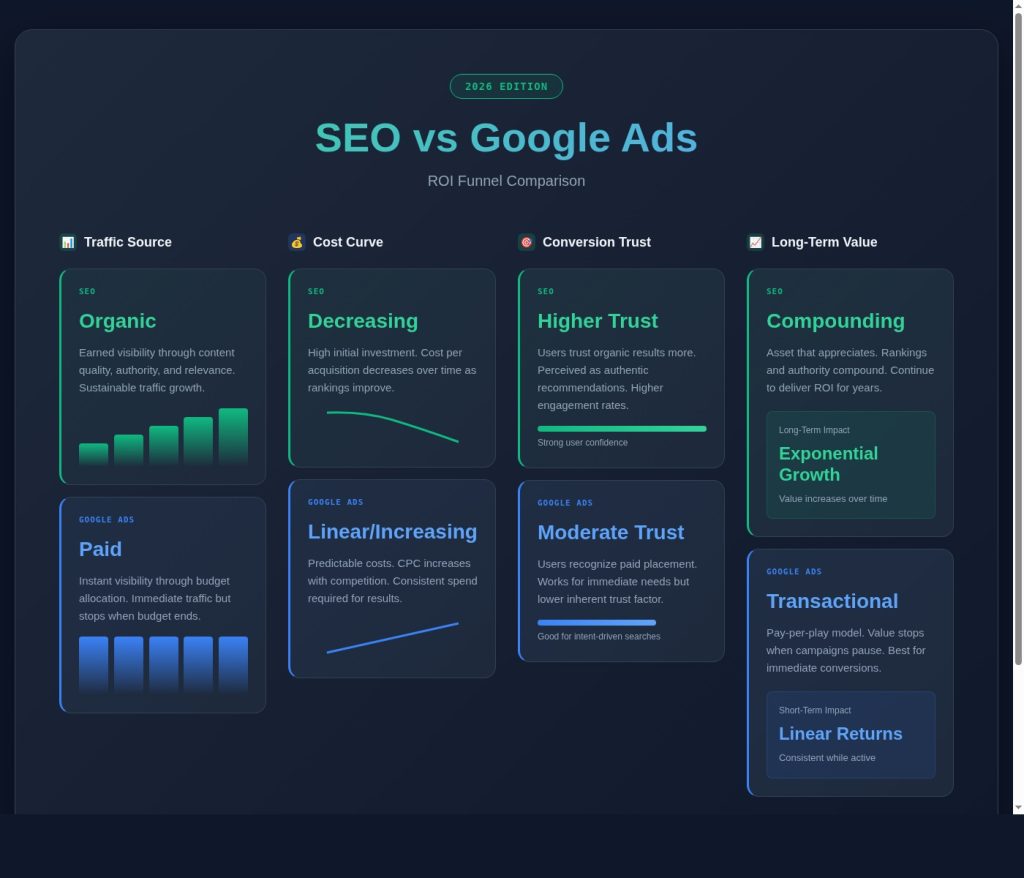
Organic search is still the most significant source of web traffic worldwide. This position is beneficial for the long-term ROI of digital marketing because traffic doesn’t disappear once the ad campaign stops.
Yet, SEO requires patience and execution. The results typically appear within 3-6 months in competitive industries. The strength of technical SEO, the content depth, and strategic link-building drive rankings improvements.
The 2026 year is the time when SEO ROI improves further because of:
- AI-driven search still rewards authoritative content
- People trust organic results more than advertising
- Evergreen content compounds over time
- Organic leads are often converted to higher intent stage leads.
SEO increases brand trust. The highest rankings indicate credibility. Trust is a result of authority. Trust is the key to conversion.
For companies that want to predict future growth, SEO develops an engine for revenue that grows without the need for proportional cost increases.
The way Google Ads ROI Will Work in 2026
Google Ads delivers speed.
When campaigns go live, the traffic begins immediately. Businesses are able to be found on high-intent keywords in a matter of minutes. This advantage makes Google Ads powerful for product launch, seasonal promotions, and lead generation.
Google states that its advertisers make on average $2 per each $1 they spend on Ads. This statistic shows the potential for a high online marketing ROI when campaigns are optimised.
But paid traffic ceases after the budget is exhausted.
ROI is contingent upon:
- Cost per click
- Conversion rate
- Customer lifetime value
- Quality Score
- Bidding strategy
Google Ads in 2026 uses sophisticated automated technology along with smart bidding. Machine learning can optimize the way ads are delivered in accordance with the behavior of users. This improves efficiency and also enhances the competition.
Industries like finance, legal, and SaaS are impacted by the burden of high CPC rates. Companies must be aware of margins. A strong landing page and conversion optimization are the keys to their profitability.
Google Ads works best when companies:
- You need immediate results
- Be a part of the landscape of competitive search
- Introduce new products
- Quickly test demand for keywords
Paid search can be controlled and provides tangible results. But it also requires ongoing commitment to your budget.
SEO vs. Google Ads Cost, Speed, and Scalability
When looking at SEO against Google Ads, businesses evaluate three elements: speed, cost, and scaling.
SEO Vs Google Ads ROI Comparison
| Factor | SEO | Google Ads |
| The Initial Cost | A moderate investment is made in strategies and content | Immediate budget required |
| Speed of Traffic | Growth is gradual (3-6 months) | Traffic in the immediate time |
| Long-Term Cost | The decreases will occur over time. | It continues throughout the time that the ads are running |
| Scalability | The content authority of content is amplified through compounding. | Scales that match the budget |
| Credibility | Trust is high among users | Lower trust than organic |
| Control | Algorithm-dependent | Full control over the campaign |
| Sustainability | Long-term assets | Visibility in the short-term |
SEO lowers the cost per purchase over time. Google Ads increases spending as the number of users increases.
If your approach is focused on short-term revenue, Google Ads wins in speed. If your focus is on the profitability of your brand and its authority, SEO wins sustainability.
Smart businesses analyze SEO as well as Google Ads together instead of making a decision based on emotions.
Which one is better for various Businesses?
The solution for SEO as well as Google Ads is dependent on how you run your business, the sales cycle, and competition.
Startups
Startups gain from Google Ads for its speedy validation. Paid advertisements test fast. But startups need to develop SEO before they can rely on ad spending.
Ecommerce Businesses
Online retailers make use of Google Shopping Ads to promote their products. But SEO drives category page rankings and long-tail sales. Combining SEO with Google Ads improves overall digital marketing ROI.
B2B & SaaS Companies
B2B businesses have long sales cycles. SEO helps with educational content, whitepapers, and solutions pages. Organic traffic helps lead to leads. Google Ads supports bottom-funnel keywords.
SEO typically provides higher ROI for SaaS in the long run because subscription models rely on customer lifetime value.
Local Businesses
Local businesses profit from Google Ads for location-based queries. However, local SEO using Google Business Profile increases trust and traffic recurrence.
Each model calls for a carefully planned allocation, not blind preference.
What happens when SEO and Google Ads perform best
The most effective strategy for 2026 will be to blend SEO with Google Ads intelligently.
Here’s how integration can improve ROI:
- Utilize Google Ads data to identify keywords that convert well.
- Make use of SEO to get organic search results on profitable keywords
- Be the first to dominate search results using both organic and paid listings
- Retarget organic visitors by using paid ads
- Make sure your brand’s keywords are protected through ads
This double visibility improves the click-through rate as well as builds credibility.
Businesses that use SEO with Google Ads reduce risk. If algorithm changes impact rankings, advertisements continue to drive their traffic. If costs for advertising increase, SEO sustains visibility.
The data alignment between the two channels boosts the ROI of digital marketing dramatically.
Are you looking for a strategy that maximizes Return on Investment?
At 6s Marketers, we design integrated strategies for growth. We blend SEO that is technical, authority on content, and highly-performing paid advertising. We assist businesses in reducing the cost of acquisition while increasing the long-term viability of their business.
If you’re seeking clarity between SEO and Google Ads, connect with 6s Marketers now and receive customized ROI strategies. Talk to our experts.
Conclusion: Which will provide the best Return on Investment in 2026?
The solution for SEO or Google Ads depends on the timeframe and the business objectives.
SEO offers a better long-term ROI by increasing the amount of traffic it generates, its authority,y and a lower cost per purchase. Google Ads delivers faster ROI due to its immediate visibility and targeted precision.
The most profitable businesses of 2026 employ both of them strategically.
If you’re looking for long-lasting growth instead of just short periods of traffic, consider investing in SEO. If you require immediate leads, you can use Google Ads. If you are looking for the highest return on investment from digital marketing, you should combine both.
6s Marketers assist businesses in developing efficient strategies that increase revenue, not merely vanity metrics. Let’s connect.