

There’s a meeting that happens in almost every company, usually after a bad quarter.
Traffic’s down. Leads are thin. Someone pulls up the competitor’s website and says, “They weren’t even ranking six months ago.” And then the question lands: what does an SEO company do? Should we hire an SEO agency?
The room nods. But ask anyone there what an SEO agency actually does on a Tuesday morning, the real work, not the pitch deck version, and you’ll mostly get vague answers. “They, uh… optimize content? Keywords and stuff?”
That gap between “we should do SEO” and “we understand what we’re buying” is expensive. It leads to wasted retainers, wrong expectations, and agencies that hide behind rank reports while delivering nothing that touches revenue.
So let’s close that gap. Here’s what an SEO company actually does — and what it should be doing for you.
Key Takeaways
- SEO agencies connect search visibility to revenue goals.
- Technical SEO makes the path for organic growth.
- Great content strategy starts with intent, not keywords.
- Real link building earns authority — never buys it.
- Local SEO is essential for geography-dependent businesses.
- SEO compounds; paid ads stop when the budget does.
- Strong agencies act as growth partners, not order-takers.
What Is an SEO Agency?
An SEO agency is a multi-disciplinary team, think technical analysts, content writers, digital PR specialists, and data people, working together to improve where and how often your business shows up in organic search results.
That’s the clean definition. Here’s the honest one: what is an SEO agency in practice is a growth function that lives inside search. It’s not about getting you to the top of Google for its own sake. It’s about making sure the people who are already searching for what you sell actually find you — before they find someone else.
Explore how a revenue-focused SEO strategy works.
Why Choose SEO Services for Businesses
Sometimes the trigger is reactive. A Google core update wipes out 40% of your organic traffic overnight. A well-funded competitor started investing in content two years ago and now owns every high-intent keyword in your space. Or the paid search budget has ballooned to the point where your CFO is circling it in red every budget review.
Other times, and this is rarer, honestly, a business hires an SEO agency proactively. They’ve done the math on opportunity cost. They know that every month their competitor holds position one for a transactional keyword is a month of pipeline that bypasses them entirely.
Here’s a specific scenario worth thinking about. A B2B SaaS company selling fleet management software to logistics firms ranks on page two for “fleet management software for trucking companies.” Page two. That means the 300-or-so people searching that phrase each month, people who are clearly evaluating vendors, not just browsing, never see them. Their competitor in position one is collecting those demo requests. Month after month.
SEO services for businesses exist to fix that. Systematically. Through the signals that actually move Google’s needle: technical site health, content depth, topical authority, and external credibility.
Core Services: What Do SEO Agencies Do
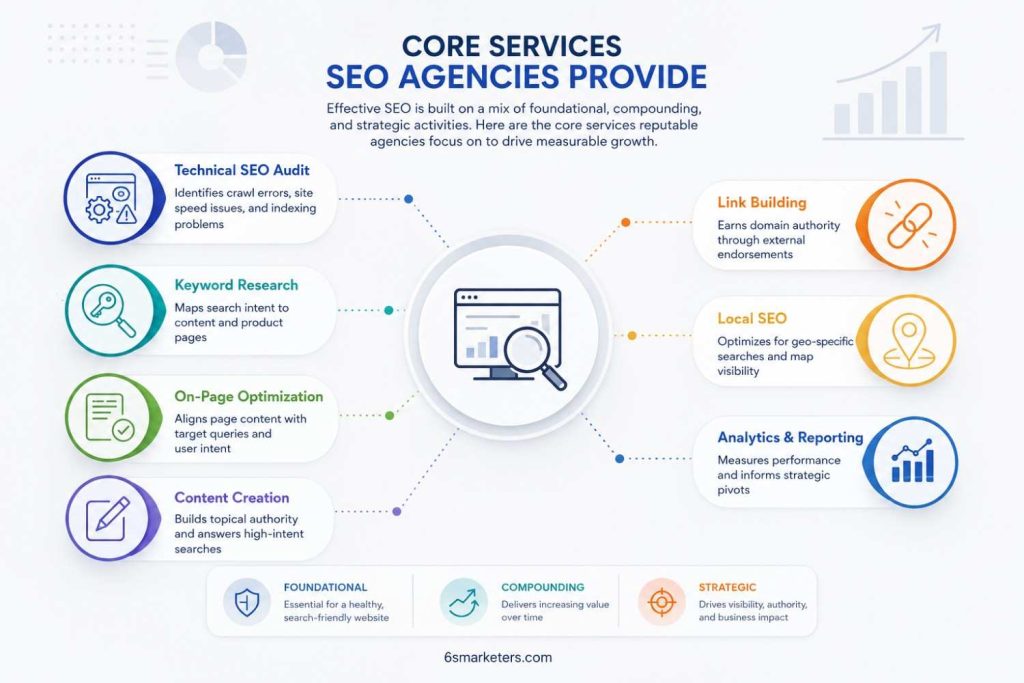
One thing reputable agencies don’t say enough: not all SEO work carries equal weight. Some activities are foundational; skip them, and nothing else works. Some compounds, over time, become more valuable the longer they run. And some are, bluntly, filler that looks good in a report but doesn’t move revenue.
Good agencies tell you which is which.
| SEO Activity | Purpose |
| Technical SEO Audit | Identifies crawl errors, site speed issues, and indexing problems |
| Keyword Research | Maps search intent to content and product pages |
| On-Page Optimization | Aligns page content with target queries and user intent |
| Content Creation | Builds topical authority and answers high-intent searches |
| Link Building | Earns domain authority through external endorsements |
| Local SEO | Optimizes for geo-specific searches and map visibility |
| Analytics & Reporting | Measures performance and informs strategic pivots |
Technical SEO Explained
This is unglamorous work. Nobody puts “we fixed your canonical tags” on a case study slide. But technical SEO is the reason everything else either functions or fails.
A technical SEO agency is looking at the structural signals that tell search engines whether your site deserves to be crawled, understood, and indexed properly. In practice, that means diagnosing things like:
- Core Web Vitals failures — load speed, visual stability, interactivity (all direct ranking signals per Google)
- Crawl budget waste on low-value or duplicate pages
- JavaScript rendering issues that hide content from Googlebot entirely
- Canonical tag misconfigurations that split ranking signals across duplicate URLs
- Mobile usability failures on key landing pages
- robots.txt rules accidentally block pages that Google should be indexing
That last JavaScript issue is worth pausing on. It’s more common than people realize. A well-known failure pattern: a company invests heavily in content — well-written, keyword-relevant, genuinely useful — but built on a JavaScript framework that renders client-side. Googlebot visits, sees near-empty HTML, and ranks accordingly. The content might as well not exist. Rankings stay flat. The team blames the content. The real culprit is rendering architecture.
Technical audits surface these before they quietly compound for a year.
Content & Keyword Strategy
Most keyword research is done in the wrong direction. A team picks the terms they want to rank for — usually the most competitive, highest-volume phrases — and reverse-engineers content around them. It feels strategic. It rarely produces results.
An effective keyword and content strategy starts with intent. Not “what do people search?” but “what are they trying to do when they search this?” Because that question talks about everything you should create.
A decent SEO agency segments this into four intent categories:
- Informational: People learning. Blog posts, guides, and explainers work here.
- Navigational: People looking for a specific brand or page. Product and brand page optimization.
- Commercial investigation: People comparing options before buying. Comparison pages, case studies, and ROI calculators.
- Transactional: People are ready to act. Service pages, product pages, demo request pages.
When you ask: What do SEO agencies do, and someone answers, “write blog posts,” they’re describing maybe 20% of a content strategy. The other 80% is mapping the right content type to the right intent stage so your brand exists at every point in the buyer’s research journey, not just the top of the funnel, where everyone competes.
Link Building & Authority
Here’s the version of link building nobody in an agency pitch meeting talks about: the one that gets your site penalized.
Paid links. Private blog networks. “Guest post” farms. Link exchanges dressed up as partnerships. These shortcuts worked in 2011. Today, Google’s ability to identify unnatural link patterns — especially after years of algorithm refinements- means that one bad link-building campaign can trigger a manual action that takes six months and a forensic disavow file to recover from.
Legitimate link building is slower and harder, and worth every bit of the extra effort. It looks like:
- Publishing original research that journalists and bloggers cite because it’s genuinely useful
- Digital PR campaigns that get your executives or data featured in trade publications
- Building tools, calculators, or assets that earn links naturally over time
- Relationship-driven outreach — not mass email blasts, actual conversations with writers in adjacent spaces
The compound effect of earned authority is substantial. A domain with strong, clean backlinks from credible sources doesn’t just rank better today — it’s harder for competitors to overtake over time.
Local SEO Services
If any part of your business depends on where your customers physically are, local SEO is not optional. It is the game.
Local SEO is about owning the searches that happen in a specific geography — and that means Google Business Profile optimization, NAP (Name, Address, Phone) consistency across every directory your business appears in, local citation building, and review management.
Think about what this means in practice. A physiotherapy clinic in Bangalore doesn’t need to rank nationally for “sports injury physio.” They need to rank for “sports physio Whitefield” or “physiotherapy near Marathahalli.” Those searches have immediate purchase intent — someone in pain, looking for help nearby. Ranking for them isn’t a branding exercise. It’s a direct revenue driver.
Agencies that understand local search build strategies around proximity signals, Google’s local pack algorithm, and geo-specific content — not the national SEO playbook scaled down.
Talk to our team about local SEO for your business →
Reporting & Analytics
This is where most agency relationships quietly fall apart.
The reports keep coming. Rankings are moving. Organic traffic looks decent. And somehow, six months in, the sales team has no idea whether SEO is contributing anything. The marketing team can’t point to a single deal influenced by organic search.
That’s a reporting problem. Not an SEO problem.
Vanity metrics are easy to produce and politically safe — nobody gets fired for showing traffic going up. But the right reporting framework connects SEO activities to business outcomes that actually matter:
- Organic sessions from target geographies and segments
- Conversion rates on organic traffic by landing page type
- Pipeline influenced by organic search (requires CRM integration, but it’s possible)
- Share of voice on high-intent keywords against named competitors
- Month-over-month progress on keyword gaps that map to revenue pages
Work with an agency that reports on revenue, not just rankings.
What Do SEO Agencies Do To Drive ROI
The number one misconception about SEO ROI: people treat it like a campaign with a start and end date. Run it for three months, measure results, and decide if it worked. That’s not how it operates.
SEO is a compounding asset. A well-optimized page that earns strong backlinks and ranks for a commercial keyword doesn’t stop working when you stop paying. It continues generating leads, capturing brand awareness, and pulling in organic traffic for months or years. Paid search shuts off the second the budget does. Organic visibility doesn’t.
To build the business case: if your average contract value is ₹8,00,000 and SEO brings in 15 qualified leads per month with a 20% close rate, that’s roughly ₹24,00,000 in monthly revenue from organic search alone — at a cost that’s a fraction of what equivalent paid traffic would require.
Getting there takes 6–12 months of consistent, compounding work. That timeline frustrates some decision-makers. The ones who understand it — and invest accordingly — tend to be the ones with the best organic channels two years later.
See how a revenue-focused SEO strategy builds long-term ROI.
Conclusion
So, what does an SEO company do? It builds the technical foundation that lets search engines find you. It creates content that earns the trust of buyers before they ever reach your sales team. It develops authority signals that tell Google your site deserves visibility. And it measures all of it against outcomes that matter to the business — not just rankings on a spreadsheet.
Done right, it’s one of the most durable growth investments you can make. Done poorly, it’s a monthly cost that produces reports and not much else.
Three things to act on immediately:
- Pull your current organic traffic data and see how much is converting. If you can’t answer that, your reporting is broken.
- Ask your current or prospective agency to show you a report that connects SEO work to revenue — not just traffic.
- Before you brief anyone on content or links, run a technical audit. Everything else depends on the foundation being sound.
When you’re ready to build something that actually compounds, let’s talk.
External Sources Referenced: