

Google Core Update 2025 December, is a new update as confirmed through its Search Status Dashboard. Businesses and SEOs should analyze their content for alignment with Google’s new quality signals, as the said update has already begun to move the SERPs.
We’re going to learn more about this December 2025 core update, why it’s important, and how you can plan with a strategy to reduce risks and take advantage. In the end, our goal is for you to understand the trends behind Google’s core changes and make informed decisions for your business moving forward.
What is Google Core Update 2025(December )
Similar to other core updates, Google’s December 2025 Core Update is a broad change to Google’s search ranking systems. This update is designed to improve the appearance of relevant and satisfying content in search results. And, affects sites around the world, across all industries and languages.
Core updates, as opposed to selective alterations such as spam filtering or page speed changes, involve recalibrating Google’s ranking standards. As a result, they tend to create noticeable Google search volatility and Google ranking flux as it reevaluates the content quality signals of millions of web pages.
Google says that the rollout may take up to three weeks to fully complete, which is similar to other rollouts earlier in 2025. During this period, businesses should expect week-to-week swings in rankings as the algorithm progressively applies new criteria.
Why This Matters
This update represents Google’s ongoing efforts to reward user-centric content that meets user intent. As search behavior evolves, so do the signals Google uses to evaluate quality. For site owners, this means understanding the core update’s direction can be the difference between growth and unnecessary volatility.
Get all the Google Updates Information.
Key Highlights from the Search Status Dashboard
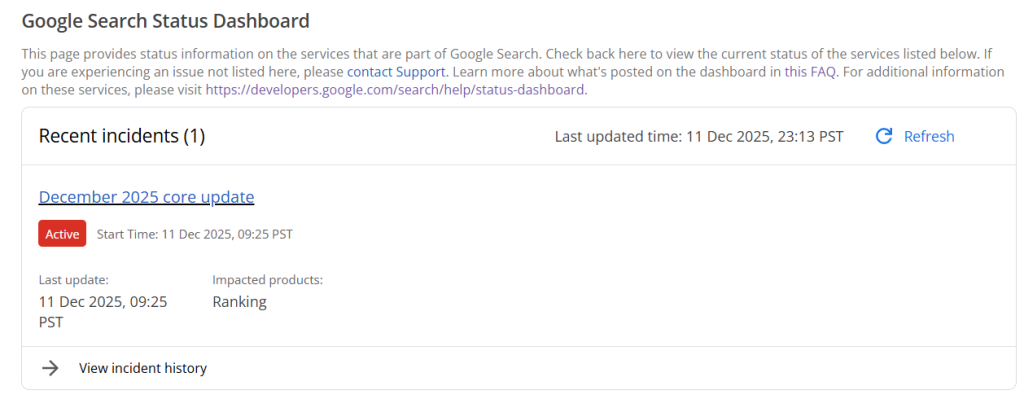
Google’s Search Status Dashboard gives us authoritative insight into the progression of this core update. According to the dashboard entry, the update was logged as an “incident affecting ranking,” with a firm start date and expected rollout duration.
Here are the key takeaways:
- Launch Date: December 11, 2025, at 09:25 PST.
- Rollout Window: Up to three weeks.
- Scope: Broad core algorithm update — affecting all types of websites.
- What to Expect: Continued ranking volatility throughout the rollout period.
The dashboard data also confirms similar rollout timelines for earlier core updates in 2025, such as the June and March updates, underscoring Google’s typical process for large-scale algorithm changes.
What the Dashboard Doesn’t Tell You
While the dashboard confirms timing and impact, it doesn’t specify the exact ranking factors altered. Instead, Google’s documentation describes core updates as broad recalibrations rather than targeted fixes—meaning the effects are felt across many ranking criteria, including content relevance, expertise signals, backlinks, trustworthiness, and more.
How This Update Impacts Rankings
Naturally, Google ranking fluctuations become one of the most visible business impacts of core updates. We’ve already seen early reports of fluctuation as the update begins rolling out. This isn’t unusual; volatility is almost always present during major algorithm changes.
Ranking Shifts Across Industries
Some sites may see gains in keyword positions and higher organic traffic, especially if their content aligns well with modern quality benchmarks—things like:
- Strong user intent fulfillment
- Demonstrable expertise and authority
- Clear, accurate, fresh information
Conversely, sites with weaker signals in these areas may notice:
- Drop in organic visibility
- Fluctuating impressions and clicks
- Competitive content overtaking their previous rankings
SEO tools and data trackers often capture these changes as search volatility spikes during update rollouts. This pattern was observed previously during the June 2025 core update, where rankings moved dramatically across sectors.
Understanding the Broader Impact
It’s important to understand that changes in rankings are not bad. They are Google’s judgment of the relevance of the content for a query. At times, variations settle down after the completion of rollout. At other times, they show strong alignment (or misalignment) with user expectations.
Consequently, organizations should pay continual attention to data during the rollout and look through what is short-term data and draw long-term insights.
What SEOs Should Monitor During the Rollout
If you work in SEO—or own a business with a digital presence—this phase calls for careful, data-driven monitoring.
1. Track Core Metrics
Assess these key performance indicators throughout the rollout:
- Organic impressions and clicks in Google Search Console
- Average position trends for target keywords
- CTR (Click-Through Rate) patterns
- Traffic trends per landing page
Comparing pre- and post-update data over days and weeks helps you identify which pages gained or lost visibility, and whether those shifts are stabilizing or continuing unpredictably.
2. Watch User Engagement Metrics
Google increasingly values pages that satisfy user intent. Metrics like bounce rate, dwell time, and interaction depth can indicate whether your content truly serves searcher needs.
3. Benchmark Against Competitors
Often, ranking fluctuations aren’t just about your site—they reflect how your competitors adjusted their content strategy. If competitors are gaining positions, analyze what they’ve done differently.
4. Avoid Premature Over-Optimization
It’s tempting to make immediate site changes during volatility, but reacting too quickly can confuse your data. Instead, document trends and changes you observe now. Once the rollout stabilizes, you’ll get clearer insight into what improvements matter most.
Conclusion
As businesses contend with Google Core Update 2025, it’s clear that understanding algorithm shifts is really essential. The December 2025 core update reflects Google’s long-term commitment to surfacing content that truly serves human search intent and offers tangible value.
At 6S Marketers, our team stays ahead of these core shifts so your business isn’t left guessing. We help optimize content and strategy to align with Google’s evolving benchmarks and maximize long-term visibility.
Ready to navigate the December 2025 core update with confidence? Connect with 6S Marketers for expert SEO consultation today.
FAQs
1. How long will the Google December 2025 Core Update take to roll out?
Google states the rollout may take up to three weeks to complete, meaning full implementation could stretch into early January 2026 as Google fully propagates algorithm changes.
2. Will rankings return to “normal” after the update finishes?
Rankings often stabilize after a core rollout, but “normal” is relative. Some shifts represent lasting changes in how Google evaluates quality, so long-term trends matter more than daily fluctuations.
3. Does this update target specific types of content?
No. Core updates are broad and affect many ranking signals. They don’t target niche industries specifically but instead reassess how pages align with user intent and quality criteria across the web.