

If you are noticing that your organic traffic has been behaving differently recently, you don’t have to panic. Google officially began rolling out the Google March 2026 Core Update at 2:14 AM PDT on March 27, 2026. According to Google’s Search Status Dashboard, the rollout may take up to two weeks to fully complete.
This is not just another routine algorithm update. It has come just weeks after a February 2026 Discover-focused core update. This Google core update 2026 shows a decisive escalation in how Google evaluates content quality, author credibility, and technical performance. If your growth is tied to organic search, you need to understand exactly what is happening and what to do about it.
Key Takeaways
- Rollout began March 27; expect up to 2 weeks.
- Over 55% of tracked sites saw ranking shifts.
- E-E-A-T signals are now the major ranking factors.
- Thin AI content gets penalized more aggressively.
- Original, experience-driven content is the top winner.
- Core Web Vitals directly influence ranking outcomes.
- Named author credentials now affect page-level authority.
What Is a Core Update?
A Google core update is basically a big re-evaluation of how Google’s algorithm is judging the quality of all web content out there & what it ranks accordingly. Unlike those spam updates (which only go after websites that are playing naughty tricks) or product review updates (which just focus on one specific type of content), core updates are a simultaneous re-weighting of hundreds of different Google search ranking factors.
Here’s what you need to get: core updates don’t actually penalise websites. They just re-evaluate which pages are best at serving up what the user is looking for – and when that all changes, your rankings change with it.
Google March 2026 Core Update — What to Expect During Rollout
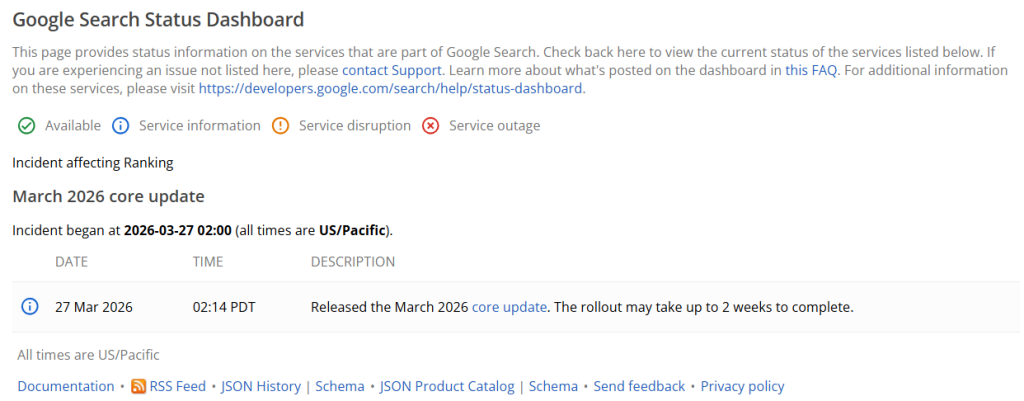
The key distinction to keep in mind: ranking movements during the rollout are considered noise. Analysts recommend waiting until the rollout is complete before drawing conclusions or taking action, since only movements after completion reflect the new baseline.
Rankings may continue to change throughout the two-week window. It can also make it difficult to tell whether visibility changes reflect a lasting reorder or a temporary movement mid-rollout.
There are two parallel dynamics that have been identified in earlier phases: a deeper integration of Helpful Content signals into the core algorithm and significant movement in AI Overviews. Many visibility losses are caused not by ranking drops but by new SERP elements pushing organic results further down, even when page quality hasn’t changed.
Who Might Be Affected?
Not every website will feel this update equally. Based on early industry analysis, certain profiles are more exposed than others.
Sites likely to see ranking drops:
E-commerce, healthcare, finance, and tech sectors have seen the biggest shifts so far, as Google continues to put a big emphasis on expertise & trust in competitive fields. Those who’ve invested big in churning out high volumes of low-quality, AI-generated content with zero editorial oversight are being hit pretty hard.
Sites relying on copious amounts of AI-generated content with little to no editorial oversight have seen some of the biggest declines, as Google’s classifiers have just gotten that much better at sniffing out content that’s all about serving up search results rather than what users actually need, even if the underlying text is technically correct..
Parasitic SEO was also targeted — this refers to low-quality content sections published on otherwise authoritative domains, which are now algorithmically decoupled from the site’s overall authority.
Sites likely to hold or gain ground:
Winners from the March update all tend to have a few things in common: original research, some real-deal proprietary data, & expert commentary that can’t be found anywhere else. Industry-specific publications, niche blogs with some actual hands-on experience, and websites that put their own studies & surveys together tend to perform particularly well.
What Google Is Likely Evaluating
The Google algorithm update March 2026 appears to intensify scrutiny across three core dimensions.
1. E-E-A-T: The Experience Factor Is Now Primary
Google’s March 2026 core update was like a wake-up call for content creators. It cranked up the importance of Experience – that first “E” in E-E-A-T – to levels never seen before. Pages that show you’ve lived through some of what you’re writing about, with all the specifics and unique details to back it up, are now outranking the comprehensive but dull stuff.
A study from Search Engine Journal found that fully 72% of top-ranking pages now proudly display the qualifications of their authors, up from about 58% beforehand. That’s a pretty stark difference. Sites publishing in sensitive topic areas without clear authorship and demonstrated expertise face a real problem.
2. AI Content Quality, Not Quantity
This is the first core update, which is believed to make use of Google’s Gemini 4.0 Semantic Filter for identifying low-quality AI-generated content. Now here’s the key point about AI – it’s not the enemy, but neither is it a magic bullet.
This update is all about targeting big volumes of content that sound good but add nothing unique. The writers of that stuff are often tempted to use AI tools, but the result is thin, forgettable pages that don’t stand out from the crowd. On the other hand, when you team up AI with real human know-how, that’s when you start to see some real results.
3. Information Gain: Does Your Content Add Anything New?
Google appears to have increased the focus on Information Gain, a concept the company has patented. In practical terms, what Google is doing is taking a close look at how much of what you’ve written is actually new and exciting, compared to what’s already out there. Pages that just rehash the same old stuff, no matter how cleverly you put it, are starting to slip down the rankings.
4. Technical Performance
Just like the last update, the March 2026 update also reinforced the importance of fast website load times – specifically, Largest Contentful Paint (LCP) – which should be under 2.5 seconds. The difference this time is that the stakes are higher than ever. New data shows that 47% of sites with slow load issues saw rank drops, with Google’s systems now favoring load times under two seconds for top visibility.
What You Should Do (SEO Action Plan)
This is where strategy separates the teams that recover quickly from those still troubleshooting months later.
Step 1: Diagnose Before You Act
In Google Search Console, compare performance for March 2026 against February 2026. Pages with drops greater than 30% are your recovery priorities. When you start looking at your pages that are losing traffic, don’t just throw some updates onto the usual suspects. Segment your pages by type – blog posts, landing pages, the whole works – so you can see exactly where you need to focus recovery efforts.
Step 2: Audit and Strengthen Author Signals
Author bio pages with verifiable credentials, industry affiliations, and byline consistency across content are now ranking infrastructure, not optional metadata. Sites that added structured author pages with verifiable credentials saw measurable ranking improvements within weeks of the update.
Move away from generic “Editorial Team” bylines. Named authors with linked profiles, demonstrable expertise, and external mentions build the kind of accountability signals Google is now weighing more heavily.
Step 3: Upgrade Your Content for Core Update Recovery SEO
When you start looking at your pages that are losing traffic, don’t just throw some updates onto the usual suspects. Segment your pages by type – blog posts, landing pages, the whole works – so you can see exactly where you need to focus recovery efforts.
When you audit a page that’s not doing well, ask yourself – could someone have written this with a 30-minute Google search and a few minutes of writing? If the answer is yes, then that page is at risk.
Step 4: Fix Technical Performance Now
Run a Core Web Vitals audit. Prioritize LCP under 2.5 seconds and aim for load times under 2 seconds overall. Technical debt that felt manageable before this update is now directly impacting your visibility.
Step 5: Monitor, Adapt, and Build for the Long Game
Historically, the next core update will probably show up in the second quarter of 2026. The pattern is clear – Google is getting stricter and stricter with content quality, and the intervals between updates are getting shorter.
Conclusion
The Google March 2026 Core Update is a strong signal about the direction of SEO trends 2026 and beyond. Google is rewarding depth, verifiable expertise, original thinking, and technical excellence. It is actively downgrading content that looks good on the surface but contributes nothing meaningful to the searcher’s experience.
For marketing leaders and content strategists, the opportunity here is real. The teams that invest now in genuine authority — through original research, credentialed authors, and technically sound websites — will build organic channels that compound over time rather than buckle with every algorithm shift.