

Introduction
If your “seo and ppc marketing” operate separately, you are not getting the complete benefit from either channel. As Search Engine Land explains, organic search (SEO) and paid search (PPC) both help people discover your business, but they enhance and influence the user journey in various ways.
In this post, you’ll learn how a well-structured ppc and seo strategy, along with an effective seo and ppc integration, can help your brand attract more qualified traffic, convert more customers, and build lasting authority. You’ll also see how integrated marketing and omnichannel marketing approaches turn these two channels into one powerful growth system.?
Let’s dive in.
Why PPC and SEO Strategies Work Better
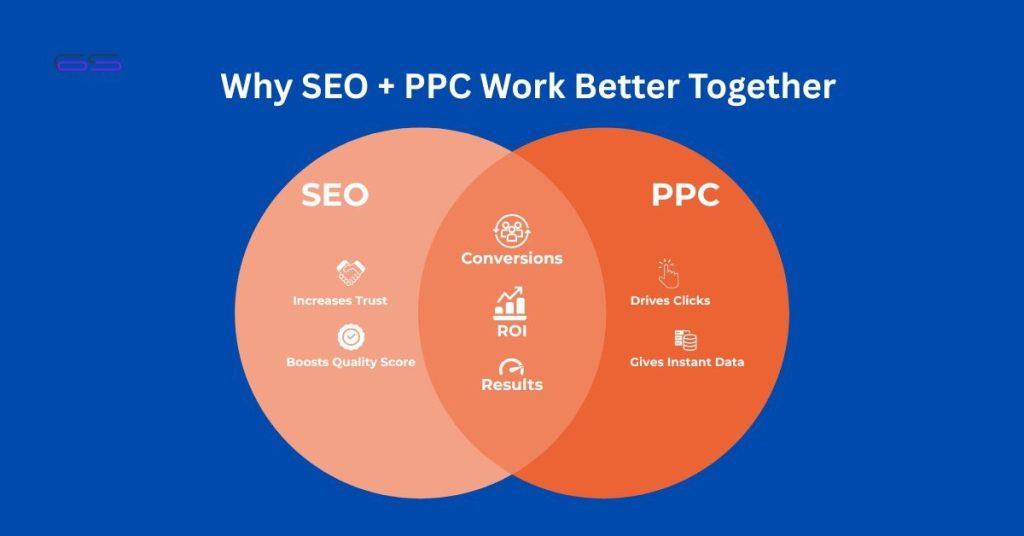
Many of the clients to whom we connect are confused and ask the question if they must choose long-term organic growth or the immediate visibility that paid ads provide. We always say that they opt for both. When SEO and PPC marketing are combined, your approach is more towards an integrated digital marketing that increases reach, improves targeting, and enhances ROI across TOFU, MOFU, and BOFU.
In addition to this, PPC and SEO strategy collaboratively results in more clicks, significant brand visibility, and higher credibility from searchers.
Organic content and SEO build long-term credibility and authority, while PPC helps you get high-intent traffic quickly. Together, they capture both long-term and immediate opportunities.
Moreover, with PPC and SEO integration, you reduce customer acquisition costs (CAC). As organic traffic grows, you rely less on paid ads, which often carry higher per-click costs, and benefit from the “free clicks” that organic rankings deliver over time.
Integrated digital marketing makes use of each channel’s strengths, i.e., long-term organic growth + instant paid visibility.
Key Benefits of an Integrated Digital Marketing
Precise Keyword Targeting
When SEO and PPC marketing teams share keyword performance data, you quickly discover which terms are driving conversions, which deliver volume, and which are highly priced. This cross-pollination helps you make wise and data-driven decisions.
PPC campaigns are often used as a testing base: you can experiment with ad copy, landing pages, and CTAs to know what resonates. Once you find winning combinations, you use them in your SEO content strategy. In this way, your long-term content investments are leveraged in live performance instead of guesswork.
Enhanced Landing Page Relevance
Well-optimized landing pages enhance user experience, get better engagement, and help your ads perform great. Since SEO work tends to focus on high-quality content and user-friendly site architecture, these improvements also benefit PPC. Relevant content and UX raise your Quality Score in ad platforms, which can lower your ad spend in the long term.
Balanced Funnel
PPC gives you such quick visibility that it can be used for launches and seasonal, and time-sensitive offers. Conversely, search engine optimization creates authority organically, which compounds over time. Using a combined strategy can help you provide full coverage of the marketing funnel and all its stages.
Cost Efficiency and Higher ROI
Because SEO traffic doesn’t cost per click (beyond your content and optimization investment), once you rank organically, much of your traffic becomes “free.”This minimizes dependence on paid ads and reduces total cost-per-acquisition over time. In real-world use cases, combining SEO and PPC resulted in up to 500% higher ROI for some brands than just running ads alone.
Additionally, businesses that adopt an integrated strategy often see a reduction in CAC and a more efficient allocation of marketing budget — making your spend smarter, not just bigger.
How to Build a Winning Integrated Marketing Strategy
Step 1: Align Your Teams and Goals
When the SEO team and PPC marketing team share keyword performance data, you soon find out which terms drive conversions, which generate volume, and which are expensive. This cross-pollination allows you to make informed decisions.
It is important to set unified KPIs that reflect overall business goals – traffic growth, lead quality, conversion rate, CAC reduction, etc., rather than referring to channel-specific metrics alone. By doing so, each initiative impacts business results in a meaningful way.
Step 2: Use PPC as a Trial for SEO
To test keywords with high potential and conversion messaging, start with PPC campaigns. It allows you to see if something works before creating content, adjusting the technical, or the site structure. After recognizing efficient keywords and ad copy, incorporate these into your SEO roadmap.
Step 3: Optimize Landing Pages for Both Ads and SEO
Your landing pages must be highly converting and optimized for search ranking. It means that your website should load quickly and be friendly on mobile with a clean UX. This will double the impact on your SEO and PPC.
When your landing page is highly relevant, your Quality Score goes up — and that can lower your CPC by 16% to 50%.
Step 4: Share Data & Iterate Continuously
Leverage data analytics tools to track performance across channels. Make sure that teams share reports regularly – which keywords are converting, which ads are not performing, which organic pages are getting traffic but not driving conversions. This ongoing process will help you adapt plans for bids, content strategy, optimization priorities, and more.
Step 5: Maintain a Balanced Budget & Timeline
Don’t completely depend on PPC, but don’t abandon it either. When SEO picks up momentum, use PPC sparingly for high-intent keywords or seasonal pushes. This balanced approach ensures that your marketing budget remains efficient and your growth sustainable.
Common Pitfalls & How to Avoid Them
Siloed Teams Prevent True Synergy
If your SEO and PPC teams don’t communicate, you’ll end up duplicating effort or even competing against yourself for keywords. That weakens your overall impact. To avoid this, build a unified strategy, shared dashboards, regular alignment meetings, and a common goal framework.
Ignoring Long-Term SEO for Short-Term PPC Gains
It’s tempting to use PPC as a quick fix and neglect SEO altogether. But that approach misses out on the compounded value of organic traffic that builds over time. Establish SEO as a core pillar — content, backlinks, site optimization — not a “nice-to-have.”
Poor Quality Landing Pages Undermine Both Channels
If your landing pages are slow, confusing, or irrelevant, both SEO and PPC will suffer. Poor UX increases bounce rates (hurting organic ranking) and lowers ad Quality Scores (raising ad costs). Invest in solid page design, relevant content, and technical optimization from the start.
Not Tracking Unified Metrics
If you measure SEO success only in rankings and PPC success only in click-through rates, you’ll miss the full picture. Use combined metrics like cost per acquisition, returning customer rate, conversion rate across channels — so you know what’s truly driving business value.
Why This Matters Now — in 2026 and Beyond
Search engine results pages (SERPs) continue evolving. With AI-driven “search overviews,” zero-click results, and shifting user behavior, claiming only paid ads — or only organic — limits your potential. Brands that adopt “integrated digital marketing” — aligned PPC + SEO + content + UX — stand out.
Moreover, as competition heats up and cost-per-clicks rise, relying solely on PPC becomes expensive and unsustainable. Integrated approaches help businesses weather fluctuations, build resilience, and capture both immediate intent and long-term visibility.
If you run a business and depend on search visibility to drive revenue, now is the time to invest in a cohesive “ppc and seo integration” strategy.
Key Takeaway
- Combining SEO and PPC consistently reduces cost per lead and improves ROI compared to single-channel strategies.
- Integrated campaigns benefit from better keyword targeting, improved landing page quality, and balanced funnel coverage.
- PPC can serve as a testing ground for SEO; SEO delivers long-term value while PPC delivers speed.
- Data-sharing, unified goals, and optimized pages ensure both channels reinforce each other.
- Common mistakes: siloed teams, neglecting SEO, poor UX — can sabotage results.
- Given the shifting digital landscape, integrated marketing is increasingly essential for sustainable growth.
Conclusion
To create a remarkable ‘omnichannel marketing’ impact that will yield results and drive growth, brands ought to seek help from the experts. 6S Marketers blends your PPC and SEO integration for better capabilities, which further align with business goals. Contact us to find out how we can create an “seo and ppc marketing” plan uniquely tailored for your brand.
We would love to hear your opinion on the current techniques.
Have you tried combining SEO and PPC? Share your strategy or results in the comments below.
If you’re ready to get the maximum out of SEO & PPC marketing Connect with 6S Marketers today.