

You spend months or years building your startup. The product performs. You believe that you have built the perfect solution. But your website analytics tells you a different story – zero visitors. Your competitors with years of expertise dominate search results. SEO for startups changes this equation completely.
The study by HubSpot’s State of Marketing report tells that 61% of marketers believe in SEO and growing the businesses’ organic visibility is their top priority.
Ahrefs, Canva, and Notion are the startups that have shown that strategic startup SEO builds sustainable growth without burning through capital on paid ads. The difference between startups that scale and those that struggle: they consider SEO as an important growth platform from the start, and not as an option.
When Does Startup SEO Actually Start Performing
Most startups start seeing initial SEO results within 3 to 6 months. The real traffic takes off between 6 and 12 months. If your business objective is to reach the 100K monthly visits milestone, plan for takes 12-24 months of consistent effort. The best time is to start now!
Key Highlights
- Fewer resources and zero authority build unique challenges for new websites.
- Strong Technical basics and a clean site structure make growth easier.
- Use low-competition keywords that initial websites can actually rank for.
- Quality content beats quantity when building authority.
- Budget-friendly link building exists through networking and creating valuable resources.
- Track data that shows real business impact, not vanity metrics.
- SEO performs over time that makes it one of the highest ROI channels.
SEO Challenges Startups Face Early On
Starting from zero traffic creates obstacles that established businesses never face. Your domain has no authority, no backlinks, and Google has zero reason to trust your content over competitors who’ve been publishing for years.
The very common difficulties are:
- Zero authority competing against sites with 5-10 years of history
- Limited budgets that make hiring specialists difficult
- Small teams without dedicated marketing resources
- Pressure to show immediate results when SEO takes months to deliver
- Lack of internal expertise to guide strategy decisions
According to Search Engine Land, many early-stage startups struggle to justify SEO investment when paid channels promise faster results. However, this short-term thinking costs startups the compound growth that SEO for startups delivers over time. The businesses that commit to search engine optimization from the beginning build advantages that competitors can’t easily cross.
Setting the Right SEO Foundation
Your technical elements determine whether Google can even fetch, understand, and rank your content. We have seen startups skipping this step. They waste months creating content that search engines struggle to index properly.
Important foundation elements include:
- Clear, understandable URLs (example.com/blog/seo-guide, not example.com/p=123)
- Page load times should be under 3 seconds
- Mobile-responsive design that works on all devices
- Secure HTTPS protocol across your entire site
- XML sitemap submitted to Google Search Console
- Proper file configuration that enables search engines to access important pages
You may think that these key elements are not so important when compared to content creation, but they are essential. Take a look at this comprehensive technical SEO checklist to ensure you’re covering all elements that affect your rankings.
Keyword Research for Zero-Traffic Websites
The problem with traditional keyword research is that it leads you toward high-volume keywords. And, these keywords are already owned by the well-established sites. So what will work for the startups? The answer is low-competition keywords, where people know exactly what they want.
Your keyword strategy should focus on:
- Long-tail keywords are usually 3 to 5-word phrases that show the user is ready to act.
- Question-driven queries (how, what, why, when) that match with user searches.
- Stick with keyword difficulty scores below 30.
- Keywords with clear intent aligned with your offerings.
- Emerging topics your competitors haven’t targeted yet.
These specific queries have lower search volume but higher conversion rates and achievable rankings. Remember, startup SEO succeeds by winning dozens of smaller battles rather than losing one massive war.
Building Content That Actually Ranks
Startups must prioritize content creation rigorously. As you lack the bandwidth to publish every day, make each article a winner. Develop a robust resource that resolves an issue more effectively than anything currently ranking.
Effective content strategies are.
- It’s better to publish 2 to 4 in-depth blogs a month than post 20 shallow ones.
- Make your content at least two-three times more detailed than the current top-ranking pages.
- Utilize distinct data, empirical examples, or frameworks.
- Incorporating visual components such as custom graphics and screenshots.
- Drafting content with headings that answer users’ questions.
- Connecting to relevant content on your site.
Make sure you structure your content around what users need. When the user searches for how to reduce customer churn, they need an actionable framework. Not a generic meaning of customer churn. Share a framework that has a model case, a checklist, and a step-by-step process that they can implement immediately. This SEO strategy for tech startups creates content that earns natural links and builds thought leadership.
Do you need an effective content strategy? Connect with 6S Marketers to develop a content roadmap that turns your startup into an industry authority.
Technical SEO for Startups: Basics You Should Not Ignore
Your site must load fast, that is, under 3 seconds. Every extra second kills your rankings and frustrates visitors. Google won’t wait, and neither will users.
Mobile matters more than desktop now. Over 60% of users search queries on phones, and Google validates your entire site based on mobile performance. You have to test it on real mobile devices, not just on the desktop previews.
Fix these today:
- Use HTTPS to secure your device.
- Create URLs that have a description (never use example.com/p=123)
- Submit an XML sitemap to Google Search Console
- Use proper heading structure (one H1, logical H2s)
- Resolve broken links and 404 errors immediately
Speed and mobile optimization aren’t optional anymore. You have to get these basics right once, then every content piece you create performs well.
Topical Authority for Early-Stage Startups
One way to gain Google’s attention is by focusing on just a single subject. Rather than jumping from one niche to another, choose something precise. Expertise grows when effort stays within clear boundaries. A steady direction often leads to stronger recognition. Authority builds slowly, yet clearly, through consistent focus.
Building topical authority requires:
- Identifying your core topic pillar (your main area of expertise)
- Creating 15-20 subtopics that branch from your pillar content
- Developing comprehensive pillar pages (3,000+ words) for main topics
- Writing supporting content (1,500+ words) for subtopics
- Linking all related content back to pillar pages
- Covering topics from beginner to advanced levels
When you do this, Google understands you’re someone to rank. If you are building an SEO agency for startups, create content about challenges faced by startups, growth problems, and industry-specific solutions. It’s suited best for startups as one can dominate a whole niche, instead of competing against the big players in the field.
| Startup Stage | SEO Focus | Expected Outcome |
| Pre-Launch (0-3 months) | Technical foundation, keyword research, and content planning | Indexable site, strategic roadmap |
| Early Stage (3-6 months) | Core content creation, on-page optimization, and initial outreach | First rankings, 1K-5K monthly visits |
| Growth Stage (6-12 months) | Topical authority, link building, and content expansion | Established rankings, 10K-30K monthly visits |
| Scale Stage (12-24 months) | Advanced link building, brand building, and content refresh | Authority growth, 50K-100K+ monthly visits |
Link Building on a Startup Budget
For many startups, it feels impossible to do link building without a budget. To kick off, begin with founder networking – leverage your personal brand and relationships to earn mentions and links. We’re not looking to get a high volume of links but would rather have relevant links from authoritative sites.
Cost-effective link-building plans:
- Create Founder content on LinkedIn and Medium with backlinks to your site
- Guest posting on industry blogs that your customers actually read
- Digital PR through Help a Reporter Out responses
- Creating original research or industry reports that others want to cite
- Building free tools or calculators that naturally attract links
- Podcast appearances and interviews with backlinks in show notes
- Strategic partnerships with complementary businesses
Create assets that naturally attract backlinks. Original research, industry reports, free tools, and comprehensive guides give other sites reasons to reference your content. These strategies cost time rather than money, making them perfect for resource-constrained startups.
Tracking SEO Success (What to Measure Early)
Focus on measurements that actually indicate progress and business impact. Track organic traffic growth, but segment it by landing page to understand what’s working. Monitor keyword rankings for your target terms, celebrating movement from position 50 to position 15 just as much as reaching position 1.
Essential metrics to track monthly:
- Organic traffic growth (total and by landing page)
- Keyword rankings for your target 20-30 keywords
- Click-through rates from search results
- Pages indexed by Google
- Backlinks acquired (quantity and quality)
- Conversion rate from organic traffic
- Average session duration and bounce rate
Conversion metrics matter more than raw traffic numbers. A thousand visitors mean nothing if nobody signs up or converts. Set up goal tracking to measure how organic traffic converts compared to other channels.
How Long Does SEO Take for Startups
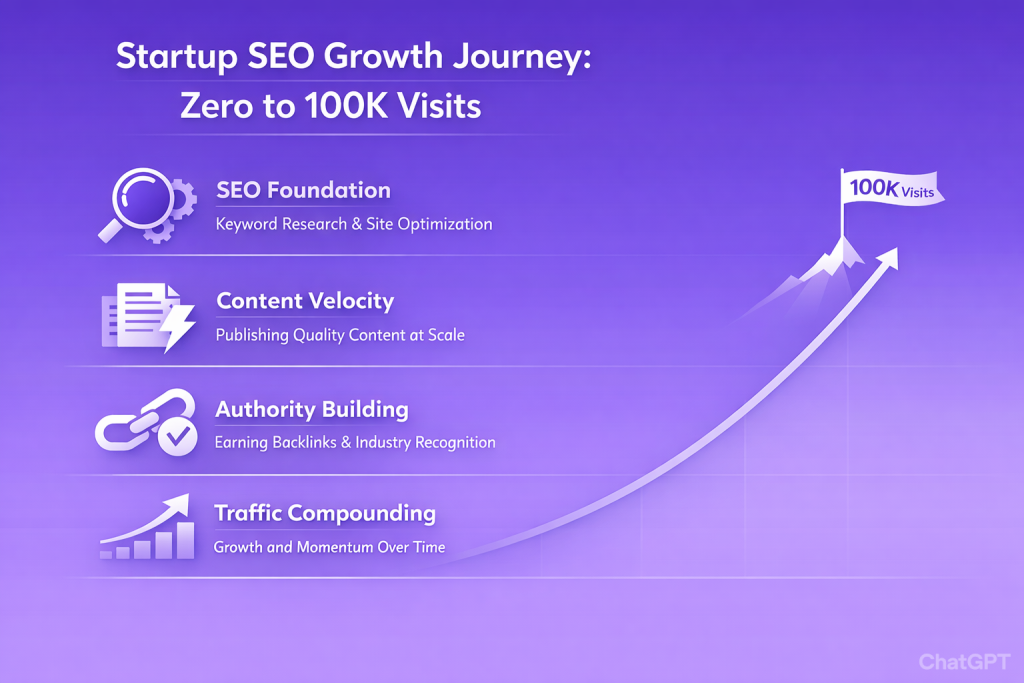
Patience is a very important factor that separates successful strategies from abandoned ones. The first 90 days focus on foundation building, like technical fixes, content creation, and initial outreach.
The goal of reaching 100K monthly traffic generally needs 12 to 24 months for most startups, provided the team puts consistent efforts and focuses on effective strategies. Also note that the timeline varies dramatically depending on competition, niche, and resource allocation.
Conclusion
To build up SEO for startups from zero to 100K visits, you need a strategy, patience, and consistency in execution. The successful startups treat SEO as their core growth channel from day one. You build a foundation of work that develops over time creatinga sustainable flow of traffic.
Ready to speedup your SEO journey? 6S Marketers specializes in helping startups build sustainable organic growth from the ground up. Our team understands the unique challenges early-stage companies face and creates customized strategies that deliver results within your budget constraints. Connect with us today to transform your SEO into your most powerful growth engine.