

Most enterprise marketing teams believe they have an AI marketing strategy in place. They’ve adopted tools, generated content at scale, and called it transformation. But here’s the uncomfortable reality: adoption is not a strategy. And in 2026, that distinction is costing brands their visibility, their pipeline, and their edge. This piece breaks down the seven signs that reveal whether your approach is genuinely future-ready — or quietly losing ground while your competitors get cited by ChatGPT, Gemini, and Perplexity.
Key Takeaways
- AI tools alone don’t equal strategy.
- Organic traffic masks invisible citation losses.
- SEO and AI search demand unified planning.
- Proprietary data separates leaders from followers.
- Brand invisibility in AI answers is a revenue risk.
- Content volume without intent signals wastes budget.
- A 30-day audit can reverse course quickly.
Why AI Marketing Strategy Has a Shelf Life Problem in 2026
Here’s something most marketing playbooks won’t tell you: what worked as an AI marketing strategy in 2024 is already showing its age.
The issue isn’t the tools. It’s the architecture. Early AI marketing adoption was largely about efficiency, faster content, automated campaigns, and smarter segmentation. Those gains were real. But the search landscape quietly shifted underneath everyone, and many teams didn’t notice.
Google’s AI Overviews. Perplexity’s answer engine. ChatGPT Search. Gemini’s deep research mode. These aren’t supplementary interfaces — they’re increasingly becoming the first point of contact between a buyer and your brand. Or not your brand, as the case may be.
Research from Search Engine Journal in June 2026 highlights that warning signals for AI-driven marketing failure tend to appear 12–18 months before the real damage shows up in revenue numbers. By the time the board asks why the pipeline is contracting, the strategic misstep has already compounded.
The question isn’t whether AI is part of your marketing. It clearly is. The question is whether your strategy is built for where AI search is going or where it was two years ago.
What a Future-Ready AI Marketing Strategy Actually Looks Like
Before diagnosing what’s broken, it helps to define what good looks like.
A genuinely future-ready AI marketing strategy does four things simultaneously:
It makes your brand citable, not just rankable. It positions your proprietary insights as the source material AI models pull from. It treats SEO and generative engine optimisation (GEO) as one discipline. And it measures brand presence in AI-generated answers as a core KPI — not an afterthought.
That’s a fundamentally different operating model than “we use AI to write content faster.” Most enterprise teams are still there, which brings us to the seven signs.
7 Signs Your AI Marketing Strategy Is Already Falling Behind
1. Your Content Isn’t Built for AI Citation in Search Results
AI-powered answer engines don’t just pull from the top 10 search results. They look for structured, authoritative content that answers a specific question clearly and completely. Most brand content, especially older pillar pages and product copy, isn’t written that way.
The format matters enormously. Direct answers in the first paragraph. Clear factual claims with supporting context. Structured data markup. Named entities (people, companies, frameworks) that AI models can verify. If your content reads like a brochure, it will be ignored by AI systems looking for definitive answers.
One B2B SaaS brand in the HR tech space found that despite ranking #2 for their primary category keyword, they had zero citations in ChatGPT responses. The gap wasn’t domain authority; it was content architecture. Their pillar pages led with features, not answers.
Fixing this starts with auditing your highest-intent pages for AI citability, not just search position. Our AI SEO strategy framework outlines exactly how to restructure content for citation eligibility across generative engines.
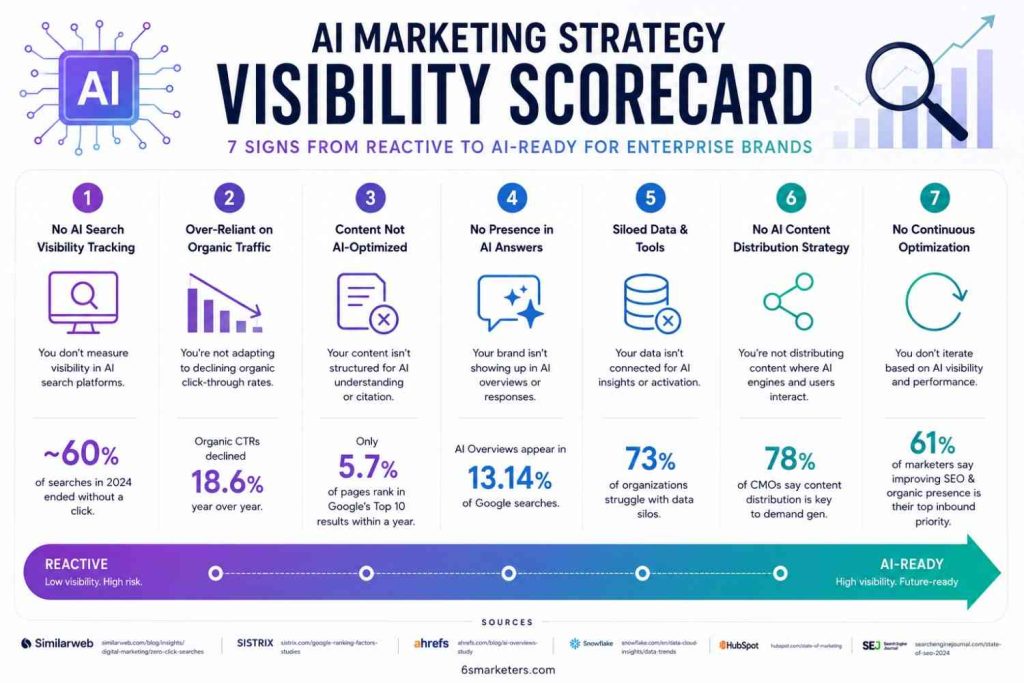
2. You’re Measuring Traffic But Not AI Search Visibility for Brands
This is one of the more dangerous blind spots in enterprise marketing right now.
Organic traffic numbers can look stable or even grow slightly while your brand’s actual presence in the buying conversation quietly collapses. Why? Because AI-generated answers reduce the need for a click. A buyer gets their question answered without ever visiting your site.
If your reporting dashboard shows sessions, pageviews, and bounce rate — but has no mechanism for tracking how often your brand appears in AI-generated responses for relevant queries — you’re flying partially blind. AI search visibility for brands is a new metric category, and most analytics stacks haven’t caught up.
The practical fix: start manually auditing AI answer engines weekly for your top 20 commercial keywords. Track whether your brand appears, and if so, in what context. This isn’t scalable indefinitely, but it reveals the gap faster than any automated tool currently available.
3. AI Tools Are Bolted On, Not Built Into Your Strategy
There’s a version of “we use AI” that involves a dozen disconnected subscriptions — one tool for copywriting, another for image generation, a third for social scheduling — none of which talk to each other or feed into a unified content intelligence system.
That’s not an AI marketing strategy. That’s a tool stack.
The distinction matters because bolted-on AI creates efficiency without strategic coherence. Content gets produced faster, but without the keyword architecture, internal linking logic, or topical depth that makes it perform. Teams hit output targets while the overall content programme loses authority.
A genuine AI-integrated strategy means AI is embedded in planning decisions — which topics to prioritise, which content gaps to fill, which pages to consolidate — not just in the execution of producing assets. The planning layer is where most enterprise teams are still doing it manually.
4. Your Brand Doesn’t Appear in AI-Generated Answers
This one is straightforward and worth testing right now. Open ChatGPT, Gemini, or Perplexity and type in the category question your ideal customer would ask. For example: “What are the best B2B content marketing agencies in [your sector]?” or “Which platforms do CMOs use for [your specific use case]?”
If your brand doesn’t appear or appears with less prominence than direct competitors, that’s not a content gap. That’s a brand authority gap in the AI layer. And it has commercial consequences, because enterprise buyers are increasingly using these tools during the early research phase of the buying cycle, long before they hit a search engine.
Getting cited by AI engines requires a combination of factors: domain authority, structured content, third-party mentions and endorsements, named expert profiles, and original data. It’s not a single fix, but the first step is knowing you’re missing. Explore how to get featured in AI summary results to close this gap systematically.
5. You Have No Proprietary Data or Original Research
Think about the content that gets referenced by AI models. It’s almost always one of three things: official documentation, peer-reviewed research, or original industry data from credible organisations.
If your content library is made up entirely of opinion pieces, listicles, and best-practice guides, you have nothing that AI systems are designed to cite. You’re producing content that might rank for long-tail keywords, but you’re not producing the kind of authoritative primary source that becomes embedded in AI responses.
This is the hardest gap to close because proprietary data requires real investment: original surveys, internal benchmarks, platform usage data, and anonymised client case studies. But it’s also the most defensible moat. Competitors can replicate your blog topics. They cannot replicate your data.
One practical entry point: if you have clients, start collecting anonymised performance benchmarks across campaigns. Even a quarterly data report based on 50 client accounts creates a citable asset that generic content never can.
| AI-Demand Content Tactic | Outcome |
| Original industry benchmark report | High citation frequency in AI answers |
| Named expert Q&A with credentials | Entity recognition by AI models |
| Structured FAQ with direct answers | Featured snippet + AI overview inclusion |
| Third-party co-authored research | Trust signal for generative engines |
| Case study with specific, named metrics | Used in AI commercial recommendation responses |
6. Your Team Is Still Treating SEO and AI Search as Separate Disciplines
Walk into most marketing teams, and you’ll find a clear organisational divide: SEO sits with one person or agency, AI tools sit with another, and generative engine optimisation is either nobody’s job or everyone’s, which means it’s effectively nobody’s.
That structural gap is producing real strategic blind spots. The keyword research framework used for traditional SEO doesn’t automatically translate to AI search intent. The content brief that optimises for a featured snippet doesn’t automatically optimise for AI citation. The metrics used to report SEO performance don’t capture AI visibility at all.
AI marketing strategy in 2026 demands that these disciplines be unified, not siloed. The team or agency responsible for search visibility needs to own both the traditional search presence and the generative engine presence and plan them together from the same content brief.
If you want to see how this integration works in practice, our AI SEO strategy framework maps out the unified planning process.
7. You’re Producing More Content But Getting Less Return
This is the canary in the coal mine for a strategy that’s broken at the foundation.
Content volume has gone up because AI tools make production faster and cheaper. But organic performance, brand mentions, pipeline attribution, and AI citation rates haven’t moved proportionally. Often, they’ve declined.
The reason is almost always the same: the strategy didn’t evolve with the tool adoption. More content is being produced with the same old briefs, the same keyword targeting logic, and the same performance benchmarks, while the environment those strategies were built for has fundamentally changed.
Marketing teams that fail to clearly demonstrate AI ROI — not just output — are significantly more vulnerable to budget cuts and restructuring. Producing content at scale without measurable impact is increasingly indefensible to leadership.
The fix isn’t to produce less. It’s to produce with sharper intent: fewer pieces, better structured, more original, with clear AI citability built in from the brief stage.
How to Audit and Fix Your AI Marketing Strategy in 30 Days
If you’ve recognised three or more of these signs, the good news is that none of them is irreversible. Here’s a focused 30-day roadmap:
Week 1: Diagnose
Run an AI visibility audit across your top 20 commercial keywords. Test ChatGPT, Gemini, and Perplexity. Document where competitors appear, and you don’t. Identify your five highest-traffic pages and assess their AI citability.
Week 2: Prioritise
Identify the two or three gaps with the highest commercial impact. For most enterprise brands, this is either a brand absence in AI answers or content that can’t be cited because it lacks structured answers and original data.
Week 3. Restructure
Rewrite your top five pages for AI citability: lead with direct answers, add structured FAQ sections, strengthen entity references, and embed original data or client-sourced benchmarks where possible.
Week 4. Measure and build
Set up weekly tracking for AI search presence. Start planning one original data asset — a benchmark report, a client performance analysis, a sector survey — to build long-term citation authority.
If you want a team that can run this audit and restructure your content strategy from the ground up, talk to us here.
Conclusion
The seven signs covered here aren’t indictments; they’re a map. Content that’s not built for AI citation is a rebuild opportunity. Unmeasured AI visibility is a gap you can now start tracking. Disconnected tools are a consolidation project. Brand absence in AI answers is a structured content and authority challenge with a clear path forward. Missing proprietary data is a research programme waiting to happen. Siloed SEO and AI search teams are an org structure fix. And content that’s producing diminishing returns is a strategy that needs sharpening, not abandoning.
Every gap identified here has a corresponding action. The brands that treat AI marketing strategy as a continuous and evolving discipline, not a one-time tool adoption, are the ones that will own AI search visibility over the next three years. The question is whether you’ll be one of them.
What’s the biggest AI marketing gap your team is grappling with right now? Drop it in the comments; the conversation there is often more useful than the article itself.
External Sources Referenced
- Search Engine Journal — 4 Warning Signs Your Marketing Team Is Next For AI Cuts
- Google Search Central — Search Engine Optimisation (SEO) Starter Guide.